Friday, May 18, 2007

Design and Risk and Innovation (and CEO Pay)

Over on NussbaumOnDesign, there's an interesting thread on the role of designers in innovation. Designers thrive on risk, learn from it, and move on from it, so they're useful as models for innovation processes at companies. That's is the gist of a piece by IDEO folks summarized here on BusinessWire. Given this, design as a process reduces corporate risk during innovation, Nussbaum recaps:

Let me repeat--the design process cuts risk. When you do design (or innovation--whatever you want to call it), you use ethnography, prototyping and story-telling to develop a product/service/experience. These processes actually reduce risk. This is a fact that most CEOs simply do not get. It is far riskier to come up with a new technology in the labs, make it into a product and then throw it at consumers than it is to first start with your consumers to find out what they really need and want (the essence of design).
This admirable sentiment requires a definition of design as a process that involves good customer research, a definition not all would agree with, although I myself certainly prefer it and sell that as a service during design :-)

But for any good interaction designer, intuition counts, as well as the prototyping, empathy for the customer, focus on the desirable, and grounded research to inform that process. The risk in design is that there's never perfect and complete data, and at some point, you have to just follow that intuition and make something which might be a failure if one of a million details doesn't go right. And those final details are usually a team effort, whether the designer wants them that way or not: building a product is (usually) expensive and complicated, unless it's a garage Flash app.

There are a few provocative comments following up on this later on Nussbaum's blog, suggesting that until designers put up their own capital, they are less risk-taking than their clients or the businesses that run with their ideas. A quote from the comment by Chris Conley:

Actually one could argue that designers simply ask their clients to take risks on them and their work. Few designers put their own capital at risk. I would also argue few understand the notion of investment and return which is how risk is manifest and monetized in business. Designers mostly have a cost mindset just like most business managers. An investment mindset is something that needs to be taught and is part of a innovation toolkit. Until designers put up their own capital (and not just the proverbial sweat equity) and take real equity positions in ventures, the risk is truly being born by someone else.

But there are other real risks for designers apart from personal capital, which Conley doesn't acknowledge: loss of credibility, reputation, credit (including financial reward), missed opportunities at other companies/agencies while betting on this job or client, and others that may be more important to an individual designer. Personal risk management is about all of that, too.

Edited to Add: Actually, after drafting the above and going to bed, I've woken up fairly incensed at the idea that designers should be putting up their own money in order to experience "real" business risk. Point one: Many of them do, because what they're motivated by is seeing their ideas in the world. They quit and go to startups, they do their own thing online, etc. This is fairly clearly "their own money." (At one company, when I couldn't get usability bugs taken seriously, I considered bribing engineers to fix the bugs I had filed. I was a hair away.) Point two: CEOs and other executives certainly don't put up their own money, and they're paid outrageously in comparison, so don't talk to me about money here, Mr Conley! Hmmph. Here are some articles on the pay issue, if you want to get educated about this:

Note especially that even if they "fail" they have enormous severance/retirement packages, suggesting there isn't much financial significance to their failure.

Monday, May 14, 2007

Wow: Lotus Blossom

This is fast (no load time waits and a genuinely frenetic pace), simple (text and music -- turn it on because you need it), and even better, genuinely funny: Lotus Blossom.

Go watch! Where you can do it with the sound on. (Don't watch if you might have issues with strobe effects in place.)

Sunday, May 13, 2007

Mathematica Graphs and Other Demos

More fun stuff for people who like pictures, but don't necessarily follow all the math: Wolfram has a downloadable viewer and a bunch of fun interactive demos that let you play with sliders and manipulate pictures to generate fun stuff. There are a whole bunch of categories, including "unsolved problems" that might really pique the interest of the math folks. I personally like the graph theory demo section, because of the issues I have with making sense of social network visualizations.

Note to dowloaders: You download the app. Then you start it. It launches a splash screen but seems to do nothing else. Then you click on a demo link on the website and choose "run." That runs it in the application viewer on your machine. To put a demo through its paces, try "Autorun" from the menu under the small + in the upper right corner of the little applet!

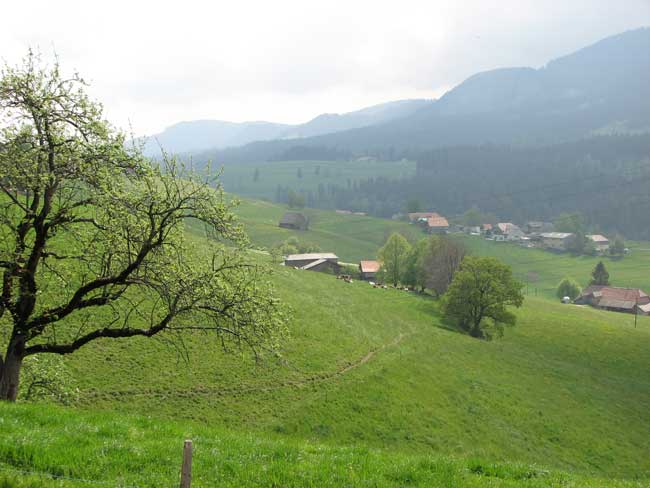
Swiss Farms in the Spring

It was early, and the mist was burning off the valleys, so these look a bit like watercolors.

Monday, May 07, 2007

The Asshole Test

Surprisingly apropos of recent posts on management, there's another popular book going around now: The No Asshole Rule: Building a Civilized Workplace and Surviving One That Isn't, by Robert Sutton, one of the authors of the well-cited and enjoyable Hard Facts, Dangerous Half-Truths And Total Nonsense: Profiting From Evidence-Based Management.

Sutton also has two blogs, on which he's posting rousing, blood stirring commentary on the reception he's getting for the assholes book. One is "official" at Harvard Business Review: The Working Life. There's a pointer there to an online test you can take to determine if you are an asshole, and it includes gems I've posted about before, such as: “You are constantly buttering up your boss and other powerful people, and expect the same treatment from your underlings.”

His other is his personal blog, Work Matters, which has even more about the book's reception. If you're interested in asshole managers and hostile workplaces, they're both good reading.

Sadly, I suspect even assholes are passing these on -- consistent with the "Incompetent People Don't Know They're Incompetent" findings I've posted about before. And I fully understand the potentional implications of my pointing this out. :-)

Saturday, May 05, 2007

Swiss Bunnies

I've been away for a week and a half, looking at green hills and mountains, tinkling cows (their bells, not relieving themselves), and other cute animals. These are Swiss checkered rabbits, who are good friends. They live in Ballenberg, an outdoor folklife museum. I think it's fair to say that their disapproval is less intense than that of your average American variety, although it seems to be a basic trait of the species.

Sunday, April 29, 2007

Workaholics in Consulting and Engineering

Really more about type-A personalities, or at least very driven people: An article in Fast Company on Boston Consulting group trying to get a grip on employees who work too many hours.
"A hero at BCG is not someone whose light is on at 10 at night," says Kermit King, the firm's head of recruiting for the Americas. "The emphasis should be on productivity per hour, and I think there's a point where productivity diminishes."

That's why the firm--which doesn't bill by the hour and explicitly states that hours don't figure in promotions--launched a program called the Red Zone three years ago to spot and tame chronic overworkers.

It's not quite working yet -- perhaps because the workload makes it impossible to succeed within the green zone. They have had a slight decrease in the percentage of employees who say their load is not manageable, though, up to 63% from 67%. (At one place I was salaried, 100% in my department said it was unmanageable. The hours we worked reflected this of course, which is one reason I charge by the hour now.)

A related post appears in the increasingly interesting 37signals blog, on development type A's: Don't Be a Hero. Their gist is that if you haven't finished a task in estimated time allowed, don't push on to do it in more time:

That’s where the concept of sunk cost gives us a guide on what to do. It doesn’t matter what you’ve already spent. That time and money is gone. It only matters whether spending what’s left is worth it or not. Business school 101, but one of the hardest lessons to internalize.
Unfortunately, the switching cost is often high for creatives and execution-driven folks. In morale if not attention to task measures. But in general I think their point is very good.

Sunday, April 22, 2007

Fractal Art

I've been playing with 2 fractal-generating applications recently, and recommend them for different reasons. If you'd like to quickly generate random beautiful 2d images, of often breath-taking beauty, use Apophysis.

If you like to play with dials and sliders and 3d imagery, and generally do a bit more work yourself, I recommend Chaoscope, a "3d strange attractors" rendering package.

Samples from both:

Thursday, April 19, 2007

12 Breeds of Client

Freelance Switch, a site for freelancers of all types, has a nice post about different types of client personalities and how to handle them. It's applicable whether you're a genuine freelancer or working in a consultative role inside a large organization -- I recognized a lot of it from traditional dealings with consumers of interface design and usability, including previous managers. Some of my favorites, in the "recognizable but not so nice" category:
  • The Hands-On Client: The hands-on client is a frustrated artist, as soon as they walk in the door they will be telling you about their skill as an artist, illustrator, photographer or writer. The hands-on client already has a very specific idea about what they want and usually has very little interest in your thoughts on the matter.... If you feel you have an ethical responsibility to point out the flaws in your hands-on client’s directions, you are headed for conflict. Hands-on client’s secretly believe that they could do their job much better than you and that there is little or no specialist knowledge you could possibly impart. One oddity about working with a hands-on client sometimes occurs when you give in your creative ambitions and agree to do it their way. All of a sudden your hands-on client may accuse you of making them do all the work or not doing your job.
  • The I’ll-Know-It -When-I-See-It Client: The I’ll-Know-It-When-I-See-It client shares much in common with the uninterested client except in a more frustrating way. Their indecisiveness and inability to articulate what they are after makes them one of the few clients that it is generally best to steer clear of.
  • The Always-Urgent Client: All their emails are ‘highest priority’ and their couriers are always red-hot. They work on weekends and late into the night and think that everyone else does too. Additionally the always-urgent client often seems to think they are your only client and that their job should therefore be your highest priority as well as theirs.
  • The Decision-By-Committee Client: Usually inhabiting the world of large corporate clients, the decision-by-committee client can still be found in smaller operations where they share their decision making with a spouse, neighbour or dog. The decision-by-committee client is one who lacks a single point of authority and for which every decision must be approved by many people.
I'm breaking in a new tag for this one, a consulting tag.

Friday, April 13, 2007

Crazy Bosses Hall of Fame

An entertaining read at CNET: the Crazy Boss Hall of Fame, featuring stories of swearing CEOs and bathroom reading that's circulated daily. Weird stuff in there, it might make you feel better if you work for a nutcase. I don't like the suggestion that I always get in these articles that because they're aggressive and nasty they succeeded in business (maybe I read it in, but it's caused by close juxtaposition of wacky antisocial story with glory story of million dollar business win).

But there are some good failures in there too, like Craig Benson of Cabletron who also failed in politics. Anyone else find irony in a guy who ran a company like a "military environment" and then ran for office on a libertarian-bent of "less government in people's lives." He had a virtual staff and virtual volunteers, with whom he had (virtual?) affairs. He ran standing meetings from behind a standing desk -- leading to a great quote from the article link above:

"It is," Peterson said, "the most efficient way to reach the wrong answer in the shortest amount of time."

Best-selling books touting surprising management styles keep coming. First Break All The Rules: What the World's Greatest Managers Do Differently has 227 positive reviews on Amazon right now. Hopefully, being a great manager isn't just about finances but includes something about work culture, too. I'd like to think you don't have to be an asshole to do good things for the company. Meanwhile, breaking the rules doesn't make you an asshole either -- a senior VP at a former company criticized a move I made as a manager for an employee of mine on the grounds that "I've never heard of anyone doing that before!" Yes, it really was intended as a criticism, and probably said more about him than me, alas.

Relevant past posts on ghostweather: Is Your Boss a Psychopath? And Past and Current Employees and Your Reputation, not to mention, Demotivation and Burnout.

Thursday, April 12, 2007

Logos of Web 2.0

In case you haven't seen this -- at FontFeed, there was a nice deconstruction of the look of web 2.0 company logos. (Thanks to a graphic designer I worked with recently for the link. Same could be done on the websites with probably similar results; I feel like I've seen the 37signals look all over the place in the last couple years.) In a non-graphic designery vocabulary, I myself note a lot of blue and orange, more "soft" rounded fonts rather than angular in this selection, and greys and gradients.

Monday, April 02, 2007

Adorable Monsters

Two cute monster-related items for early April:

Daily Monster, an online growth of cool monster art. It's Stefan Bucher's site (thanks Steve): And while I was poking around on Jared Tarbell's site for a friend, I found his combinatoric monster art, which made me grin wide. I want to be Jared when I grow up.

Sunday, April 01, 2007

Passionate About Your Job? Your Career? Your Company?

A while ago, Creating Passionate Users had a post about employees who are passionate about their employer versus passionate about their work. The gist was that people who are passionate for their company are like this:
  • Defends the company to anyone, anywhere that criticizes or questions its products, policies, or practices
  • The ultimate team player who goes along with the group rather than voice dissent
  • Is well-liked because they do whatever is asked, enthusiastically
  • Accepts (and uses) phrases like, "this is what corporate needs us to do."
  • Cares a lot about his career path in the company; focused on getting management recognition.
Whereas employees who are passionate about their work are recognizable because they:
  • Would spend his own money, if necessary, for better tools
  • If they were NOT doing this as their job, they would still do something related to it as a hobby
  • Works late nights when, "I'm just one-compile away from this awesome refactoring that's going to make this thing run 40% faster." In other words, they work late when they're driven by something they know they can do better on.
  • [And somewhat controversially:] May not be extremely well-liked, but is highly respected and tolerated because he's known as one who, "cares deeply about doing the best possible job, and is very good at what he does." CPU's update was: The person must be liked well enough for people to want to work with him again...
While I enjoyed the post, I had some issues with the distinction between work vs. employer, or company. In my experience the distinction is really about "career at this company" vs. "the work I do." I've rarely seen a place where loyalty to the company is a major factor anymore (although I can think of one strong candidate in my employment history). When people talk critically about employee loyalty to the company, they really mean something more sinister about "fit" and "culture" and "not making waves." Look out for this rhetoric, it's usually covering for something else that's going on. But that's not the point here right now.

Career motivated people are a hair away from appearing motivated by the work they do, but it's a really important hair. They can be recognized by some similar signs as CPU's indicators of company loyalty:

  • Excessive concern for what management thinks, or what the promoting, salary-raising decision-makers think
  • Covering their asses behavior: blame assignment, rather than taking ownership and responsibility individually for tough problems that need resolution
  • Star behavior: Taking credit and not giving it to others. Often excused by managers as "my team did it so I did it." Not quite what the team thinks...
  • Competition for the plum jobs (some may be genuinely hard, but it's notably the ones that are visible to CEOs and Senior VPs that they go for)
  • Wangling to get on the speaker list at important events attended by senior management; this may look like it's for "good" but often it's self-promotion
  • Teamplay gets sacrificed for their ambition, when it's useful to them -- less pushy voices and personalities get the uglier tasks and less interesting roles if they have something to prove.
  • Resume-building; a key distinguisher between loyalty to the company versus themselves -- they're figuring out how to make their tenure there useful to them for the next, better move.
This behavior, especially in a teamwork environment(see my old post about requirements for successful teams), can be fatal for morale of others. Unfortunately, it may be difficult to identify this behavior as different from dedication to the work itself, if no one is paying very close attention. Most of their managers probably aren't, actually, either because they have incomplete information, or aren't able to make this distinction. And some of the managers may fall into this category I've just described, which will make it even harder for them to tell that difference in their own employees or to think it important.

Sad postscript: Kathy Sierra at CPU has been receiving death threats. Her posts are always controversial to some, which is part of why she's a good read; but now she seems to be a target for it. It's hard not to read this as a response to her as an outspoken woman, rather than just an opinionated smart blogger.

Saturday, March 31, 2007

Visualizing Poetry

April may be the cruelest month, but it's also the month of poetry, and Knopf does an annual poem-a-day mailing list, which I highly recommend. Thanks to my friend Tina in Seattle, I've been on this list for the last 3 years and loved every day of April.

Nine years ago we began a Knopf tradition. To celebrate National Poetry Month, we sent a poem a day by e-mail for 30 days to anyone who asked to receive them. Now, with over 25,000 subscribers, we are proud to continue with a whole new series of daily poems. Each day during the month of April you will receive a poem from some of the best poets in the world including Mark Strand, Sharon Olds, and Laurie Sheck, as well as classics from Langston Hughes, Robert Burns and more. If you know of someone who might like to join the poem-a-day party, they may visit http://www.randomhouse.com/knopf/poetry/poemaday/ to sign up.

In honor of poetry visual and written, here are some samples of Boris Muller's visualizations of poems for the annual Poetry on the Road conference in Germany.

And see the great summary of other notable vis work in Ping Mag's article on beautiful data visualizations, based around an interview with the editor of the popular Infosthetics blog. (Thanks for the pointer, MJ.)

Thursday, March 29, 2007

Engineering Rewrites and Old Code

Closely related to my Balls o' Mud post about old code bases, the latest Silicon Valley Product Group blog posting is about the necessity of engineering "headroom" for code maintenance during product lifecycles. And about inevitable rewrites to scale, perform, and I'd say, accommodate design of new features, although the article doesn't focus on that issue per se.

I knew ebay had gone through growing pains, but the article suggests some absolute heroics in the form of two mid-growth rewrites of their code that barely touched their business performance. I know of some (plenty) UI designers who've left ebay because of their unwillingness to touch their UI (it sadly needs it), but I do applaud their engineers for their effectiveness at communicating the need to do code work to survive. From the SVPG article:

The deal with engineering goes like this. Product management takes 20% of the capacity right off the top and gives this to engineering to spend as they see fit – they might use it to rewrite, rearchitect or refactor problematic parts of the code base, or to swap out data base systems, improve system performance – whatever they believe is necessary to avoid ever having to come to the team and say “we need to stop and rewrite.” If you’re in really bad shape today, you might need to make this 30% or even more of the resources. I get nervous when I find teams that think they can get away with much less than 20%.

If you are currently in this situation, the truth is that your company may not survive this. But if you are to have a chance of pulling through, you’ll need to first do a realistic schedule and timeline for making the necessary changes that engineering identifies.

If your product is slow, hard to modify, and your code base is really old and hard to understand by your own developers, you should be worrying about your future in the business. Can the people you want to modify your product succeed in actually modifying the product without total internal collapse, at version N? Here's another pointer to that ball of mud article on software architecture growth issues.

Wednesday, March 28, 2007

Owl and Bear

At the Worcester Ecotarium they have some nice animals. I especially enjoyed the polar bear and the porcupine. Unfortunately, the latter was hard to photograph as he was very busy running in and out of his cubby hole. (But there is a very relaxed and lazy one sleeping on a tree in my animal photos from Nova Scotia here.)

This little screech owl is moulting.

The polar bear likes to play and scare the guests. Expect more of her...

Saturday, March 24, 2007

Web Infovis: Crispyshop.com review

Found on Information Aesthetics, a regular read for me...

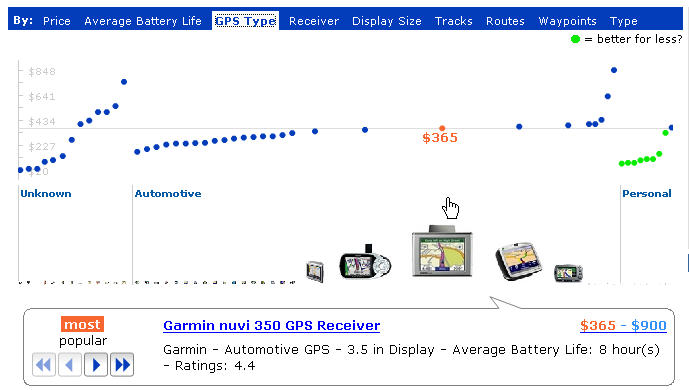
Crispyshop.com is a fascinating blend of data and shopping results that, sadly, doesn't quite work for me on grounds of overall design usability. I love to play with it, but I can't figure out how to use it to pick the GPS device I'm looking for. It has some very basic issues, which in this era of "user experience" shouldn't be happening! (Hey, I know, hire me to consult for you, guys!)

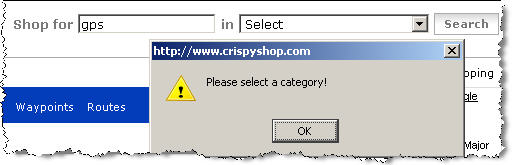
The main display is this very fluid graph showing price on the Y axis, and the dots represent products. The green dots are a great idea, but don't work in practice: you see one suggesting it's a better "deal" (by some number of unknown factors) and you head for it, and it disappears. The UI is simply too fluid. Also, you should never get an error for a simple search like the one I just got:

Whatever you do, you've gotta return results from any search done. Not an error and not a "not found" page. Finally, once I did find a product I wanted to look at, I did the usual thing -- clicked off to a merchant site to look at the details there to make sure it's what I was expecting. And an annoying popup error kept grabbing me back to the crispy page: "A script on this page is causing Mozilla to run slowly. Abort it?"

One last bash: the passion here is in the beautifully fluid graph details, clearly. To the left of it is a disappointingly "normal" set of filters that most people just don't use when searching, because they pose various cognitive problems when you're just browsing around and trying to educate yourself about a product space. These ones are particularly poor, in that the pulldown menus don't show the number of results associated with each choice (for instance, if I filter by "10% off and More" will any show up, or will I be wasting a click?). The way Kayak.com handles this is inspirational, of course, in that you get lots of information to help you manage your filters, including some little graphs showing ranges. Wine.molecular.com's demo app is a nice one too, but only works in IE for me. They show a small barchart, but only when you mouseover the slider:

Search is hard to design well: it's all about successful data reduction, for the end-user. People don't scroll through pages of results. But I'm always disappointed by cool ideas partly executed. Is the Crispyshop site intended to support a common task, or just showcase the author's brilliance in one domain (and I admit, he's pretty brilliant at that)? Is it meant to be done, or is it another beta like the endless Google beta empire?

This sadly reminds me of the conversation I had with a spokesperson for Tableausoftware at last year's Infovis conference: There was no usability testing done for that product during design, and it shows in use. I needed an in-person tutorial to get anywhere with it after having downloaded the demo version already. The functionality is excellent, but for a new user making a purchase decision, that's unfortunate in today's software world. Old software products, I will cut them some slack -- but a new product? Even just a professional once-over by someone like me can help catch a lot with the basics.

Wednesday, March 21, 2007

Past and Current Employees and Your Reputation

As my current contract winds down, and a friend quits a job I once quit too, I've been thinking about how employees can affect your company "word of mouth." Just in time, Scott Berkun posted about why you should treat your contractors and temps well :-) Not that I have in any way had a bad time of any contract, but that's relevant to the overall topic here. Manage your reputation by taking care with your own staff.

Scott makes the point that interns and temps are potential future employees, are sources of networking for your future hires, and may be top notch in the idea department, especially since they bring in fresh perspectives. "Treat them like idiots in a box, and you’ll get idiots in a box. But give them a chance to outperform your expectations and your next star recruit might already be in your office." This is a regularly delivered message on Joel Spolsky's blog too.

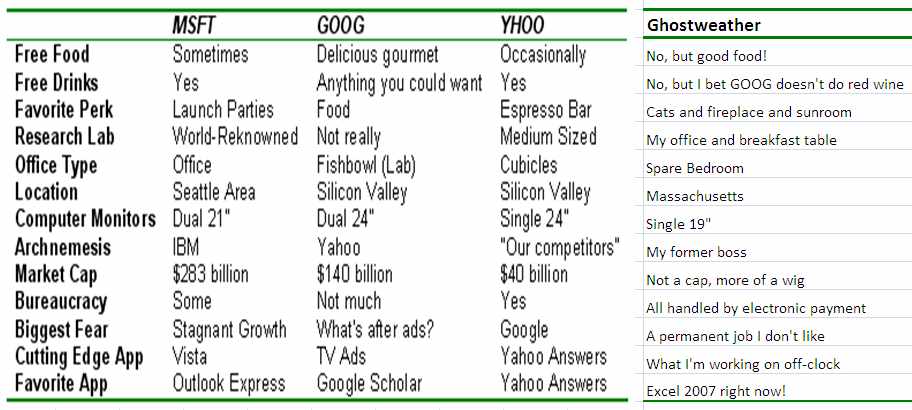
Don't miss the terrific post from the guy who interned at Google, Microsoft, and Yahoo, and compared the three in a blog post with a small chart. :-) (He ended up taking a job at Yahoo.) Here's how my situation compares in an added column on the right:

Another subject of relevance is what I call the "Departure Story," or how you mutually end it with someone who is not happy working for you. My advice is not to let anyone leave suddenly, especially someone in contact with your customers; not because they will badmouth you, but because it will cause a crack in your coherence as a place that can be depended on to handle customers carefully. Imagine how that customer feels when their email to the old account bounces, and they had no warning that their contact was leaving for other pursuits? Redirecting their email to another account where someone else gets it is probably even worse; if there's any indication to that customer that the person they were in touch with had any issues at the company, this will be damaging to the company.

Sudden departures also affect the morale of other employees, just like a big riff will; they'll wonder what happened, how safe their position is, how much of an asshole you were or the boss was. Rumors and stories will inevitably get passed around. Regardless of whether the departee signs confidentiality exit papers, this is still going to happen. So is the conversation they have with their professional industry colleagues at the next conference about whether that's a good place to work or not.

Finally, if you treat a departing employee as if they're a risk, they're more likely to become one. Just like idiots in boxes.

While I was interviewing with a local company that had gone through some troubled times with lots of layoffs, I talked with current and former staff and heard an earful about their last year. It was all on condition of anonymity, and I was grateful to hear it. It made me a bit wary, I will say, and played a role in my decision process. As a manager, you need to know this is going to happen and it isn't something you can "discipline" or "threaten" out of your staff and contractors. Equally likely is the good rep and good word of mouth, if you handle them all well.

A lot of managers moan about how hard it is to hire good people. Sometimes the problem isn't the market, it's you. Checking your street reputation due to former employees and contractors might be a good idea. Someone might like you enough to tell you the truth. Then you can go about figuring out how to change your practices and image.

The current issue of Harvard Business Review has a thought-provoking piece on how companies can't be all things to all employees, but knowing what they are and capitalizing on that is a starting point in attracting the right people for your culture who won't end up telling friends, "It wasn't like it was described in the job ad, that's for sure!"

Sunday, March 18, 2007

Tuesday, March 13, 2007

Organizing for Product Design and Production

I had an interesting chat yesterday with a manager in a large international company that is restructuring to support better innovative product creation. He asked my opinion on a number of topics, relevant to their effort:
  • Matrix organization of cross-disciplinary teams: marketing, engineering, and operations, for instance. I suggested that at the innovation phase before product development, the team might look different and have different skills, such as design!
  • Does long-distance collaboration really work during product design? I said it can, and that although video gets a bad rap, we used it effectively at Adobe in the same time zone. I am less sanguine about major timezone differences, and still a firm believer in regular face-to-face, especially at the start and during times of tension, for defusing it over a drink or meal. For designers, there's more artifact production to communicate ideas long-distance; and the whiteboard collaboration hasn't really been adequately replaced by any conference tools I've seen, but I'd love to be wrong if someone has a suggestion.
  • Quality of product: Get it out or get it right? I said this depends on ability to absorb risk in a brand, and first to market vs. competitor situation. A first-to-market product can get a few things wrong, and still have the advantage. Not if they got the major things wrong, though, and destroyed their own business and can't absorb the hit. Soft launches and long betas are another tried and true method. Google seems to live on eternal betas -- but of course they did get search pretty much right, first, as far as state of that art goes now.
  • Outsource concept design or do it inhouse: I said this depends on how much product innovation is meant to be a core competency. I think it should live in-house if it's meant to be core, because it's a risk to outsource all good idea creation. Also expensive.
It wasn't a specific question, but I pushed for the value of ethnograhic research for identifying new product areas and gaps in markets; and the value of design of both the industrial variety (closer and closer to home for software now) and the usability/interaction variety. The need to reward and remember failures is important here to encourage iteration and re-application of old ideas in new ways.

Tuesday, March 06, 2007

Pretty Visual Generators

I've been looking at online generators for the last few days (a recurrent interest) and was reminded of these pretty visual ones. Worth checking out.

Jared Tarbell's beautiful I'Ching interactive display. Hard to describe, and a little mysterious in practice, as it should be.

The Walking Insect Generator, which is also beautiful, but funnier. Seriously, do click and marvel.

A scribbler art project -- this one is fun to watch, like a lot of these visual noise generators. It tends to fuzz up your drawing.

Sunday, March 04, 2007

Test Your Psychic Powers

Participate in an online study of psychic powers run at Psi Experiments. Their first experiment is up, and all you have to do is guess (or divine) which cup the ring is hidden under. No, it's not a street hustle. You can sign up for the results, too.

Experiment One: "In Which Box is the Ring?"

Saturday, March 03, 2007

Product Idea Generator

This is addictive, like any good generator. It's especially well-done. Too bad the reload link is so tiny, but you won't miss it. Samples I got:
  • It's a rubber fish that shouts 'WARNING!' at the first sign of danger! It sounds better than it looks and mimics the movements of a lizard.
  • It's a blow-up doll that's inflammable! It kills weeds down to the root and talks.
  • It's a video recorder that scares dogs and stays exactly where you leave it.
  • It's like a normal shoelace, but it runs on six little wheels.
  • It's an aquarium that keeps track of your personal calendar!
  • It's a trouser press that flies like a rocket! It doesn't need batteries and may cause drowsiness.

Web Log Analysis: Site Flow Charts

I've been working a bit on web log analysis recently (see my contracting info), and while I didn't deliver this for a client, I did spend a little time seeing if it would be worthwhile to do in the future. After doing the usual freqencies of referrers and requests and such, I also looked at median page views per visitor.
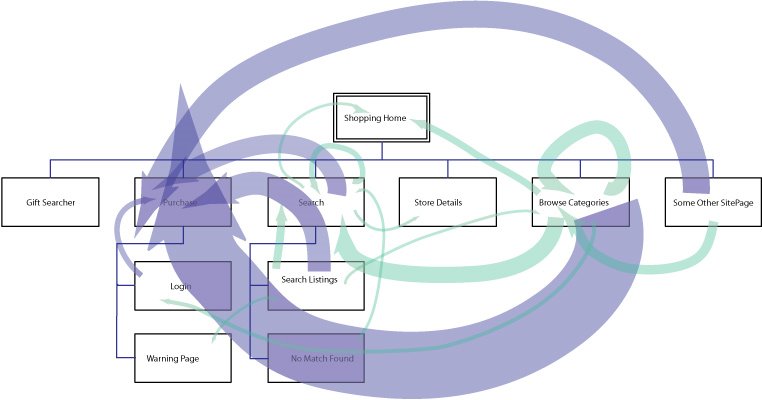
I then did a small sample extraction of page views of the users matching the median page view profile, and generated arcs corresponding to what page types they went from and to. I overlaid them on a site map I threw together, done by hand in Illustrator (and here anonymized): the width in pixels of the line directly corresponds to how many arcs there are between each node (or page type). Blue lines are going into the "purchase" process, while green are just the rest of the traffic patterns. It's a little more suggestive than the simple frequency counts that don't show actual paths; because in this I can see how few people in my sample subset go from, for instance, the "not found" search results to searching again. And it's quite obvious how relatively many people in these logs were buying products while browsing rather than after searching. It's probably worth doing this a larger scale and figuring out a good algorithm to automate the drawing, but I ran out of time on this contract project. If anyone else wants to pay me to do this for their site, drop me a note. :-)

Friday, March 02, 2007

Big Ball o' Mud: Code Tangles and Organizations

A friend pointed me to this a month ago, and I'm only getting around to this now: Foote and Yoder's Big Ball of Mud, on legacy code that no one can understand or modify without risk to, well, sanity and schedule.

They illustrate their points with physical world architectural examples, a lot coming from Stewart Brand's How Buildings Learn, because design in other domains and design of software aren't so different when you look closely.  I was, of course, thinking about interface design and organizational design while I was reading it, and about the book Architecture Without Architects, which I really like in both concept and fact after meeting a few (I'm kidding--mostly).  Foote and Yoder's interest in XP (extreme programming) is in part because of the need to accommodate changes in user requirements, but they don't talk a lot about UI design and the difficulties with keeping UI code flexible and modifiable.  (I still think it's a shame that agile and XP communities don't connect and work better with UI/UX/UE folks -- apart from the active agile-usability mailing list, of course.  The goal of a good designer is to get the right decisions made right and executed well; these goals are the same for both UI designers and code designers, and should be the goals of managers and executives who support them.  But.)

Selections from the Ball of Mud article:

  • One reason that software architectures are so often mediocre is that architecture frequently takes a back seat to more mundane concerns such as cost, time-to-market, and programmer skill. ... Architecture is a long-term concern. The concerns above have to be addressed if a product is not to be stillborn in the marketplace, while the benefits of good architecture are realized later in the lifecycle, as frameworks mature, and reusable black-box components emerge [Foote & Opdyke 1995].
  • In other words, the software is ugly because the problem is ugly, or at least not well understood. Frequently, the organization of the system reflects the sprawl and history of the organization that built it (as per CONWAY’S LAW [Coplien 1995]) and the compromises that were made along the way. Renegotiating these relationships is often difficult once the basic boundaries among system elements are drawn. These relationships can take on the immutable character of "site" boundaries that Brand [Brand 1994] observed in real cities. Big problems can arises when the needs of the applications force unrestrained communication across these boundaries. The system becomes a tangled mess, and what little structure is there can erode further.
  • Architecture and code quality may strike management as frills that have only an indirect impact on their bottom lines.

The same can be said of usability and design excellence, of course.  It's a special organization that doesn't erode the desire of people to produce quality work by saying "it's good enough to make us money right now."

A good closing quote: Alan Kay, during an invited talk at OOPSLA '86 observed that "good ideas don't always scale." That observation prompted Henry Lieberman to inquire "so what do we do, just scale the bad ones?"

Pretty often, both on the idea itself and the execution. In the short term, the prototype code works well enough, and the design is okay unless you look closer or start trying to add onto it. Same happens with UI design, without enough iteration, and tacking on new features without refactoring is like adding dirt and grass to a ball of UI mud.

I'm now using the new Office 2007 products, and I regret not seeing more refactoring of the UI, despite the famous ribbon. If you're going to start doing a UI refactor, you may as well go all the way once you've disoriented your users a little bit; for instance, why keep Word's header and footer commands under the "view" tab now, and I have to question whether "home" means anything real to anyone except on a website. Some of the changes are a great improvement, but I think a little card sorting might have helped them out a bit, too, and I find some of these choices surprising.

Sunday, February 25, 2007

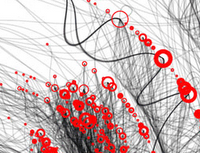
Social Networks of Video Editors on LiveJournal

A few months ago, I did a talk at IBM Research in Cambridge on video (or "vid") editors and their online and offline communities. I made a few social network images, which I thought would be interesting to folks here, and I know I have readers on LiveJournal.

The basic gist of the talk was that hobbiest television fan music video editors existed long before YouTube and their history and organization reflect how they use the internet now -- which is verifiable with some simple data analysis. (NB: I used to be one myself, and in the talk I used a lot of personal examples and anonymized the rest, to protect privacy of anyone who wasn't contacted about this talk. So I'll say "we" here although I'm not practicing myself these days.)

In a quick sum of my talk: We used to do music video editing with VCRs. We existed before the internet was our main way of communicating, and we used fanzines and APAs to exchange tips and tricks (but truthfully, this was borderline before my time, although the friends who taught me all did this). We had and still have conventions at which we showed off our work, to supplement the now popular online posting mechanisms of distribution. (YouTube is not a major site for fan video editors, but another current social network tool that supports video has just become very popular among my friends who use LiveJournal for their conversations.)

Knowing the history makes for interesting cruising of the video communities on LiveJournal. The anime video makers turn out to be, for the most part, a distinct group. This isn't too surprising when you read the "about" text on one of the video community pages (slightly disguised here):

Anime "vidders" are told they may not be as comfortable here, and that VCR vidders are welcome.

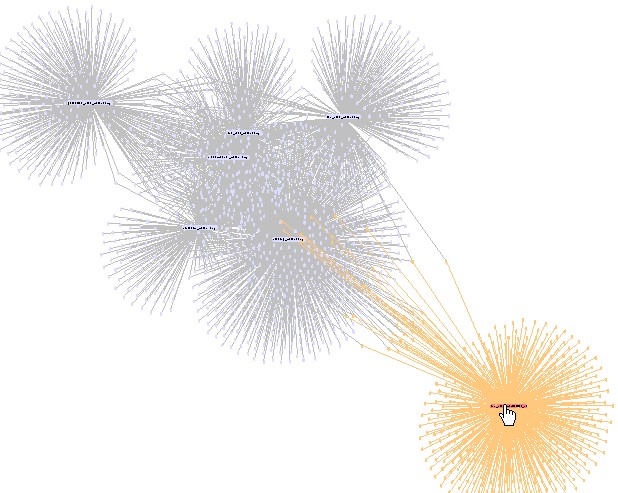
This image shows the network of members in the anime community (highlighted) which is somewhat separate from the group (and its affiliates) quoted above:

One of the communities that is closely related to this one is one in which an annual face-to-face convention is discussed, started and fed by some of the older VCR editors and now pretty much populated by the non-linear digital folks, of which former VCR people are now a part. The convention-discussion community members, highlighted below in orange, are closely interconnected to the community quoted from above, which is circled in red here:

The group circled in blue is a Battlestar Galactica video group, less closely related but more so than the anime group. The closely inter-connected groups in these images are the generic discussion groups, at which the craft and technique and technical discussions occur. More specific discussion groups are generally less connected.

I made these images with prefuse, and apologies for the quality of the uploads. I'm available to talk about this stuff anytime :-)

Sunday, February 18, 2007

A Postcard to Windhouse

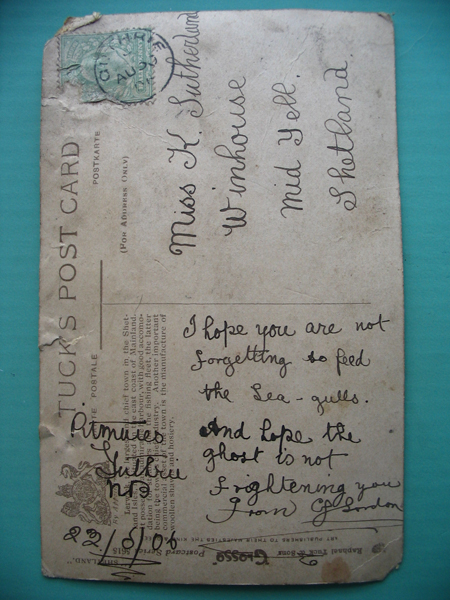
Since my last update a month ago on the haunted Windhouse stories, I received email from a reader in Stirling, Scotland, whose family lived in the house in Shetland at the turn of the (last) century. Even then the house was known to be haunted, well before it turned into a picturesque ruin on the hill. Justine scanned and sent me a copy of a postcard her great-grandmother's sister Katie received referring to the ghost.


windhouse postcard

I updated the essay again, and posted some more photos and links to the family history. They're at the bottom: my Windhouse story.

Saturday, February 17, 2007

Mayan Art

From Chichen Itza this January. The eagle is eating a heart.

I am reading a great book, Breaking the Maya Code, by Michael Coe. The first paragraph says, "It was 12 cycles, 18 katuns, 16 tuns, 0 uinals, and 16 kins since the beginning of the Great Cycle. The day was 12 Cib 14 Uo, and was ruled by the seventh Lord of the Night. The moon was nine days old. Precisely 5,101 of our years and 235 days had passed since the creation of this universe, and only 23 years and 22 days remained until the final cataclysm that would destroy it. So the ancient Maya scribes and astronomers would have calculated, for the day was 14 May 1989, and we were in Leningrad."

Saturday, February 10, 2007

Owls in Massachusetts

Last weekend was an "owl festival" at my local Audubon nature preserve. First was a great presentation on snowy owls at Logan Airport (not given there, about owls who hang out there) by Norm Smith of the Blue Hills Audubon nature preserve. Yes, there are snowy owls all over Logan's landing strips. No, this is not good for the airplanes. Yes, they are hard to spot if you're flying out from there, as I discovered a day later-- white could mean snow, trash, or owl.

Norm has some great pictures of them, and points out how little we understand them -- they don't seem to be migratory in the usual sense, and might even be circumpolar. They are able to filter out the sounds of the jets to tune in on squeaking rats. They all look a bit different, and have different personalities, too.

Some articles and links worth looking at on this work:

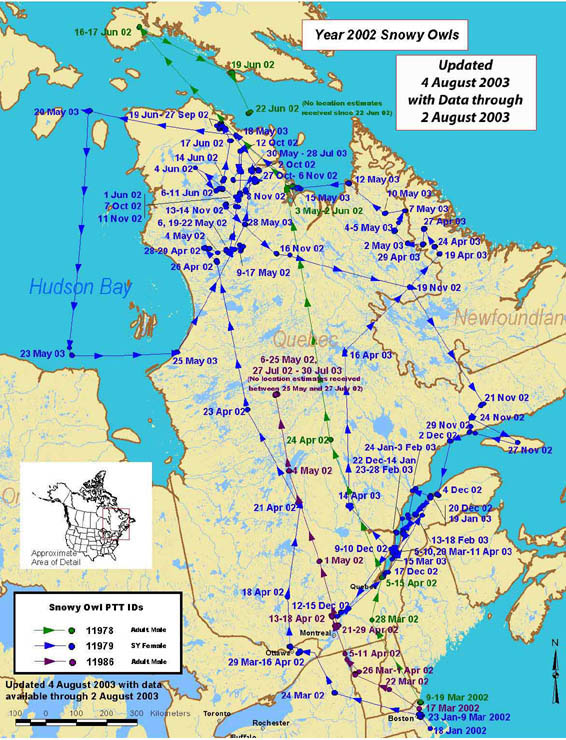
This is a map of where some of the owls he attached transmitters to ended up in Canada -- mostly up towards Hudson Bay. Some have been tracked to Siberia, though. (Hey, I've been there. I saw no owls, however.)
The day after Norm's terrific talk and slides, a guy brought in some birds living in captivity because they've been hurt or grown up with people and now identify too much with people to hunt properly. These were beautiful birds. Below you'll see this fellow with a screech owl, incredibly cute, and a wonderful great horned owl. None of my pictures turned out very well due to the interior lighting, but you get the idea.

After the demo of the birds, we went on an "owl prowl" walk in what was probably 14F degrees at best. In the gathering dark, I add, because at the point where I'd had enough of the cold, I didn't think I could see my way back to the lodge. We crunched all over the grounds of Broadmoor making dumb owl calls, and hearing not a peep back except for the bored kids shifting around while we listened and whining a little and sometimes pretending to be owls themselves which didn't really help us. It was so cold even the CD player with some real owls on it wouldn't perform properly. An owl bust, all around. Now that I know what screech owls and saw whets sound like, I can confirm I have never heard them where I live beside the reservoir. Too bad! They are really cute.
Saturday, February 03, 2007

New Moon and the Stock Market

I've been quite busy recently, and am getting a backlog of post material. Here's on oldie I never got around to blogging, which is weird and short: there is evidence that the lunar phase affects stock market performance.
We find strong lunar cycle effects in stock returns. Specifically, returns in the 15 days around new moon dates are about double the returns in the 15 days around full moon dates. This pattern of returns is pervasive; we find it for all major U.S. stock indexes over the last 100 years and for nearly all major stock indexes of 24 other countries over the last 30 years. In contrast, we find no reliable or economically important evidence of lunar cycle effects in return volatility and volume of trading. Taken as a whole, this evidence is consistent with popular beliefs that lunar cycles affect human behavior.
You can see the abstract and download the paper here: Lunar Cycle Effects in Stock Returns, on the Social Science Research Network.

Sunday, January 28, 2007

Windhouse Haunting Updated

I'm pleased to announce that I've updated my article about the haunted Windhouse in Scotland, based on a very interesting reader story I just received. I've added his account at the end as a postscript with a few more photos; and below that I added the Shetland online forum stories I found that appeared after I posted the original piece last January. (I got "seems to be the best researched" in the forum citation :-)

Saturday, January 27, 2007

MultiTouch Display

I guess it's a Tipping Point phenomenon, but I wonder who the cool kids are, everytime this happens. The iPhone demo features a multitouch display, and Jeff Han's demo of this functionality on YouTube has been getting a lot of blognoise; but this idea has been around in the research community for a while. What makes something finally get out of R&D "interesting idea" and into "must have innovation wow" in a product seen as widely as the iPhone? It was even around at Apple, and ignored for years. What does it take to get visibility and get on a product development and business radar? Some links:
  • The Jeff Han video that's been circulated a lot (ok, points for music, for high density of info and fast cutting to demo points -- is this what makes it spreadable?)
  • The Tog column that discusses some of the design history that went into the iPhone (many many ideas over many years, including random access voicemail -- we discussed and prototyped this at AT&T and at Excite 10 years ago too), some of it (but not most of it) at Apple itself.
  • Bill Buxton's article referenced by Tog on multitouch displays. I know some of the people he's referencing, and I feel their mystification too.
I guess this is one of the reasons I stay as plugged in as I can to what's happening in R&D--the best of that work will eventually make it into products, and I'd like to lessen that time by figuring out the tipping point for it.

Wednesday, January 24, 2007

Democratizing Data Insight

It's an exciting world right now... i-Stuff and the spread of "design" as a buzzword aside, I'm thrilled by the spread of data and graphs into the public world. A few recent pointers on the theme of public data exploration:
  • Gapminder.org's Hans Rosling presented to TED a year ago, with the beautiful animated charts that his site made famous. His final comments say, in paraphrase, "Publically funded data is public, but hard to get at, hard to search, and presented in boring ways. We can and should change this." One of his great takeaways, for me, from his data illustrations of "third world" healthcare is that the error in the data is no doubt much less than the truth in it, at the magnitudes he illustrates.
  • Swivel is a new site for data upload and exploration, with a fun blog. They also allow community discussion around their charts. I like their enthusiasm and enjoy the blog a lot.
  • Friends from IBM (Martin Wattenberg and his group) have just announced a similar concept to Swivel's, but with even more graph types and they're all nicely interactive. Upload data, create a picture, and post it... other people can play with your data and present their own insight pictures, or modify yours. And comment on them. It's Many Eyes, and it even has a nice website!
  • Google claims to be making real time stock quotes available, which means live data plotting is possible. Found on swivel's blog, a post on Googleblog: Real Time Quotes for Free.
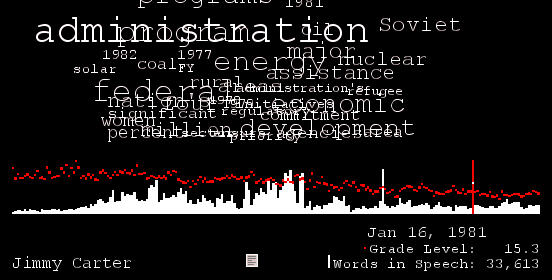
  • And don't forget processing.org. There's a nice visualization of State of the Union speeches highlighted there, including word frequencies and grade levels of the speech. (It's by Brad Borevitz.) They've been averaging around 9th or 10th grade level, but notice the great spike of Jimmy Carter's at grade 15.

Sunday, January 21, 2007

Friday, January 19, 2007

Annual Site Stats and Changes

I don't have time to do real stats on my server logs, but I offer the annual impressionistic ones, at least, as well as some updates on the site.

Search phrases that strike me as funny, that show up every single week (usually with multiple counts):

  • girls on boats
  • alcohol induced blackouts
  • temporary wallpaper
  • real ghost photos/ghost photos/real life ghosts (etc)

Posts or pages with high hit counts, regularly:

  • The crop-circle google-montage (I should put a Google ad or two here, it's ludicrous; and no one ever comments, but it's hit 68 times or more per week.)
  • The weird red tree in Shropshire that almost made me drive off the road. It has 67 comments, which I should really trim/clean/purge most of. Also, add a Google ad.
  • An incredibly short post on Bara Hack, haunted village in CT. With a lot of chimers-in on the illegality of going there, or not.
  • My travel essays, especially the Siberia one. They're low on the page, but very popular, and the Windhouse and Fair Isle one are catching up in hits.
  • The bio/resume page is visited at least 20 times a week. I've added some info to it recently.
Visitors in sizable numbers are coming from images searching (no surprise there), a few companies where I think I know the folks :-), and increasingly from Stumbleupon, which is nice.

I spruced up the blog template a tiny bit, since Blogger has added tagging ability. Now you can click on a link to items in categories I post on regularly: design, tech industry, management, archaeology, funny stuff, weird stuff, information visualization and data analysis, etc. It took hours and hours to do a cursory tag job on my 504 posts of the last few years, so if you notice a mislabel, let me know. The tags list is on the right side under the index of recent posts.

Thursday, January 18, 2007

Powerpoint Hilarity

Le Grand Content by Clemens Kogler is an animated riff on powerpoint presentations of data and Big Questions (mostly those found in bad teenage poetry). It's very funny. Go and click on "view movie" and giggle.

Ancient Curses

A 1700 year old tablet with a curse on it was recently unearthed in Leicester (UK). This one immortalizes some guy who stole a coat. It's amazing the things we leave behind us for posterity.
One of the most interesting finds from a site on Vine Street was a 'curse' tablet – a sheet of lead inscribed in the second or third century AD and intended to invoke the assistance of a chosen god. It has been translated by a specialist at Oxford University, and reads: 'To the god Maglus, I give the wrongdoer who stole the cloak of Servandus. Silvester, Riomandus (etc.) ... that he destroy him before the ninth day, the person who stole the cloak of Servandus…' Then follows a list of the names of 18 or 19 suspects. What happened to them is not recorded.
There's another famous curse in Carlisle from the 1500's, recently carved on a stone art object that has supposedly caused all sorts of problems for the town since its installation in 2001: see Curse of the Cursing Stone. The curse itself is in old Scottish dialect, about 500 words, "one of the longest on record"-- it's addressed to the raiders on the Scottish borders, and was read out by priests to advertise their great displeasure with the illegal activities.
I curse their heid and all the haris of thair heid; I curse thair face, thair ene, thair mouth, thair neise, thairg toung, thair teith, thair crag, thair schulderis, thair breist, thair hert, thair stomok, thair bak, thair wame, their armes, thair leggis, thair handis, thair feit, and everilk part of thair body, frae the top of their heid to the soill of thair feit, befoir and behind, within and without. I curse thaim gangand and I curse thaim rydand; I curse thaim standand, and I curse thaim sittand; I curse thaim etand, I curse thaim drinkand; I curse thaim walkand, I curse thaim sleepand ; I curse thaim rysand, I curse thaim lyand; I curse thaim at hame, I curse thaim fra hame; I curse thaim within the house, I curse thaim without the house; I curse thair wiffis, thair barnis, and thair servandis participand with thaim in their deides.
Curses are like legal documents, at least the good ones: they are comprehensive and leave out no body part or aspect of life, and usually they extend into eternity. My favorite curse is literary, Manfred's curse by Byron (it starts at line 200), gorgeous and bitter:
Though thy slumber may be deep,
Yet thy spirit shall not sleep;
There are shades which will not vanish,
There are thoughts thou canst not banish;
By a power to thee unknown,
Thou canst never be alone;
Thou art wrapt as with a shroud,
Thou art gather’d in a cloud;
And for ever shalt thou dwell
In the spirit of this spell.
... And a magic voice and verse
Hath baptized thee with a curse;
And a spirit of the air
Hath begirt thee with a snare;
In the wind there is a voice
Shall forbid thee to rejoice;
And to thee shall Night deny
All the quiet of her sky;
And the day shall have a sun,
Which shall make thee wish it done.
From thy false tears I did distil
An essence which hath strength to kill;
From thy own heart I then did wring
The black blood in its blackest spring;
From thy own smile I snatch’d the snake,
For there it coil’d as in a brake;
From thy own lip I drew the charm
Which gave all these their chiefest harm;
In proving every poison known,
I found the strongest was thine own.
If you know of other good literary or historical curses, I'd be interested in pointers.

Saturday, January 06, 2007

Puzzles and Mysteries

Malcolm Gladwell wrote a great piece in the New Yorker: OPEN SECRETS: Enron, intelligence, and the perils of too much information. It's being blogged all over, but since I'm still thinking about it 12 hours after reading, I'm posting too.

He distinguishes between puzzles and mysteries, and the role of data in both.

The national-security expert Gregory Treverton has famously made a distinction between puzzles and mysteries. Osama bin Laden’s whereabouts are a puzzle. We can’t find him because we don’t have enough information. The key to the puzzle will probably come from someone close to bin Laden, and until we can find that source bin Laden will remain at large.

The problem of what would happen in Iraq after the toppling of Saddam Hussein was, by contrast, a mystery. It wasn’t a question that had a simple, factual answer. Mysteries require judgments and the assessment of uncertainty, and the hard part is not that we have too little information but that we have too much. The C.I.A. had a position on what a post-invasion Iraq would look like, and so did the Pentagon and the State Department and Colin Powell and Dick Cheney and any number of political scientists and journalists and think-tank fellows. For that matter, so did every cabdriver in Baghdad.

Adding data to a mystery doesn't make it less of a mystery, but smart analysts can bring experience to bear that will point towards possible answers that are more or less likely to be true.

The Enron disaster qualifies as a mystery, and Gladwell's summary of the confused and complex financial details is disquieting. Even financial experts couldn't make heads or tails out of what was going on with the money. I'm unsettled by how easily corporate environments breed mysteries requiring complex analysis both of their internal and external behavior; and how hard it can be to understand and correct corporate mismanagement. People lose their livelihoods all the time now-- how many other Enrons are actually happening with no one noticing?

As a side note, as I read the recap of the Woodward and Bernstein investigation I actually thought, "This is surely going on all the time now. Would anyone be shocked at this in this political era?"

Joel's Quality of Software Teams; and Design

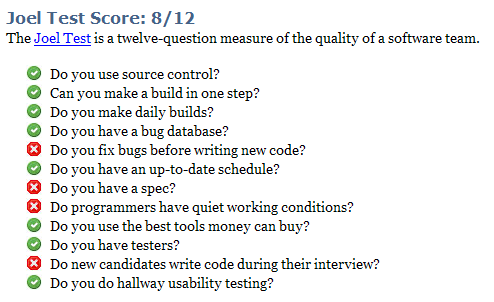
I'm a Joel Lover like many techies folks, and his job board is really tickling me. I just cruised the engineering ads (no, I'm not looking for a development job :-) and saw the the little questionnaire at the bottom of the page that measures the quality of the team hiring. Apparently people posting ads are answering honestly, which is excellent! And even more excellently, usability testing makes his list.

What would a similar test look like for hiring user experience designers, I wonder. A bunch would be similar, I think. I'd propose something like...

  • Do you develop from specs written by designers?
  • Do you have a design process with low fidelity work that is reviewed and refined before final specification is produced?
  • Do you do usability testing during design or only after shipment?
  • Do you change your design based on the results of user testing?
  • Do you measure customer satisfaction with the product, including measures of user experience such as appeal, learnability, ease of use?
  • Do designers talk to customers directly on a regular basis?
  • Are developers involved in the design reviews and process?
  • Does QA test for specification compliance?
  • Is there a dialog about business requirements and product features that includes design staff?
  • Do you require a design test and portfolio review during interviewing?
  • Are other designers involved in interviewing designers?
  • Are deadlines for specifications realistic and staged with multiple deliverables; or do you have single dates and one large spec document?
  • Is your dev process sufficiently flexible to allow for design revisions without breaking everything and everyone?
  • Are designers considered crucial to your business and to your developers? Regardless of the answer, how do you know if they are or not?

Monday, January 01, 2007

Giveaway of the Day

I've been tracking Giveaway of the Day for a little while now, and I've liked some of what I've found on it. If nothing else, it's a way to find out about smaller utility programs and new tools you don't know about, and you can't beat "free" when you want to try one. The hook here is that you only get a window of 24 hours to install and activate each one, so you have to keep up with the site if you want to catch something you want. And then they hope you tell other people so they get sales by word of mouth. I like the model.

Today's Giveaway was a nice tool to clean out your Windows startup apps (I kept wondering what the heck was slowing me down on one laptop); the other day I got a simple video cutter that helps the YouTube crowd splice stuff together and chop out scenes. More and more of these things are being described as simple and easy to use. Yay!

"America's Stonehenge"

Yesterday a friend and I went to see the site in Salem NH called "America's Stonehenge." (No, really, that's what the tourist name of it is.) Having crawled all over farmer's fields in Europe looking for passage graves, dolmens, and standing stones; visited Newgrange and other related sites; seen early archaeological sites in Orkney and Shetland... well, this was still pretty damn good.

It's complex, and dating says it's 4000 BC and younger; the passage graves have genuine boulders propped on supports that look eerily like the European neolithic monuments; as a bonus, there are carvings both on the site and in the visitor's center, claiming to be Ogham and sun-god related. There is even a complex "altar" stone with an underground whisper chamber beneath it.

Less convincing were the smaller "standing stones" and the astronomical alignment theories. We saw a lot of stones that were identical to the stones claimed to be alignment markers, which weren't labelled in any way. Amateur archaeology could be responsible for any number of bad theories and moved stones... but that said, an awful lot of it looked very authentic indeed.

Some of the sites on the topic: pictures of the stone writing, pictures of the site monuments, a timeline of the site's major datings and known historical events, a not bad short article on it, describing the altar stone. Here's the official visitor's site. (They keep pet alpacas there too, who are very pretty.)

All in all, a recommended visit!

Thursday, December 28, 2006

Demotivation and Burnout

Picture from Creating Passionate Users

Today's post is brought to you by a five day vacation, during which I've been catching up on some reading and not working long hours! I've found a couple interesting pieces recently on the subject of why people burn out, which suggests it's not the overtime in itself.

The first article was on Blogher, It's Not Just You. A recent Wharton School study looked at reasons for worker burnout. (It's unfortunately not yet available free online.)

"One of the biggest complaints employees have is they are not sufficiently recognized by their organizations for the work that they do. Respect is a component of recognition. When employees don't feel that the organization respects and values them, they tend to experience higher levels of burnout." Or, as Ramarajan puts it, "it is often not the job that burns you out, but the organization."

It turns out there was another good piece in the NY Magazine, Can't Get No Satisfaction, which meanders through social worker burnout, teacher burnout, medical burnout, and into high tech and NY Wall Street burnout. This one notes previous good research:

In 1981, Maslach, now vice-provost at the University of California, Berkeley, famously co-developed a detailed survey, known as the Maslach Burnout Inventory, to measure the syndrome. Her theory is that any one of the following six problems can fry us to a crisp: working too much; working in an unjust environment; working with little social support; working with little agency or control; working in the service of values we loathe; working for insufficient reward (whether the currency is money, prestige, or positive feedback). “I once talked to a pediatric dentist,” she says, “and he said, ‘A good day is when there are no screamers.’

Googling for Maslach, I hit an online quiz that rates your current level of burnout risk. The questions are about how you feel and about your work environment, as predicted by Maslach's findings. (E.g., "Do you feel that you are achieving less than you should?"; "Do you feel under an unpleasant level of pressure to succeed?"; "Do you find that you do not have time to plan as much as you would like to?" etc.) See how you score!

Finally, there's a related by different piece I just read when catching up on Creating Passionate Users, on Knocking the Exhuberance Out of Employees. When you burn people out, you've got robots and zombies working for you. Zombies and robots don't argue, don't have ideas, and don't threaten you or the status quo. They're a lot easier to manage, too. Hopefully no one who works for me is reading this, though, because I like arguing with them and am in no way an advocate of less exhuberance. Let that go as read!

Lastly, an article on Job Burnout in an online manufacturing magazine says (citing Maslach) burnout is about a mismatch "between what people are and what they have to do. It represents an erosion in values, dignity, spirit, and will-—an erosion of the human soul." America, with increasingly long hours and questionable corporate values, is a leader in burnout. We measure customer satisfaction, but worker satisfaction isn't a serious corporate issue, and the 40 hour work week is long dead.

Postscript: I can't believe I forgot the classic article on burnout, the electrocuted dogs experiment by Seligman: Learned Helplessness. This one has a positive spin to it, in that it suggests some therapeutic ways out of the syndrome. Happy New Year!

Wednesday, December 27, 2006

Innovation 1000: Companies Profiting from R&D

An excellent study of companies spending money on R&D over the last five years, and their payoff (or not): Smart Spenders: The Global Innovation 1000.

Some takeaways from this study:

Patents don't equal profit. Although a common measurement for innovation, it's a distractor: portfolio doesn't equal profit.

"Money simply cannot buy effective innovation."

There are no significant statistical relationships between R&D spending and the primary measures of financial or corporate success: sales and earnings growth, gross and operating profitability, market capitalization growth, and total shareholder returns. Gross profits as a percentage of sales is the single performance variable with a statistical relationship to R&D spending.... Researchers who study innovation estimate that 70 to 80 percent of the final unit cost of a product (the cost reflected in gross margin) is driven by R&D-based design decisions — for example, product specifications, the number and complexity of features in a device, the choice of standardized or customized parts, or the selection of manufacturing processes. This correlation of R&D spending and gross margin shows that in many companies, the R&D silo has succeeded in its narrow goal: creating a lower-cost offering that thus yields a wider margin, or a more differentiated offering for which a higher price can be charged.

R&D money is being offshored-- or innovation is now occurring in the "rest of the world" rather than Europe, North America, and Japan.

The "integrated value chain" of innovation shows that companies that leverage their "ideation" into commercial products more efficiently are seeing payoff. This makes sense, but seems to be hard to do.

Many high-leverage companies apply distinctive approaches to innovation at all four stages. For example, from the ideation stage through project selection and product development, high-leverage innovators tend to prize end-user input. The Stryker Corporation, a $4.9 billion medical technology company headquartered in Kalamazoo, Mich., works closely in R&D with the surgeons and other medical professionals who use its products. The Black & Decker Corporation’s innovation strategy is also heavily determined by end-users. “We’ve spent a lot of time focusing on where they work, where they play, where they buy, and where they learn,” says CFO Michael Mangan. “Understanding and developing those relationships really increases the efficiency of our new product introductions.”

There are two great stories of how two very different companies seize opportunities. SanDisk operates by watching the market for parts and capitalizing on opportunities offered by lower costs.

In the flash memory industry, prices fall 40 to 50 percent per year. Thus, at SanDisk, a small team of senior executives meets twice per week to monitor prices and market trends. Their awareness, fed back into the company’s innovation process, allows SanDisk to act quickly on new opportunities. In 2004, for example, the company realized that falling costs had created an opportunity for it to enter the market for MP3 audio players with a flash memory–based device. Management contacted an original equipment maker, defined design specifications, and delivered the new product to retailers’ shelves within six months. The SanDisk player is now number two in the market, after Apple. “We don’t have big planning and product committees,” says SanDisk Chief Financial Officer Judy Bruner. “Most decisions, even those involving huge capital commitments, are made pretty quickly by a small number of pretty visionary people.”

Symantec leverages shared code and a strong core engineering team that allows them to be nimble when responding to changes. “We have a large portfolio of products and business units,” says Ann Marie Beasley, vice president of strategy. “One of the key contributors to our R&D bang for the buck is that there’s a lot of common engineering and design, as well as actual code reuse.”

Not profiled in this article, I recently read an update on Philips Design in Fast Company: Design Intervention. Philips has been recruiting for at least 6 years for its R&D Lab, and I keep wondering what's up with them. This piece pointed out a couple positives from their output, which I recall seeing in stores, including the the Ambilight HD LCD display.

A 1995 Philips Design project called "Vision of the Future" was conceptually very similar to the Simplicity extravaganza in Manhattan--a flood of flash-forward products and ideas. Indeed, the concepts unveiled back then read today like a laundry list of the technologies that are changing our lives, including personal digital assistants and voice-recognition systems. Three years later, though, Philips went back to see how many of those concepts had actually gone into production and discovered that while a laudable 60% were already for sale, only 3% of them were made by Philips. "Their design and technical specs were usually good," says Enrique Dans, a professor at Instituto de Empresa Business School, "but they were disconnected from the market."

They're learning from history and adjusting, it seems.

"Philips's total sales from products introduced in the last year were 49% of total revenues in 2005, up from just 25% in 2003. In medical systems alone, an industry with long product cycles, some 70% of revenues came from products less than two years old--up 20 percentage points from the previous year. And despite disappointing LCD results in 2006's second quarter, from a less-than-expected World Cup boost, growth in Philips's medical systems and consumer electronics came in better than expected, at 9% and 10%, respectively."

I'm always impressed by companies that learn from history. And by good analysis in business. Edited to add: There's a nice piece here about a guy studying incentives for failures, a critical part of the innovation process. A lot of companies pay lip service to the value of risk-taking and failure in the corporate learning process, but few of them have incentive plans that reward risk-taking with failure rather than rewarding only the success stories. Employees aren't dumb when it comes to rewards vs. lip service and know what really counts to their managers.

Sunday, December 24, 2006

Twenty About Design

I seem to update this one once a year. I wrote it when I was frustrated about the invisibility of design as a process and a skill at one company, and I've updated it to moderate it and expand and then contract it over the last 18 months. The latest update focuses more on hiring (a perpetual issue), teamwork, and recognizes management as both a problem and a solution in corporate culture.

Twenty Things About Design

Saturday, December 23, 2006

Morocco Photo Selection

I haven't had the time to do this carefully, so this is rather hasty -- but here's a selection of the photos I took in Morocco this summer.

Sunday, December 17, 2006

Atlas Mountains Town

This is where they filmed the slave town in Africa for Gladiator -- they added a fake Hollywood gate to the front of this place for the movie.

Saturday, December 16, 2006

Google Patents Sketches

If you like sketches of product designs, and things people patent (often very odd), I recommend Google Patents search. For the product designer, these sketches are often educational as effective communication tools.

Warning: Most software companies don't want you doing any patent searches on anything you work on, because it can get you in legal trouble if you have prior knowledge of existing patents when you produce new designs. So avoid searching on patents related to your current software design work!

Dennis Frailey: A Day in the Life

Last week I was lucky enough to be in a 3-day training course on project management. I was not entirely sure this course was a good idea for timing and content reasons, despite having a great interest in the topic myself-- but the instructor proved me wrong.

Rather than the usual consulting company instructor (these people often piss me off), we got a thoughtful, wise practitioner, who impressed all of us (a tough crowd) with his depth of experience in the software industry and his thorough research understanding of the problems we were facing.

Dennis Frailey's ACM "a day in the life" bio story is here. The university classes he teaches are described here. He has made career changes based on revised understandings of the "real" problems he encounters in daily work. I share his impressions about research and practice, although I've had far less experience than he has at either:

Although I loved teaching (and still do it on a part time basis), I quickly learned that survival in academia is based on "research", not education. And the numbers game rewards you for cranking out large numbers of papers rather than small numbers of really good papers. I did some innovative research in the areas of real time operating systems and computer architecture, but I found most of the really interesting work in these fields was being done in industry... And when I was granted tenure, I learned that the research that counted the most was what I had done for industry and could not have done in academia. Moreover, there is a certain sense of satisfaction one gets from building a real product that one cannot get by writing research papers. This led me to consider and ultimately to accept a permanent move to industry, which I did in 1977.

Once in industry, at the corporate engineering center of Texas Instruments (now part of Raytheon), I discovered something else. Most of the real problems are not to be found in the research labs but in the areas where real products are being planned and developed. Thus I migrated from doing computer architecture research to actually building computer and software systems that had to work. This gave me a deeper appreciation of the intellectual challenges and rewards associated with "getting dirt under your fingernails" so to speak. It also gave me a totally different understanding of what software "engineering" is... Once I had to make reliable systems that peoples' lives depend on, I began to appreciate the need for "engineering discipline" and for greater emphasis on understanding the processes we use to develop software. This led me to move into new parts of the company where I learned about different kinds of issues. Many years later, my varied background has qualified me for a senior technical position where I am expected to understand the entire scope of a problem, from the technical details to the management concerns.

I bailed from research for some similar reasons, during the dot com boom. I've also had the intuition for years that the hardest problems in building software are not the technical problems or even the design problems, but the management problems. Which may be one reason that UI design and usability methods haven't had the impact they should have had on the industry -- not because of lack of the value they add, but because lack of organizational historical data (of most kinds, but especially quality and process-related), management incomprehension and lack of good design and planning during the dev process, and resulting interdisciplinary confusion and contention when pressure hits. Not to mention that even without the design process differences that UI and usability introduce, complex software development management seems to be entirely lacking at many companies. Chaos, confusion, and conflict are the norms I've experienced in most schedule-driven releases. Few people can make the complicated, emotionally-laden tradeoffs required in a mature, big-picture style, because there just aren't enough managers with this kind of skill and vision.

You can tell a lot about someone from who they admire and why. Dennis's response to this question:

One man I admire is Eugene Helms, who was my first boss at Texas Instruments. He would often sit through a meeting, say very little except asking a few questions, and in the end would sum up the most important points - i.e., he listened, thought about what he was hearing, and put it all together. He also trusted those who worked for him to know more about their specialties than he did. As a result, he could see the big picture better than just about anyone else. He was kind and supportive, and he would stand up for what was right.
I admire Dennis, and I hope that says good things about me.

Saturday, December 09, 2006

VPs as Indicators of Problems

Scott Berkun has a nice snarky post about VPs of Innovation; if you've got one, you're probably in trouble on that front, and it's not likely they're going to help.

Which reminds me of a company in my neck of the woods (not mine): they're created a "VP of Retention." I heard this from a friend recently, as we've interviewed a bunch of folks bailing ship from that place. Ok, kudos to their executive staff for noticing they have a problem; but sad and sorry it is that they had to "solve" it at that level, didn't notice before, and haven't done enough analysis internally to understand why they have a management disaster on their hands.

Management is the least recognized role and the most important, in these situations, in my experience.

Friday, December 01, 2006

A collection of professional essays...

The more involved in management I am, the less I feel I am doing things that I can point to and say "I did that." (Also, the less I work for companies that make consumer or well-known products, but that's a different issue and a weird trend I noticed a few years ago...) But I got the good news today that an essay of mine will appear in a book accepted by MIT Press for 2007 publication along with many others by names that I know from my field: luminaries, old friends, and former research colleagues. Most of the other authors are probably wondering who I am in this list; I feel honored to be there and to have been invited to submit something to it. Here's the info on the current Table of Contents: HCI Remixed: Essays on Works that have Influenced the HCI Community. (This book must be 500 pages long!)

We're all writing about previous work that influenced us, in a personal essay vein. It could become a nice secondary textbook in a reading course in interface design or human-computer interaction research. I was fascinated by the list of source papers and immediately downloaded a bunch that I didn't know myself. As soon as I flipped through them, I wanted to know what the other folks said about them. I can see the appeal of this collection immediately. Great idea, Tom and David.