Showing posts with label interesting. Show all posts

Friday, November 28, 2008

Jobs for a Stressed Economy: Smashing Stuff, and Psychics

What do you do when you're stressed? You can pay to throw things, at Sarah's SmashShack in San Diego. Sarah's site says you can come alone or in groups, and throw crockery and other nice breakables in her special smashing rooms. Along with whatever soundtrack you prefer.
Celebrate that break up...good riddance! Celebrate dumping that job you hated anyway! Celebrate that promotion you darn well deserved! You can write on the things you break -- we've got lots of markers for you to use. ... We don't use any "weapons" here...no hammers, sledgehammers, baseball bats, golf clubs, flame throwers (come on!), bb guns, etc. It's all YOU.
According to one article, business is really great right now, since people are understandably super stressed by the economy.

The "menu" is kind of - funny while still a little disturbing? smash shack menu excerpt

Women seem to have written the bulk of the testimonials. I find this rather interesting.

"The best cathartic release around (besides bashing a pole w/a bat). Peaceful angry destruction is very centering. :)" ...Vanessa

"I was a little trepidatious at first, but I loved it! I especially loved writing things on the plates and smashing the bad things. Terrific stress-relief for this stress-filled stay-at-home mom." ...Rachel R

Sarah is clearly a business genius. In another booming business, psychics are doing very well, and more and more men in business are using them, according to this NYT article: "Love, Jobs, and 401k's."

“Your mortgage agents, your realtors, your bankers, you can’t go to these people anymore,” said Tori Hartman, a psychic in Los Angeles. “...People are sensing that the traditional avenues have not worked, that all of a sudden this so-called security that they’ve built up isn’t there anymore. They come to a psychic for a different perspective.” ... Their clients, who include a growing number of men, are often professional advice-givers themselves, in fields like real estate and investments, and they typically hand over anywhere from $75 to $1,000 an hour for this form of insight.

“My Web traffic is up and up and up,” said Aurora Tower, a New Yorker who constructs spidery star charts for her growing clientele. “People will entertain the irrational when what they consider rational collapses.”

The fellow who runs LivePerson.com, a very cool site offering person-to-person consulting on any number of subjects, tracks the rise in his psychic experts' business against the economy. LivePerson.com offers technology and business consultants, home repair consultants, almost anything, and yet...

Live Person earned revenues of $30 million this year, about 70 percent derived from spiritual readers, Mr. LoCasio said. "In this day and age, a spiritual guide is an everyday therapist — that’s what the business has become," he said.

That's what good business sense is all about - staying tuned into what people will still pay for when times are tough. Or, in the case of smashing crockery, offer them things they didn't even know they wanted and could pay for!

Sunday, July 27, 2008

Some Fun Entries in the Create the Future Design Contest

Now that the Create the Future Design Contest is open and collecting entries, it's time to point out some of the reasons I love this contest. Before I do, I should say that although I help with the site design and administration, I have nothing whatever to do with judging, which is done by a panel of engineering and research experts recruited by NASA Tech Briefs. And my opinions won't mean anything to them!

One thing that makes this contest fun are the wacky ideas - the napkin sketches, the weird diagrams, the mad scientist schemes. Some of them just sound funny at first, but are actually quite earnest. Take, for example, the "Thumbtack Remover." Or the "Personal Transport Pod" (I especially like the solar panels). (Be sure to check out the scheme for the "Personal Safety Belt" by the same inventor, which slightly resembles a super hero's costume.) And then there's the eSpider, a recyclables pre-sorter with a hand that looks like a spider.

Some of the entries have terrific images, rendered with high-end tools like Rhino and SolidWorks. Here's a student entry using Rhino to illustrate a convertible boat. Another student entry uses Rhino to diagram a medical self-diagnosis unit, called Sintomatico. And there's a student design for a vertical bike rack, using SolidWorks, which makes any design look very professional. Here's a part of a SolidWorks entry for an electromagnetic rail motor:

Some have surprising descriptions - this one for a breast exam device features a quote from a famous columnist that I didn't expect, but supports the case! This one is for handling hair-oil storage, which makes me flash back on Clooney's hair treatments in "O Brother." In another odd hair-related device, you've got to check out the Bowman, which I find hilarious. He submitted pdfs, so be sure to open them up! Bowman entry on www.CreateTheFutureContest.com Some also have funny names, like the A.T.E.A.M, for the "ANTI-TERRORIST ECM-AUDIO MECHANISM."

A few words about the site and contest: While we are showing page view counts, there is no prize for page views this year. It was too much trouble to police last year. I will probably review and reset them any case, to keep them more or less believable. Please check out the entries with fewer page views right now, they are very deserving of eyeballs. There will be some form of public rating mechanism in October for another popular vote prize - development resources willing. Finally, if you like the home page, the flash banner of the Wright Brothers' plane with jet engines was done by an intern at SolidWorks, game design student from WPI Alex Schwartz. Awesome addition to the site.

If you have a blog and you post about the contest, I'll put your post link up on the site's press page.

Sunday, January 27, 2008

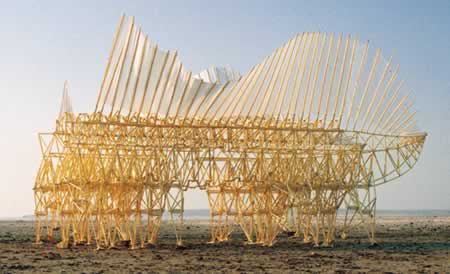
Theo Jansen's Strandbeests

One of the excellent presentation's at SolidWorks World 2008 was the keynote by Theo Jansen, maker of strange tube sculpture creatures that walk on the sand, powered by wind. The man is brilliantly mad, and his obsession and philosophy are very interesting to see -- apparently for much of the geek world, given his press coverage in recent years (see Wikipedia links).

Worth the videos at TED 2007, and the explanation here on YouTube from ArtFutura for how they walk can be viewed in this Physics Engine demo of a model of one walking over obstacles.

Friday, December 07, 2007

Food for Brains

It's been a tough week - minor road accidents in snow, encounters with consultants that earn $2500 for a few hours of phone time [I don't earn this!] - so here's venty post on something that bugs me: People with bad memories. I don't mean bad in the sense of "I lost my keys again," more in the sense of "Weren't you going to schedule that meeting?" No, you were, you said you would! Why do I suddenly feel so defensive, when I did nothing wrong??

Any number of excellent books have been written about project management and scheduling, but few of them confront this phenomenon head on, and I've now seen it at a bunch of companies. Someone important, or even just useful, can cause a lot of damage by having a bad memory. If they're a manager, it might become their employee's second job to stockpile email in case they need to "prove" who's mistaken at review time. If it's a peer, they don't pull their share of the work because they conveniently forgot to do most of it and someone else has to, or some schedule slips. This might be passive aggressive (if they're not a psychopath or an asshole), but since it's the holidays, let's consider that it might be a medical problem. Maybe they're eating badly?

A few suggestions for coping: Start ordering in veggie platters. Take them out for sushi whether they like it or not. Leave them Secret Santa Ginkgo Biloba supplements by their monitor. And finally here's a list of some nice articles from Psychology Today on food for your brain, which I rather enjoyed:

Happy holidays, and eat better! [Edited to add: Consider hiring a chimp instead if your team mate or manager can't remember things after eating better.]

Sunday, November 04, 2007

Fast Company: ebay, and Business in Siberia

I caught up on the latest print version of Fast Company on a flight, and I have to admit I'm loving it via print. I read almost ever word, while on the site I just browse occasionally. And now I can point to fun stuff, since the mag is all online.

First, some slightly irksome "news": ebay is trying to revamp itself in the face of flattening numbers. Like a lot of business press, this makes a hero-to-be out of a new exec hire, Matt Carey, CTO. He learns in paragraph one during a focus group that the site is hard to use. He determines to "make the buying process efficient and fun again."

Having heard the industry gossip for years about the company -- mostly from designers who've left in droves -- the people who knew it was hard to use and knew it needed usability and design work weren't listened to when it might have prevented flattening numbers in the first place. Too risky to change what was seen as successful! Till the big picture numbers start to look scary, and the competition spreads, I guess. That's when it might already be too late. A reminder that design and usability are strategic competencies not handled well by most executive boards at most companies.

On to more fun: Nightmare in Boomtown, a story you could not make up. With all the twisted personalities at work, it would make a good movie. It's the saga of a fallen rabbi gone to Kazakhstan to do business, and getting eaten alive by the corrupt system and an angry gangster rival who wanted a $5 million dollar discount he didn't get. It probably cost a few hundred thousand, but the ex-rabbi gets locked up in a Siberian jail for a year and virtually abandonned by any officials who should care.

In October 2006, after 11 months in Siberia, Seidenfeld was loaded aboard a prison train to be extradited from Russia to Kazakhstan. For 32 days, he was stuffed into a 3½-foot-by-7-foot cell in a boxcar with one toilet for 60 convicts. His fiancĂ©e, Natiya, doggedly followed the train on its 3,000-mile journey, intercepting it as it stopped at detention centers. Word of the presence of a wealthy Western businessman had traveled fast among the prisoners, and Seidenfeld learned early on the importance of isolating himself as much as possible. Natiya secured lawyers wherever the train stopped, bribed officials, and did whatever she could to make sure Seidenfeld traveled in his own cell. He kept his head down while shuffling to and from different prison stops to avoid the batons of the more-sadistic guards. "If I had been kept with the rest of the population, I might not be around today," he says.
Really a fascinating read....

Saturday, October 20, 2007

October Roundup: Owls, UFOs, Ghosts

I've been busy on non-work related activities, for once!

Owls: Saw-whet migration is upon us. The local birders with Mass Audubon were caught off-guard by how many of the little owls are on the move south from Canada this year. Record numbers on some nights, and earlier than usual. These are tiny, adorable owls, who seem to like people and hang out for a bit. They even like being petted, which makes them a great ambassador for birdkind.

I put up a gallery of their extreme cuteness: Saw Whet Owl Banding in MA. I will be posting some video later. But for now, I require you to be amazed (this is not a baby bird):

Here's another set of photos (with a better macro lens) featuring yours truly holding one of these cutie pies.

And just to be slightly scientific, the site with the most data on the migration patterns and how to track these guys lives at Project Owlnet.

UFOs:

Last weekend I also went to a local UFO conference, hosted by Mass Mufon. There were two very interesting talks, one on crop circles and the other on the Shag Harbor Incident in Nova Scotia.

The crop circle presentation started quite strong, with a lot of data and images that can also be found on the website at BLT Research. My data analysis interest was piqued but then dismayed by claims of correlations as "proof." The speaker got less scientific and more, well, peculiar towards the end when she announced a bunch of other phenomena including the ghost of her dead brother caught on film at recent circles. I don't quite understand why the folks interested in paranormal end up mixing it all together so readily; one phenomenon probably has nothing to do with another!

The Shag Harbor UFO Crash Incident from 1967 was entertainingly recounted by Chris Styles, a good storyteller who had collected a lot of documents from the Canadian government (who are much happier to send things out on request than the US government). The most interesting sidebar was that a character named Maurice "Mace" Coffey was working as a parapsychologist investigating mysterious phenomena in the Canadian Air Force at the time of the "crash." He was the Fox Mulder of Canada. He's also editor of a collection of Maritime poetry and was later an important figure in the Northwest Territories (once helping find a downed plane, in which the survivor had lived only by cannibalism). I personally wanted to hear more about Mace, and maybe less about the RCMP.

Ghosts: I've received a few more stories about Windhouse, the haunted house in Scotland that I keep track of here. The essay is updated at the bottom with more photos from contributor Phil Mortimer (scary Photoshop work as shown below) and from another relative of a former inhabitant, Kate Bainbridge.

Phil Mortimer pics of Windhouse

Sunday, October 07, 2007

Search Engine Poetry Generator

I've always liked random poetry generators (I could dig up some of my favorites, but I'll save it for another day) -- so I wrote one based on an idea I saw on someone else's blog. (I admit their idea is more interesting, but I had a simple goal to start with: practice with SQL and PHP on my hosting server.)

My generator builds random "poetry" by stringing together keywords and keyphrases that hit my site from searches in the last month. (I'm afraid it's not a real-time feed from my logs, it's canned from the last month.)

Popular searches on my site: ghosts, Canada, and disorganized organizations. It makes for peculiar poetry, not good, but kind of fun. Victoria's Secret is definitely showing up more and more, too.

One of them:

alice in wonderland porn
   lost
  i need
  stone
  tivo patents

for me, illusion
   -- erin
Give it a try, or ten...

Sunday, September 30, 2007

Visual Personality Tests

Random personality tests of recent discovery: tests that rely only on visuals. Or, kind of.

This first one is "psychogeometrics." Go here and pick the shape you are most drawn to. If you want to really test the test, before you click on it to read about yourself (!), take a short questionnaire (not visual) here and see if the shape it picks for you matches what you chose by look alone. (Mine: "You appear to be a complex personality. Or perhaps you didn't take the questions seriously.")

Then, for a really visual one, take the Dewey color test. This one is entirely based on response to colors, and comes with an interesting color chart for the month, kind of like biorhythms in flavor but all in hues.

I found out about the latter because another former colleague of mine dropped out of interface design management to become a color and interior design consultant, and she uses the Dewey system. She says she got sick of fighting for good software. That makes 4 colleagues (2 junior, 2 exec level) who have quit the UI design fight in mid-career. Who's next? Are other software professions like this?

Tuesday, September 04, 2007

Pavel's Puzzles

Thank goodness, just when I was dreading starting my post about strategy and tactics, Pavel Curtis gave me a good excuse to avoid it: he's launched an online puzzle shop! Since I'm currently reading the slightly evil yet fascinating The 4 Hour Workweek: Escape 9-5, Live Anywhere, and Join the New Rich which describes many such businesses, I'll be fascinated to watch his progress. (Updated to add: Here's his announcement post about it, on his regular blog.)

Pavel is not only a Lisp hacker with mathematical talents, ex-PARC denizen, and founder of famous online community LambdaMOO, he's a gentleman who co-hosts an annual games party on New Year's that attracts an interesting crowd. I went once attached to one of his invitees, and it was more fun than I would have expected, being your typical uncompetitive, non-gamer who freezes under public performance pressure. His and other puzzles dotted the house, I recall. That was back in the hills of Palo Alto, before the more recent Seattle move! We are all getting old and moving too often.

If you like puzzles with interesting stories, go help Pavel retire from the Evil Seattle Empire and become the new rich!

Sunday, April 22, 2007

Fractal Art

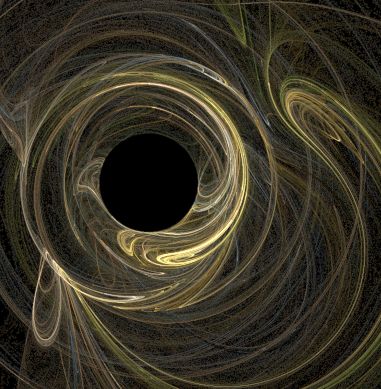
I've been playing with 2 fractal-generating applications recently, and recommend them for different reasons. If you'd like to quickly generate random beautiful 2d images, of often breath-taking beauty, use Apophysis.

If you like to play with dials and sliders and 3d imagery, and generally do a bit more work yourself, I recommend Chaoscope, a "3d strange attractors" rendering package.

Samples from both:

Tuesday, March 06, 2007

Pretty Visual Generators

I've been looking at online generators for the last few days (a recurrent interest) and was reminded of these pretty visual ones. Worth checking out.

Jared Tarbell's beautiful I'Ching interactive display. Hard to describe, and a little mysterious in practice, as it should be.

The Walking Insect Generator, which is also beautiful, but funnier. Seriously, do click and marvel.

A scribbler art project -- this one is fun to watch, like a lot of these visual noise generators. It tends to fuzz up your drawing.

Saturday, February 10, 2007

Owls in Massachusetts

Last weekend was an "owl festival" at my local Audubon nature preserve. First was a great presentation on snowy owls at Logan Airport (not given there, about owls who hang out there) by Norm Smith of the Blue Hills Audubon nature preserve. Yes, there are snowy owls all over Logan's landing strips. No, this is not good for the airplanes. Yes, they are hard to spot if you're flying out from there, as I discovered a day later-- white could mean snow, trash, or owl.

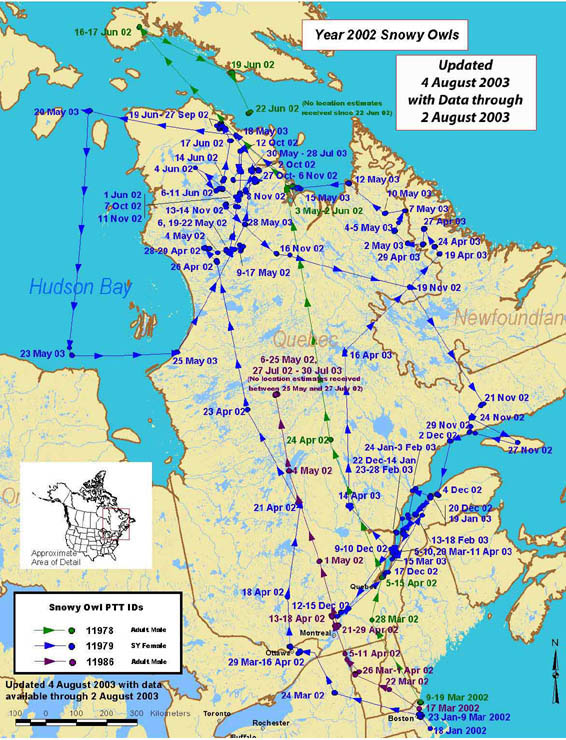
Norm has some great pictures of them, and points out how little we understand them -- they don't seem to be migratory in the usual sense, and might even be circumpolar. They are able to filter out the sounds of the jets to tune in on squeaking rats. They all look a bit different, and have different personalities, too.

Some articles and links worth looking at on this work:

This is a map of where some of the owls he attached transmitters to ended up in Canada -- mostly up towards Hudson Bay. Some have been tracked to Siberia, though. (Hey, I've been there. I saw no owls, however.)

The day after Norm's terrific talk and slides, a guy brought in some birds living in captivity because they've been hurt or grown up with people and now identify too much with people to hunt properly. These were beautiful birds. Below you'll see this fellow with a screech owl, incredibly cute, and a wonderful great horned owl. None of my pictures turned out very well due to the interior lighting, but you get the idea.

After the demo of the birds, we went on an "owl prowl" walk in what was probably 14F degrees at best. In the gathering dark, I add, because at the point where I'd had enough of the cold, I didn't think I could see my way back to the lodge. We crunched all over the grounds of Broadmoor making dumb owl calls, and hearing not a peep back except for the bored kids shifting around while we listened and whining a little and sometimes pretending to be owls themselves which didn't really help us. It was so cold even the CD player with some real owls on it wouldn't perform properly. An owl bust, all around. Now that I know what screech owls and saw whets sound like, I can confirm I have never heard them where I live beside the reservoir. Too bad! They are really cute.

Wednesday, January 24, 2007

Democratizing Data Insight

It's an exciting world right now... i-Stuff and the spread of "design" as a buzzword aside, I'm thrilled by the spread of data and graphs into the public world. A few recent pointers on the theme of public data exploration:
  • Gapminder.org's Hans Rosling presented to TED a year ago, with the beautiful animated charts that his site made famous. His final comments say, in paraphrase, "Publically funded data is public, but hard to get at, hard to search, and presented in boring ways. We can and should change this." One of his great takeaways, for me, from his data illustrations of "third world" healthcare is that the error in the data is no doubt much less than the truth in it, at the magnitudes he illustrates.
  • Swivel is a new site for data upload and exploration, with a fun blog. They also allow community discussion around their charts. I like their enthusiasm and enjoy the blog a lot.
  • Friends from IBM (Martin Wattenberg and his group) have just announced a similar concept to Swivel's, but with even more graph types and they're all nicely interactive. Upload data, create a picture, and post it... other people can play with your data and present their own insight pictures, or modify yours. And comment on them. It's Many Eyes, and it even has a nice website!
  • Google claims to be making real time stock quotes available, which means live data plotting is possible. Found on swivel's blog, a post on Googleblog: Real Time Quotes for Free.
  • And don't forget processing.org. There's a nice visualization of State of the Union speeches highlighted there, including word frequencies and grade levels of the speech. (It's by Brad Borevitz.) They've been averaging around 9th or 10th grade level, but notice the great spike of Jimmy Carter's at grade 15.

Friday, January 19, 2007

Annual Site Stats and Changes

I don't have time to do real stats on my server logs, but I offer the annual impressionistic ones, at least, as well as some updates on the site.

Search phrases that strike me as funny, that show up every single week (usually with multiple counts):

  • girls on boats
  • alcohol induced blackouts
  • temporary wallpaper
  • real ghost photos/ghost photos/real life ghosts (etc)

Posts or pages with high hit counts, regularly:

  • The crop-circle google-montage (I should put a Google ad or two here, it's ludicrous; and no one ever comments, but it's hit 68 times or more per week.)
  • The weird red tree in Shropshire that almost made me drive off the road. It has 67 comments, which I should really trim/clean/purge most of. Also, add a Google ad.
  • An incredibly short post on Bara Hack, haunted village in CT. With a lot of chimers-in on the illegality of going there, or not.
  • My travel essays, especially the Siberia one. They're low on the page, but very popular, and the Windhouse and Fair Isle one are catching up in hits.
  • The bio/resume page is visited at least 20 times a week. I've added some info to it recently.
Visitors in sizable numbers are coming from images searching (no surprise there), a few companies where I think I know the folks :-), and increasingly from Stumbleupon, which is nice.

I spruced up the blog template a tiny bit, since Blogger has added tagging ability. Now you can click on a link to items in categories I post on regularly: design, tech industry, management, archaeology, funny stuff, weird stuff, information visualization and data analysis, etc. It took hours and hours to do a cursory tag job on my 504 posts of the last few years, so if you notice a mislabel, let me know. The tags list is on the right side under the index of recent posts.

Saturday, January 06, 2007

Puzzles and Mysteries

Malcolm Gladwell wrote a great piece in the New Yorker: OPEN SECRETS: Enron, intelligence, and the perils of too much information. It's being blogged all over, but since I'm still thinking about it 12 hours after reading, I'm posting too.

He distinguishes between puzzles and mysteries, and the role of data in both.

The national-security expert Gregory Treverton has famously made a distinction between puzzles and mysteries. Osama bin Laden’s whereabouts are a puzzle. We can’t find him because we don’t have enough information. The key to the puzzle will probably come from someone close to bin Laden, and until we can find that source bin Laden will remain at large.

The problem of what would happen in Iraq after the toppling of Saddam Hussein was, by contrast, a mystery. It wasn’t a question that had a simple, factual answer. Mysteries require judgments and the assessment of uncertainty, and the hard part is not that we have too little information but that we have too much. The C.I.A. had a position on what a post-invasion Iraq would look like, and so did the Pentagon and the State Department and Colin Powell and Dick Cheney and any number of political scientists and journalists and think-tank fellows. For that matter, so did every cabdriver in Baghdad.

Adding data to a mystery doesn't make it less of a mystery, but smart analysts can bring experience to bear that will point towards possible answers that are more or less likely to be true.

The Enron disaster qualifies as a mystery, and Gladwell's summary of the confused and complex financial details is disquieting. Even financial experts couldn't make heads or tails out of what was going on with the money. I'm unsettled by how easily corporate environments breed mysteries requiring complex analysis both of their internal and external behavior; and how hard it can be to understand and correct corporate mismanagement. People lose their livelihoods all the time now-- how many other Enrons are actually happening with no one noticing?

As a side note, as I read the recap of the Woodward and Bernstein investigation I actually thought, "This is surely going on all the time now. Would anyone be shocked at this in this political era?"

Saturday, May 13, 2006

PersonalDNA

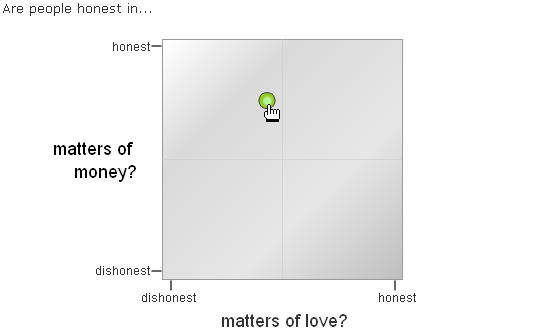
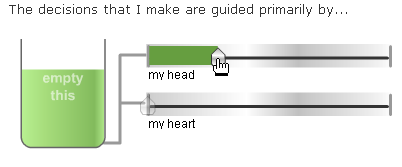
There are personality quizzes all over the net, spread as memes via sites like LiveJournal where memes have a long life. PersonalDNA is a next-generation personality quiz, with high quality widgetry that the respondent has to manipulate to set their answers. While fun to take, I am not so sure that all that gadgetry entirely supports the problem at hand and it probably detracts a bit. I found it hard to figure out where in a quadrant of 4 my "dot" should live in a case like this.

On the other hand, it's very fun to take, and you get the results in nice couple of visuals suitable for posting in a blog with the URL; and you can ask other people to rate your own personality and compare the results. It has all the makings of a successful meme, and for once it looks like some serious visual design and engineering went into the site. I wouldn't be surprised if someone like this finally figures out how to make some money off this stuff; there's millions here waiting to be had, given the massive popularity of these quizzes in social sites.

Incidentally: I came out as a "Benevolent Inventor."

PersonalDNA | Your True Self Revealed - Fast Fun Free Personality Tests.

Saturday, April 15, 2006

April is Poetry Month

Endicott Studio is celebrating Poetry Month nicely with a new illustrated poem every day. If you like fairy tales and poetry, this is the place for you. Featuring writers like Delia Sherman, Ellen Kushner, Holly Black, Jane Yolen...

plusminus design: flashbag

This is one of those brilliant and simple ideas, that also happens to be funny. A USB device that "fills up" visibly until it's ready to explode, at which point the drive is full: plusminus design: flashbag. (Off Information Aesthetics, where else?)

Thursday, February 02, 2006

The Snapshirts Blog Tag Cloud Meme

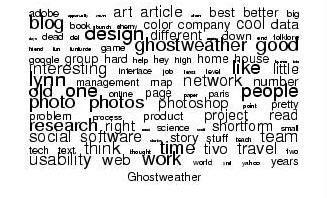
I don't know if 3 people count as meme-spreaders, but I got the Snapshirt blog cloud link off Jeff Mather who got it off someone else. I also wouldn't order the T-Shirt, but I like the cloud of terms it got off my site, so here it is.

One of the disadvantages of using blogger is that you can't tag entries, and therefore it's all one big soupy list that no one can find anything in (including me). I found another site somewhere that was offering a tag-cloud generation service for blogs, but when I tried it, it basically hung trying to do mine. Anyone have any further suggestions for how to do this easily in a useful (interactive) format for my own site? Drop me a note if so; I may hate flickr, but I like tags a fair bit.

Sunday, January 29, 2006

Illusion of Explanatory Depth

Fantastic post here: Mixing Memory: The Intellectual Teeth of the Mind. Chris is writing about the Illusion of Explanatory Depth, a cognitive science observation that people often think they know how things work when in fact they don't know.

The old-time reader who knows me will automatically connect this to one of my favorite findings of recent years, that I seem to repost every six months: Incompetent People Really Have No Clue that they're incompetent (that was the popular press reportage, here's the scientific article).

Back to Explanatory Depth:

The idea behind the illusion of explanatory depth (and it may be a dangerous one) is simply that there are many cases in which we think we know what's going on, but we don't. There are many great examples in cognitive psychology (e.g., psychological essentialism, in which we believe that our concepts have definitions, but when pressed, learn that either they do not have definitions, or we don't have conscious access to those definitions), but you don't have to look to scientific research to find them. If you ask 100 people on the street if they know how a toilet's flushing mechanism works, many, if not most will tell you "Of course I do!" But if you then ask them to explain it, you will quickly find that they really have no idea how a toilet's flushing mechanism works. This is the illusion of explanatory depth. They know that when they push down on the flusher, the water leaves the bowl, and then fills back up, but they don't know how this happens, they only think they do.

In experiments, it was shown that participants' ratings of their own knowledge of a subject decreased over time, upon being asked to explain device functioning and having problems doing so, and upon receiving explanations that clarified their issues. They realized what they didn't know, by being forced to explore it and being "corrected," essentially.

Chris recaps 3 factors that influence the phenomenon:

  • Confusing environmental support with representation: People may rely on visible parts to build their (shallow) theories about how things work. For me this relates -- very tangentially-- to the notion of "affordances" in UI theory, where roughly speaking analogies to physical world behavior are sometimes leveragable for indicating functionality of controls. I have to think about the implications a bit more.
  • Levels of analysis confusion: Multiple causation means you can stop at any level you want, and usually stop early. For me this raises the question of when a level is sufficient, and whether it always matters to go further? In UI design, we want to work with and understand existing mental models of application behavior, but also educate our users with feedback in the UI about necessary differences between their "naive" expectations and how things really work. We don't need to explain object models and for-loops in our code (hopefully) but we sometimes need to indicate relationships that aren't obvious to our users from their current world knowledge.
  • Indeterminate end state: People have a hard time knowing when they know enough, partly because of the above point. Stories about how things work help clarify this, because of their determinate beginnings and endings -- assuming they're well-structured and not ultra-postmodern and intended to confuse! (This reminds me, again tangentially, of Harvey Sacks' proto-story told by a small child: "The baby cried. The mommy picked it up." Causation is represented, there's a problem and a solution, a beginning and an end. But it's also a story of the most simple analytic level possible!)

Chris says: To sum up, then, the [Illusion of Explanatory Depth] exists for explanations that involve multiple relations between parts, particularly causal relations, but not for more surface knowledge (e.g., facts, stories, and simple procedures), and it shows up fairly early in childhood. The concern it raises for doing science is that increasing specialization -- depth in branches of science -- means shallower understanding on the part of practioners of mechanisms outside their immediate field.

Now see the article noting that geniuses built their work on the work of other geniuses. Although not all examples are cross-disciplinary, it's clear that cross-disciplinary work is a huge opportunity and an increasing challenge.