Showing posts with label research. Show all posts

Sunday, October 28, 2018

Still in France, But On the Market Again!

After 2 years teaching at the business school, my classes had become very popular: hence, huge, and therefore tremendous work to grade and manage.  I left that position in October and have been consulting again since.  I'm still based in Lyon, but am entertaining offers of other locations and remote work!  I'm currently doing NLP data science consulting for a nice client based in London (SpiritAI).

Teaching

The past couple of years have been very busy: I created from scratch and taught a lot of classes, including:
  • a 3-week Python Bootcamp
  • a very popular Business Analyst Tools class (teaching Excel data analysis, SQL, and Tableau)
  • a couple variants of courses on Python data analysis with Pandas and NLP tools
  • a Python Flask-based web database programming short course
  • and a non-coding Introduction to Artificial Intelligence for business students.

The Introduction to AI was a non-programming course, in which I tried to round up or make videos, demos, and readings that would be accessible to a non-technical business student audience.  The need for materials that explain this technology in a non-pandering, but still accessible, format to a wide audience is huge. I have a blog post about that course permanently in draft format; the worst thing about that class is the materials have become almost immediately outdated in a year.  At least, the examples of state-of-the-art, demos, and business applications parts.

The possibility of making demos and showing off the capabilities of AI in the browser, thanks to TensorFlow.js and ml5.js, have changed the landscape for teaching this subject with gentle intro tools.  If you're willing to do the hacking work, of course, which I was/am!  Time allowing when grading and answering student emails about missing the quiz deadline.

OpenVis Conf 2018, in Paris!

While I was with the school, I also organized and co-chaired (with Arvind Satyanarayan) the program for OpenVis Conf in Europe for the first time!  It was more work than expected, due to the logistics of being out of Boston and in a foreign business climate, but the conference was largely deemed a success.  The videos are up on our web site.

We are thinking of taking a year off to re-group for the future of the conference, because I've left my academic job, Arvind just started teaching at MIT, and Irene Ros (founder of the conference) is also in a new job.

Writing About (Fun) Tech

In the past year, I wrote a number of articles either recapping conference talks I gave or hawking for OpenVis.  I used Medium rather than this blog, as you may have noticed.  My articles are here:

  • My AI-Art Talk for Resonate: A quick overview of some code-art-generator projects I wrote for a conference I never went to, using visuals and text to make a kind of visual poetry.

I also have an occasionally-ongoing series of posts and a newsletter about "Things I Think Are Awesome," which are online projects (usually) that are creative, interesting, make me smile, and distract me from politics right now.  You can find the Medium posts on my page and the tinyletter signup here.  I keep trying to cheer up enough to write another one, but it's been a tough year in politics and work.

Research Code Work & Talks

Some of my project work alone or with colleagues at the business school included:

  • Scraping french job ads to analyze the skills requested in the text (we stored in Mongo and then indexed in ElasticSearch for a web search interface).
  • Collecting Instagram and Twitter posts on various "brand" topics to analyze the images posted with them: I used both Google and Amazon image recognition APIs to compare and test them, and also had students help label subsets to test retraining a tensorflow model (it did quite well on some types)
  • Collecting Tweets on various topics for NLP analysis for messages about "brands" (I also gave these to students to analyze for my NLP course)
I was also the co-founder and head of development for a Data R&D Institute at the business school, with a significant pedagogical and outreach focus; but this Institute was shut down after one year when they launched a new AI Institute focused on business and social science research in AI.

My talk slides that don't get turned into blog posts usually live here.  I gave a number of invited talks in the past couple of years.  My updated resume lists some of them.  I'll be fixing up the web site gradually too!

Travels

One of the main reasons I wanted to be in Europe for a few years was for weekend travels.  I post my pics on Instagram.


Now I'm off to other things...!  I still have French residence for a few years, but may move due to taxes and relatively low tech salaries in France. We'll see what the future holds.


Sunday, August 08, 2010

Fan Video Editing Community and Copyright

In April, I gave a talk at UIUC's HCI department on fan video remix artists, or "vidders," as they are known within the fan media community. To build the talk, I drew on several years of LiveJournal network data, and a large 2-part survey I did in the spring of 2010 to document current attitudes, trends, and self-reported demographics of the community. Afterwards, I made my slides available in an annotated deck for the vidders themselves, as I had promised I would -- there were some interesting comments, including disagreement with certain aspects of the technical commentary (whether meta-data is really useful and available for management of clip collections) and whether the quote I pulled about "political correctness" as a dampener on some fans' "fun" was fair and balanced as a critique of the recent years' vidding discussions on issues of race and gender in vids. I haven't updated the annotations or the deck -- I'm posting it as I posted it to them; if someone is interested in hearing more about the community discussion, I'm happy to reply in comments or email.

I'm posting about this now because of two great things happening for this group of video editing fans -- this weekend is the annual meeting of Vividcon, a fan-run con all about vidding and vids as art and fun. I'm following the tweets with great jealousy -- I never made it off the entry waitlist this year.

The second great thing of recent days is the passage of the new DMCA exemptions from copyright-infringement laws for vidders (and other video artists) using copyright materials for artistic purposes. Since Internet sharing began, fans have regularly had their videos removed from many media sharing sites by copyright police. Some still post on password-protected private servers, rather than making them public and findable by "The Powers That Be."

Francesca Coppa posted on the blog of the Organization of Transformative Works that the case for the copyright-law exemption had been made in part based on the artists' need for high quality original source material for their remix works.

That said (and it's true), it's ironic to me that my own history goes back to the pre-Internet-sharing days, when we borrowed n-th generation tapes and made fuzzy vids with stone knives and bear skins. Check out my slide deck (pdf) for more on this. My talk includes some network analysis, one slide of which shows the "age" effect for when a vidder started vidding, and whose work they admire -- the VCR-era folks (including myself) are now off to the edges on the right and top. Fortuitously, right after my talk, Mimi Ito's article on anime fan editors came out in First Monday. I had already exchanged mail with her about her anime research, and it influenced my second round of survey questions to the vidders. Anime editors differ enormously from the vidder community; one major difference is that fan vidders are mostly women, while anime is more mixed, tending towards more male, and anime editors seem to be younger or to have started earlier, from what Mimi found. In my network graphs and quotes from the community, I show some points of overlap between anime and fan vidders, points and nodes which have increased in the past few years as the two groups learn about each other online and at cons like Vividcon.

Anyway, here are my slides: "Vidding Evolution: Community Change Among Fan Video Editors" (2010).

Sunday, July 13, 2008

Cognitive Daily Roundup: Reputation, Gossip, Educating Children in Math

I've been subscribed to Cognitive Daily via the Kindle, and it's been a great feed on that device. [Secrets to a good Kindle feed: Full text that's well-written, not too many links because following links is slow via Whispernet, and regular updates. Ars Technica used to be a great Kindle read, until they changed their Kindle format to just a capsule intro plus link to "more." Me and a zillion others unsubbed and gave it a bad Amazon review for this. I hope it comes back as it was.]

The Kindle lets you save pages as Clippings, which makes blogging about stuff a bit easier. It's not as good as having del.icio.us, which I usually use to track things, but it's not bad.

So here's a few interesting recent Cog Sci research recaps.

How Do You Make a Reputation for Yourself? This study of business school students over time produces an unhappy conclusion. Actual cooperative behavior yields far less payoff in an impression on people than one's starting reputation and popularity. If someone starts out with a good reputation and popularity, then cooperative behavior pays off. Cog Sci Daily chart of popularity vs. cooperativeness

It turns out that your reputation for cooperativeness is only affected by your behavior if you're already popular. If you're not popular, it appears that no one takes notice of your behavior, so it has no impact on your reputation. People with lots of social connections can build a good reputation -- or a bad one -- with much more ease than people with few social connections.

This is not good news for the average workplace and the hope of objective performance evaluation. This study doesn't get at some of the root causes for reputation and popularity independent of behavior, so there's more work to be done here.

Related albeit indirectly, The Economic Value of Gossip, recapping a NY Times article, "Five Facts Prove No Match for Gossip, It Seems." People are more willing to believe others than their own eyes.

The donor was told that the source of the gossip didn't have any extra information beyond what the donor could already see for himself. Yet the gossip, whether positive or negative, still had a big influence on the donors' decisions, and it didn't even matter if the source of the gossip had a good reputation himself. On average, cooperation increased by about 20 percent if the gossip was good, and fell by 20 percent if the gossip was negative.

Now for something completely different. My brother just had a baby girl. As a woman in technology, I've spent a certain amount of time annoyed by my educational past and stereotypes about women in math and science. I'm tired of hearing about how girls aren't good at spatial and 3D tasks. (Especially since I've been working in the CAD industry for the past few years.) There's some interesting hope for new kids out there, now.

Video Games May Reduce Gender Gap in Spatial Ability, and spatial ability is key to many important math and science skills. Apparently after a few months playing Medal of Honor (but not after playing a non-combat game), both girls and boys improve in their spatial reasoning ability. The improvement lasts after game play stops, too.

Also, Children Learn and Retain Math Better Using Manipulables. Giving them blocks to count and do multiplication with helps them understand the reasoning, not just do memorization. But parents and schools need to invest in these kinds of toys.

Sunday, May 18, 2008

CHI 2008 Conf: Usability Considered Harmful

The premier human-computer interaction conference, aka CHI 2008 (pronounced "kai" not "chee") was in Florence, Italy this year. After missing last year's in Silicon Valley, I went despite the ruinous exchange rate. (Other local colleagues went to Italy for the conference, but blew it off to go skiing instead!) One of the more interesting and crowd-drawing sessions was the paper by Saul Greenberg and Bill Buxton, "Usability Evaluation Considered Harmful... Some of the Time." Following it was commentary by Bonnie John, Tom Rodden, Dan Olsen and the ever-sharp CHI attending audience. Here's Saul and Bill listening to the commentary: Buxton and Greenberg

An initial note: CHI as a conference has a huge percentage of academic and research attendees. How to make it "relevant" to the "practitioner" audience is a regular concern of the conference committee. Why research isn't necessarily relevant is one of the reasons for their paper, I think. (And for things I've spoken and written about in the past, too.)

The main argument was...

...We too often perceive … an unquestioning adoption of the doctrine of usability evaluation by interface researchers and practitioners. Usability evaluation is not a universal panacea. It does not guarantee user-centered design. It will not always validate a research interface. It does not always lead to a scientific outcome.
Their supporting arguments were these:
  • CHI reviewers require evaluation, and usually quantitative (lab study) testing results, as a part of a submitted paper (reflected in the submissions guidelines)
  • Quantitative usability studies are often the wrong type of study for certain kinds of design: such as inventions in prototype stage; other types of user study may be more correct for these.
  • In an argument familiar from Buxton's book Sketching User Experiences, a focus on usability evaluation too early in a development cycle produces poorer final results than will experimenting with more design concepts (or "sketches")
  • Early-stage technical innovations that are disruptive or paradigm changing may produce poor or ambiguous user testing results, which may prematurely kill them off as research topics -- when long-term these ideas might find audiences and produce large-scale social or practice change after adoption.

Greenberg and Buxton argue that CHI has too great a focus on scientific results (and poor ones at that), rather than on supporting good design and invention.

“Science has one methodology, art and design have another. Are we surprised that art and design are remarkable for their creativity and innovation? While we pride our rigorous stance, we also bemoan the lack of design and innovation. Could there be a correlation between methodology and results?”
Tom Rodden at CHI

Comments ran the gamut from polite disagreement about the counts of types of papers accepted at the conference, to observations that publication-treadmills don't allow time for disruptive risky innovation that can be studied longitudinally, especially for students in grad school. Saul asked the CHI audience to review papers differently -- after all, the audience there constitutes what gets in, and what's considered good work. What constitutes good work worthy of acceptance is in the hands of the reviewers in the room! Finally, it was noted that different, "riskier" work of a design or featuring ethnographic evaluation instead of user testing is regularly accepted at other conferences in the same ACM family: DIS, DUX, CSCW, even Ubicomp and UIST.

Most difficult, for me, is the idea that the CHI reviewing audience has the credibility and experience to review riskier design work that doesn't come along with (the right kind of) user study. With mostly academics and researchers on the reviewer list, I question whether this audience has the depth of practical design experience and credentials required to recognize and talk about "good design" with credibility. What do I require for credibility: having done a lot of real-world design, and having evaluated a lot of products from a customer-centric perspective. When I say "real world" I don't mean academic design - where it's notoriously easy to go wild and crazy. In the context of a business or large organization, the kinds of compromises that designers face are what separate the real good from the mediocre.

I would like to repeat that human computer interaction is not fully represented at CHI. The conference is just one forum. While it's true that CHI publication counts more than most others to researchers in this field, it doesn't necessarily represent the full range of activities and professional expertise in the broader field of interaction design.

Sunday, March 23, 2008

Netflix Contest and Recommender Systems (short history)

I'm fascinated by the Netflix challenge: Netflix is offering one million dollars for an algorithm to improve recommendations based on movie ratings. Along with this go intermediate "progress" prizes of $50,000 per year the contest runs. The prize leaderboard is interesting reading, in that you can see who is entering teams, their results, and sometimes a bit about the team. Team Bellkor is a group of researchers from AT&T Labs, my first employer out of grad school. (I don't know these particular folks.) Netflix provides an interesting example of one company "funding" research at another company. The research lab folks are getting papers out of it, of course, probably the most important thing they need to do in a research lab (money comes second; although these days, proof that their work can impact a real business domain may beat everything else).

In another AT&T Labs connection, the Netflix prize FAQ cites an excellent overview paper on evaluation of recommender systems (pdf), co-authored by a colleague of mine, Loren Terveen, from the HCI department I was in at Bell Labs. Loren worked closely with Will Hill, one of the Bellcore researchers who (co-temporaneous with Pattie Maes at MIT and Paul Resnick) kicked off the work on recommender and ratings systems that you now find implemented all over the Internet. Recommender systems as a broad theme include all user ratings on products or comment postings (such as Amazon book ratings, or ratings implemented in almost all forum software now); they're intended to help others find good quality content by aggregates of ratings from other users, not from editorial oversight which is costly and therefore scales poorly to large amounts of content. There are important tweaks you can apply to your system or your filtering mechanism, such as "ratings of people like me" versus ratings of everyone, of course. (Netflix has some version of predicted "ratings for YOU", specifically, which I haven't investigated in any detail.)

I recommend glancing through Loren et al.'s paper, for a refreshingly meta perspective on a piece of technology that now defines a lot of assumptions behind what is called "web 2.0." As a more personal note, I wander among mostly non-research types these days, and the hot topics du jour (like "social networking") tend to get dropped into web system design discussions all the time, with a kind of naive "of course we need it" mentality. I can only sigh at how old I feel sometimes. Critical evaluation and careful implementation do matter, even for all the stuff that made it out of research projects into profit-making companies and community-platform toolkits.

As another personal note, I'm generally pleased by the level of researchy savvy I detect in the Netflix prize FAQ. Hey, if you're hiring at a software company, consider investing in some serious research-minded folks for competitive advantage!

Monday, February 18, 2008

Colbert Bump for Books

I love this type of real world data analysis: Juice Analytics has done some data mining on book sales following author appearances on the Colbert Report, and finds that the more liberal folks get a bigger sales bump! Surprise!

Here is one of their graphs, normalized and aligned for when the authors so classified (by them) appeared and their change in sales figures inferred from Amazon rankings. They also cite an interesting academic study of whether used book sales cannibalize new book sales on Amazon, which finds they rarely do.

Thursday, February 07, 2008

Genetics and Environment: Are You Depressed?

A good, clear article on the role of genetic predisposition vs. upbringing and occurrence of depression lives at Psychology Today in The Identity Dance. Although there are genes that may suggest a higher chance of developing certain mental illnesses, including depression, your upbringing has a lot to do with how likely you are to succumb during trigger events.

The results were striking: 43 percent of subjects who had the short genes and who had experienced four or more tumultuous events became clinically depressed. By contrast, only 17 percent of the long-gene people who had endured four or more stressful events wound up depressed—no more than the rate of depression in the general population. People with the short gene who experienced no stressful events fared pretty well too—they also became depressed at the average rate. Clearly, it was the combination of hard knocks and short genes that more than doubled the risk of depression.

... Moffitt and Caspi have found a similar relationship between another gene and antisocial behavior. Abused and neglected children with a gene responsible for low levels of monoamine oxidase in the brain were nine times more likely to engage in violent or other antisocial behavior as adults than were people with the same gene who were not mistreated. Finnish scientists have since found similar effects on genes for novelty seeking—a trait associated with attention deficit hyperactivity disorder. Children who had the genes and who were also raised by strict, emotionally distant parents were much more likely to engage in risky behavior and make impulsive decisions as adults than children with the same genes who were raised in more tolerant and accepting environments.

The saddest part of the article is the alcoholic monkey, though.

Tuesday, September 18, 2007

Stats on Remote Viewing Tests

There are lots of bogus stats studies on parapsychology tests, but this looks more promising: UC Davis statistician analyzes validity of paranormal predictions. Pity it's in something called "The California Aggie."
In 1995, Utts was hired by the American Institutes of Research, an independent research firm, along with psychologist Ray Hyman from the University of Oregon to analyze data from a 20-year research program sponsored by the U.S. government to investigate paranormal activity.

After doing initial research, Hyman and Utts found statistical support, she said.

"The two of us did this review and we both concluded that there were really strong statistical results there, but [Hyman] still didn't believe that it could be explained by something psychic - he thought there would be some explanation [that he] can't provide," Utts said.

The research program involved remote viewing, in which test subjects were asked to describe or draw an unknown target. The target could be anything and could be located anywhere. According to Utts' meta-analysis of the 966 studies performed at Stanford Research Institute, subjects could identify the target correctly 34 percent of the time. The probability of these results occurring by chance is .000000000043.

In contrast, statistical support for the effect of aspirin on heart attacks: "The results demonstrated that aspirin reduced the number of heart attacks in people likely to have heart disease by 25 percent, with a probability of it occurring by chance equaling .0003."

Hyman's concern is valid, of course; the stats don't tell us causation, just that there's a pattern in the data that's unlikely to be due to chance. All sorts of biases could have been introduced during the experiments to produce the results.

But it's still provocative!

Saturday, August 11, 2007

Victoria's Secret Market Research? Or not.

From my huge backlog of things to post, today I choose Victoria's Secret's online survey -- because I'll be tickled by the effect on my web logs.

Yes, in the past I have bought from VS, and do still buy their bras from time to time, despite the price tag. So I got sent an online survey. I always take these market research surveys for professional reasons, since I write them myself for clients from time to time. This one was, well, just strange.

It's hard to judge it as bad or good without knowing what branching logic they have built in. Branching means: If a respondent picks option (a), show them a different followup set of questions than if they had picked option (b). So I may not have seen the whole thing, and may have ended up in a strange cul-de-sac for people who buy bras because they're sexy. I hope not.

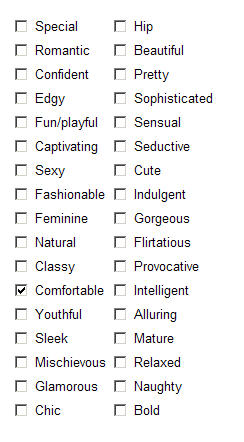
When I got to this checklist of "how does your bra makes you feel" (or somesuch), I was genuinely surprised. There are no negatives in here, and the word "supported" doesn't appear. I wonder what they can learn from this, apart from what they want to hear? The only way to avoid their positive bias is to check nothing, which I suspect will be tough for that helpfully-minded customer set that like to fill out surveys.

Previous to this question, they asked about other retailers you buy from. Now, if they had the usual sort of market research plan, I would expect to see an attempt at a basic SWOT analysis on the results: analysis of their strengths, weaknesses, opportunities, and threats.

How do you do that? Well, the logic is roughly this:

  1. Ask:Where do you buy your bras?
  2. Ask:What's important to you about your bra?
  3. Ask:What's your feeling about the bra you bought?
  4. Data analysis: For people who bought from us in (1), what's the difference between (2) and (3). If there's a big gap, that's our opportunity, going forward. (And roughly, strengths and weaknesses, when you compare against people who bought from Sears and Macy's and Frederick's of Hollywood on the same dimensions.)
If they're going after pure brand image and evaluation of their own success at achieving it, I think they still screwed up. Or at least they lost a serious opportunity in their data collection. They know where I shop (or where I said I shop, where I remembered I shopped), and they didn't have any adjectives that don't seem to be their personal target brand image in the list.

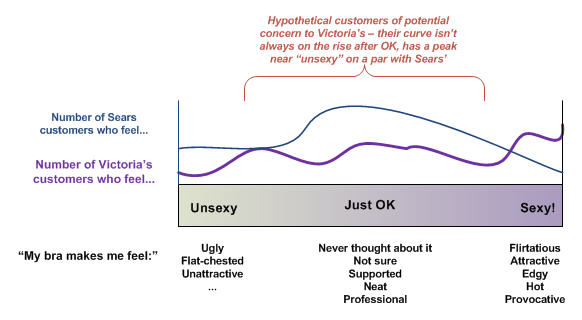
With the right vocabulary choices, including negatives and neutrals, they could have done some interesting segmentation based on where their own customers fall in "feeling" versus the other retailers' customers. Something like this:

They can always conclude from their data that some of their customers aren't that interesting to them from a marketing perspective (e.g., the people who shop at Sears, like their stuff a lot, and only occasionally go into a VS store -- because they'll be hard to capture if they're not dissatisfied enough with Sears).

In any case, some other common mistakes I see in market research via survey:

  • You try to collect too much in one survey, and can't do the analysis (plus you irritate the people who filled it out). You can always get more data later in other forms.
  • You don't know what you're trying to get out of it, so you can't construct the instrument well to get anything at all.
  • You set it up to learn what you want to hear (which is what I think was going on with VS -- I won't even tell you about the underwear questions), so you learn nothing and waste time, money, and your customers' patience.
  • You collect the data, then don't know what to do with it. You either don't do much, because of lack of skills in data analysis (clustering, mining, etc), or worse, you do nothing. You have it, but didn't take advantage of it. (This makes me quite uptight when I run into it. Good data is gold. My consulting tagline is "data-driven" for a reason.)
  • You solicit data from the wrong people, but don't even know it, because your survey didn't check on their credentials for answering and providing input. So you can't toss out any of the responses to clean the rest of the data.
End data rant of the week... I think I'm going to Sears now.

Sunday, March 04, 2007

Test Your Psychic Powers

Participate in an online study of psychic powers run at Psi Experiments. Their first experiment is up, and all you have to do is guess (or divine) which cup the ring is hidden under. No, it's not a street hustle. You can sign up for the results, too.

Experiment One: "In Which Box is the Ring?"

Sunday, February 25, 2007

Social Networks of Video Editors on LiveJournal

A few months ago, I did a talk at IBM Research in Cambridge on video (or "vid") editors and their online and offline communities. I made a few social network images, which I thought would be interesting to folks here, and I know I have readers on LiveJournal.

The basic gist of the talk was that hobbiest television fan music video editors existed long before YouTube and their history and organization reflect how they use the internet now -- which is verifiable with some simple data analysis. (NB: I used to be one myself, and in the talk I used a lot of personal examples and anonymized the rest, to protect privacy of anyone who wasn't contacted about this talk. So I'll say "we" here although I'm not practicing myself these days.)

In a quick sum of my talk: We used to do music video editing with VCRs. We existed before the internet was our main way of communicating, and we used fanzines and APAs to exchange tips and tricks (but truthfully, this was borderline before my time, although the friends who taught me all did this). We had and still have conventions at which we showed off our work, to supplement the now popular online posting mechanisms of distribution. (YouTube is not a major site for fan video editors, but another current social network tool that supports video has just become very popular among my friends who use LiveJournal for their conversations.)

Knowing the history makes for interesting cruising of the video communities on LiveJournal. The anime video makers turn out to be, for the most part, a distinct group. This isn't too surprising when you read the "about" text on one of the video community pages (slightly disguised here):

Anime "vidders" are told they may not be as comfortable here, and that VCR vidders are welcome.

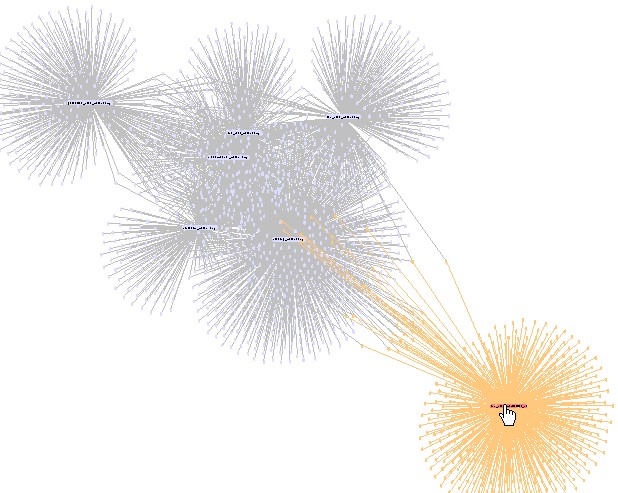
This image shows the network of members in the anime community (highlighted) which is somewhat separate from the group (and its affiliates) quoted above:

One of the communities that is closely related to this one is one in which an annual face-to-face convention is discussed, started and fed by some of the older VCR editors and now pretty much populated by the non-linear digital folks, of which former VCR people are now a part. The convention-discussion community members, highlighted below in orange, are closely interconnected to the community quoted from above, which is circled in red here:

The group circled in blue is a Battlestar Galactica video group, less closely related but more so than the anime group. The closely inter-connected groups in these images are the generic discussion groups, at which the craft and technique and technical discussions occur. More specific discussion groups are generally less connected.

I made these images with prefuse, and apologies for the quality of the uploads. I'm available to talk about this stuff anytime :-)

Saturday, February 03, 2007

New Moon and the Stock Market

I've been quite busy recently, and am getting a backlog of post material. Here's on oldie I never got around to blogging, which is weird and short: there is evidence that the lunar phase affects stock market performance.
We find strong lunar cycle effects in stock returns. Specifically, returns in the 15 days around new moon dates are about double the returns in the 15 days around full moon dates. This pattern of returns is pervasive; we find it for all major U.S. stock indexes over the last 100 years and for nearly all major stock indexes of 24 other countries over the last 30 years. In contrast, we find no reliable or economically important evidence of lunar cycle effects in return volatility and volume of trading. Taken as a whole, this evidence is consistent with popular beliefs that lunar cycles affect human behavior.
You can see the abstract and download the paper here: Lunar Cycle Effects in Stock Returns, on the Social Science Research Network.

Saturday, January 27, 2007

MultiTouch Display

I guess it's a Tipping Point phenomenon, but I wonder who the cool kids are, everytime this happens. The iPhone demo features a multitouch display, and Jeff Han's demo of this functionality on YouTube has been getting a lot of blognoise; but this idea has been around in the research community for a while. What makes something finally get out of R&D "interesting idea" and into "must have innovation wow" in a product seen as widely as the iPhone? It was even around at Apple, and ignored for years. What does it take to get visibility and get on a product development and business radar? Some links:
  • The Jeff Han video that's been circulated a lot (ok, points for music, for high density of info and fast cutting to demo points -- is this what makes it spreadable?)
  • The Tog column that discusses some of the design history that went into the iPhone (many many ideas over many years, including random access voicemail -- we discussed and prototyped this at AT&T and at Excite 10 years ago too), some of it (but not most of it) at Apple itself.
  • Bill Buxton's article referenced by Tog on multitouch displays. I know some of the people he's referencing, and I feel their mystification too.
I guess this is one of the reasons I stay as plugged in as I can to what's happening in R&D--the best of that work will eventually make it into products, and I'd like to lessen that time by figuring out the tipping point for it.

Thursday, December 28, 2006

Demotivation and Burnout

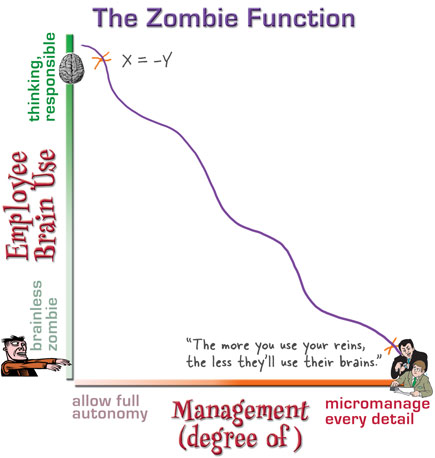
Picture from Creating Passionate Users

Today's post is brought to you by a five day vacation, during which I've been catching up on some reading and not working long hours! I've found a couple interesting pieces recently on the subject of why people burn out, which suggests it's not the overtime in itself.

The first article was on Blogher, It's Not Just You. A recent Wharton School study looked at reasons for worker burnout. (It's unfortunately not yet available free online.)

"One of the biggest complaints employees have is they are not sufficiently recognized by their organizations for the work that they do. Respect is a component of recognition. When employees don't feel that the organization respects and values them, they tend to experience higher levels of burnout." Or, as Ramarajan puts it, "it is often not the job that burns you out, but the organization."

It turns out there was another good piece in the NY Magazine, Can't Get No Satisfaction, which meanders through social worker burnout, teacher burnout, medical burnout, and into high tech and NY Wall Street burnout. This one notes previous good research:

In 1981, Maslach, now vice-provost at the University of California, Berkeley, famously co-developed a detailed survey, known as the Maslach Burnout Inventory, to measure the syndrome. Her theory is that any one of the following six problems can fry us to a crisp: working too much; working in an unjust environment; working with little social support; working with little agency or control; working in the service of values we loathe; working for insufficient reward (whether the currency is money, prestige, or positive feedback). “I once talked to a pediatric dentist,” she says, “and he said, ‘A good day is when there are no screamers.’

Googling for Maslach, I hit an online quiz that rates your current level of burnout risk. The questions are about how you feel and about your work environment, as predicted by Maslach's findings. (E.g., "Do you feel that you are achieving less than you should?"; "Do you feel under an unpleasant level of pressure to succeed?"; "Do you find that you do not have time to plan as much as you would like to?" etc.) See how you score!

Finally, there's a related by different piece I just read when catching up on Creating Passionate Users, on Knocking the Exhuberance Out of Employees. When you burn people out, you've got robots and zombies working for you. Zombies and robots don't argue, don't have ideas, and don't threaten you or the status quo. They're a lot easier to manage, too. Hopefully no one who works for me is reading this, though, because I like arguing with them and am in no way an advocate of less exhuberance. Let that go as read!

Lastly, an article on Job Burnout in an online manufacturing magazine says (citing Maslach) burnout is about a mismatch "between what people are and what they have to do. It represents an erosion in values, dignity, spirit, and will-—an erosion of the human soul." America, with increasingly long hours and questionable corporate values, is a leader in burnout. We measure customer satisfaction, but worker satisfaction isn't a serious corporate issue, and the 40 hour work week is long dead.

Postscript: I can't believe I forgot the classic article on burnout, the electrocuted dogs experiment by Seligman: Learned Helplessness. This one has a positive spin to it, in that it suggests some therapeutic ways out of the syndrome. Happy New Year!

Wednesday, December 27, 2006

Innovation 1000: Companies Profiting from R&D

An excellent study of companies spending money on R&D over the last five years, and their payoff (or not): Smart Spenders: The Global Innovation 1000.

Some takeaways from this study:

Patents don't equal profit. Although a common measurement for innovation, it's a distractor: portfolio doesn't equal profit.

"Money simply cannot buy effective innovation."

There are no significant statistical relationships between R&D spending and the primary measures of financial or corporate success: sales and earnings growth, gross and operating profitability, market capitalization growth, and total shareholder returns. Gross profits as a percentage of sales is the single performance variable with a statistical relationship to R&D spending.... Researchers who study innovation estimate that 70 to 80 percent of the final unit cost of a product (the cost reflected in gross margin) is driven by R&D-based design decisions — for example, product specifications, the number and complexity of features in a device, the choice of standardized or customized parts, or the selection of manufacturing processes. This correlation of R&D spending and gross margin shows that in many companies, the R&D silo has succeeded in its narrow goal: creating a lower-cost offering that thus yields a wider margin, or a more differentiated offering for which a higher price can be charged.

R&D money is being offshored-- or innovation is now occurring in the "rest of the world" rather than Europe, North America, and Japan.

The "integrated value chain" of innovation shows that companies that leverage their "ideation" into commercial products more efficiently are seeing payoff. This makes sense, but seems to be hard to do.

Many high-leverage companies apply distinctive approaches to innovation at all four stages. For example, from the ideation stage through project selection and product development, high-leverage innovators tend to prize end-user input. The Stryker Corporation, a $4.9 billion medical technology company headquartered in Kalamazoo, Mich., works closely in R&D with the surgeons and other medical professionals who use its products. The Black & Decker Corporation’s innovation strategy is also heavily determined by end-users. “We’ve spent a lot of time focusing on where they work, where they play, where they buy, and where they learn,” says CFO Michael Mangan. “Understanding and developing those relationships really increases the efficiency of our new product introductions.”

There are two great stories of how two very different companies seize opportunities. SanDisk operates by watching the market for parts and capitalizing on opportunities offered by lower costs.

In the flash memory industry, prices fall 40 to 50 percent per year. Thus, at SanDisk, a small team of senior executives meets twice per week to monitor prices and market trends. Their awareness, fed back into the company’s innovation process, allows SanDisk to act quickly on new opportunities. In 2004, for example, the company realized that falling costs had created an opportunity for it to enter the market for MP3 audio players with a flash memory–based device. Management contacted an original equipment maker, defined design specifications, and delivered the new product to retailers’ shelves within six months. The SanDisk player is now number two in the market, after Apple. “We don’t have big planning and product committees,” says SanDisk Chief Financial Officer Judy Bruner. “Most decisions, even those involving huge capital commitments, are made pretty quickly by a small number of pretty visionary people.”

Symantec leverages shared code and a strong core engineering team that allows them to be nimble when responding to changes. “We have a large portfolio of products and business units,” says Ann Marie Beasley, vice president of strategy. “One of the key contributors to our R&D bang for the buck is that there’s a lot of common engineering and design, as well as actual code reuse.”

Not profiled in this article, I recently read an update on Philips Design in Fast Company: Design Intervention. Philips has been recruiting for at least 6 years for its R&D Lab, and I keep wondering what's up with them. This piece pointed out a couple positives from their output, which I recall seeing in stores, including the the Ambilight HD LCD display.

A 1995 Philips Design project called "Vision of the Future" was conceptually very similar to the Simplicity extravaganza in Manhattan--a flood of flash-forward products and ideas. Indeed, the concepts unveiled back then read today like a laundry list of the technologies that are changing our lives, including personal digital assistants and voice-recognition systems. Three years later, though, Philips went back to see how many of those concepts had actually gone into production and discovered that while a laudable 60% were already for sale, only 3% of them were made by Philips. "Their design and technical specs were usually good," says Enrique Dans, a professor at Instituto de Empresa Business School, "but they were disconnected from the market."

They're learning from history and adjusting, it seems.

"Philips's total sales from products introduced in the last year were 49% of total revenues in 2005, up from just 25% in 2003. In medical systems alone, an industry with long product cycles, some 70% of revenues came from products less than two years old--up 20 percentage points from the previous year. And despite disappointing LCD results in 2006's second quarter, from a less-than-expected World Cup boost, growth in Philips's medical systems and consumer electronics came in better than expected, at 9% and 10%, respectively."

I'm always impressed by companies that learn from history. And by good analysis in business. Edited to add: There's a nice piece here about a guy studying incentives for failures, a critical part of the innovation process. A lot of companies pay lip service to the value of risk-taking and failure in the corporate learning process, but few of them have incentive plans that reward risk-taking with failure rather than rewarding only the success stories. Employees aren't dumb when it comes to rewards vs. lip service and know what really counts to their managers.

Friday, December 01, 2006

A collection of professional essays...

The more involved in management I am, the less I feel I am doing things that I can point to and say "I did that." (Also, the less I work for companies that make consumer or well-known products, but that's a different issue and a weird trend I noticed a few years ago...) But I got the good news today that an essay of mine will appear in a book accepted by MIT Press for 2007 publication along with many others by names that I know from my field: luminaries, old friends, and former research colleagues. Most of the other authors are probably wondering who I am in this list; I feel honored to be there and to have been invited to submit something to it. Here's the info on the current Table of Contents: HCI Remixed: Essays on Works that have Influenced the HCI Community. (This book must be 500 pages long!)

We're all writing about previous work that influenced us, in a personal essay vein. It could become a nice secondary textbook in a reading course in interface design or human-computer interaction research. I was fascinated by the list of source papers and immediately downloaded a bunch that I didn't know myself. As soon as I flipped through them, I wanted to know what the other folks said about them. I can see the appeal of this collection immediately. Great idea, Tom and David.

Tuesday, April 25, 2006

LiveJournal Social Networks

A year ago I did a survey on memes on LiveJournal that garnered a whole lot more responses than I anticipated. I presented some data from that survey at an informal workshop last year at the CHI conference, and revisited the same data again a year later (this week). Here are two pictures I generated of the friends' lists of 222 people, with the same 2 people highlighted in red in 2005 and in 2006.

2005:

2006:

I believe the latter one shows less network connectivity. I have some stats to support it. Stay tuned...

PS. I used Jeff Heer's prefuse toolkit to make these pictures.

Sunday, April 09, 2006

You Make Your Own Luck

A nice (positive!) story off one of my favorite blogs, Mind Hacks. You Make Your Own Luck is a summary of the book by Richard Wiseman, The Luck Factor. Wiseman's analysis says that being "lucky" comes down largely to personality attributes, such as being open-minded, optimistic, experimental, and aware of opportunities when they come up.

Principle One: Maximise Chance Opportunities Lucky people are skilled at creating, noticing and acting upon chance opportunities. They do this in various ways, including networking, adopting a relaxed attitude to life and by being open to new experiences.

Principle Two: Listening to Lucky Hunches Lucky people make effective decisions by listening to their intuition and gut feelings. In addition, they take steps to actively boost their intuitive abilities by, for example, meditating and clearing their mind of other thoughts.

Principle Three: Expect Good Fortune Lucky people are certain that the future is going to be full of good fortune. These expectations become self-fulfilling prophecies by helping lucky people persist in the face of failure, and shape their interactions with others in a positive way.

Principle Four: Turn Bad Luck to Good Lucky people employ various psychological techniques to cope with, and often even thrive upon, the ill fortune that comes their way. For example, they spontaneously imagine how things could have been worse, do not dwell on the ill fortune, and take control of the situation.

Saturday, April 01, 2006

The Physics of Friendship

Another interesting (and successful) paper on modeling of social networks by physicists: A System of Mobile Agents to Model Social Networks (pdf), by Gonzalez, Lind, and Hermann. I recommend the more accessible writeup here.

The gist is that they can model friendship patterns in schools with a system of particle collisions and diffusions, and accurately reproduce the empirical data from a large survey of 84 schools' friendship relations. With a minor variation, the model extends to sexual relations in an HIV study (not at schools).

How depressing to learn we're just particles bumping into each other!

Sunday, March 05, 2006

Sleep on it for complex decisions.

Complex decisions are made better after a night's sleep, according to BBC NEWS: Sleep on it. It looks like simple decisions are better made consciously than unconsciously, though. (Now, how can you tell the two apart? And why does the alert brain seem so limited-- is this another "7 plus or minus 2" result?)
The conscious thought group managed to pick the best car based on four aspects around 55% of the time, while the unconscious thought group only chose the right one 40% of the time.

But when the experiment was made more complex by bringing in 12 attributes to weigh up, the conscious thought group's success rate fell to around 23% as opposed to nearly 60% for the unconscious thought group.

Importantly, post-decision satisfaction ratings were included in this study. So -- if you have a group of people in charge of making complex multivariate decisions, who also have sleep disorders, your organization is in trouble--? Unless someone up above gets a lot of sleep on all the complex decisions everyone is coping with, perhaps.

That question cuts a little close to home, for some of us. It also begs a new candidate interview question...