Sunday, April 29, 2007

Workaholics in Consulting and Engineering

Really more about type-A personalities, or at least very driven people: An article in Fast Company on Boston Consulting group trying to get a grip on employees who work too many hours.
"A hero at BCG is not someone whose light is on at 10 at night," says Kermit King, the firm's head of recruiting for the Americas. "The emphasis should be on productivity per hour, and I think there's a point where productivity diminishes."

That's why the firm--which doesn't bill by the hour and explicitly states that hours don't figure in promotions--launched a program called the Red Zone three years ago to spot and tame chronic overworkers.

It's not quite working yet -- perhaps because the workload makes it impossible to succeed within the green zone. They have had a slight decrease in the percentage of employees who say their load is not manageable, though, up to 63% from 67%. (At one place I was salaried, 100% in my department said it was unmanageable. The hours we worked reflected this of course, which is one reason I charge by the hour now.)

A related post appears in the increasingly interesting 37signals blog, on development type A's: Don't Be a Hero. Their gist is that if you haven't finished a task in estimated time allowed, don't push on to do it in more time:

That’s where the concept of sunk cost gives us a guide on what to do. It doesn’t matter what you’ve already spent. That time and money is gone. It only matters whether spending what’s left is worth it or not. Business school 101, but one of the hardest lessons to internalize.
Unfortunately, the switching cost is often high for creatives and execution-driven folks. In morale if not attention to task measures. But in general I think their point is very good.

Sunday, April 22, 2007

Fractal Art

I've been playing with 2 fractal-generating applications recently, and recommend them for different reasons. If you'd like to quickly generate random beautiful 2d images, of often breath-taking beauty, use Apophysis.

If you like to play with dials and sliders and 3d imagery, and generally do a bit more work yourself, I recommend Chaoscope, a "3d strange attractors" rendering package.

Samples from both:

Thursday, April 19, 2007

12 Breeds of Client

Freelance Switch, a site for freelancers of all types, has a nice post about different types of client personalities and how to handle them. It's applicable whether you're a genuine freelancer or working in a consultative role inside a large organization -- I recognized a lot of it from traditional dealings with consumers of interface design and usability, including previous managers. Some of my favorites, in the "recognizable but not so nice" category:
  • The Hands-On Client: The hands-on client is a frustrated artist, as soon as they walk in the door they will be telling you about their skill as an artist, illustrator, photographer or writer. The hands-on client already has a very specific idea about what they want and usually has very little interest in your thoughts on the matter.... If you feel you have an ethical responsibility to point out the flaws in your hands-on client’s directions, you are headed for conflict. Hands-on client’s secretly believe that they could do their job much better than you and that there is little or no specialist knowledge you could possibly impart. One oddity about working with a hands-on client sometimes occurs when you give in your creative ambitions and agree to do it their way. All of a sudden your hands-on client may accuse you of making them do all the work or not doing your job.
  • The I’ll-Know-It -When-I-See-It Client: The I’ll-Know-It-When-I-See-It client shares much in common with the uninterested client except in a more frustrating way. Their indecisiveness and inability to articulate what they are after makes them one of the few clients that it is generally best to steer clear of.
  • The Always-Urgent Client: All their emails are ‘highest priority’ and their couriers are always red-hot. They work on weekends and late into the night and think that everyone else does too. Additionally the always-urgent client often seems to think they are your only client and that their job should therefore be your highest priority as well as theirs.
  • The Decision-By-Committee Client: Usually inhabiting the world of large corporate clients, the decision-by-committee client can still be found in smaller operations where they share their decision making with a spouse, neighbour or dog. The decision-by-committee client is one who lacks a single point of authority and for which every decision must be approved by many people.
I'm breaking in a new tag for this one, a consulting tag.

Friday, April 13, 2007

Crazy Bosses Hall of Fame

An entertaining read at CNET: the Crazy Boss Hall of Fame, featuring stories of swearing CEOs and bathroom reading that's circulated daily. Weird stuff in there, it might make you feel better if you work for a nutcase. I don't like the suggestion that I always get in these articles that because they're aggressive and nasty they succeeded in business (maybe I read it in, but it's caused by close juxtaposition of wacky antisocial story with glory story of million dollar business win).

But there are some good failures in there too, like Craig Benson of Cabletron who also failed in politics. Anyone else find irony in a guy who ran a company like a "military environment" and then ran for office on a libertarian-bent of "less government in people's lives." He had a virtual staff and virtual volunteers, with whom he had (virtual?) affairs. He ran standing meetings from behind a standing desk -- leading to a great quote from the article link above:

"It is," Peterson said, "the most efficient way to reach the wrong answer in the shortest amount of time."

Best-selling books touting surprising management styles keep coming. First Break All The Rules: What the World's Greatest Managers Do Differently has 227 positive reviews on Amazon right now. Hopefully, being a great manager isn't just about finances but includes something about work culture, too. I'd like to think you don't have to be an asshole to do good things for the company. Meanwhile, breaking the rules doesn't make you an asshole either -- a senior VP at a former company criticized a move I made as a manager for an employee of mine on the grounds that "I've never heard of anyone doing that before!" Yes, it really was intended as a criticism, and probably said more about him than me, alas.

Relevant past posts on ghostweather: Is Your Boss a Psychopath? And Past and Current Employees and Your Reputation, not to mention, Demotivation and Burnout.

Thursday, April 12, 2007

Logos of Web 2.0

In case you haven't seen this -- at FontFeed, there was a nice deconstruction of the look of web 2.0 company logos. (Thanks to a graphic designer I worked with recently for the link. Same could be done on the websites with probably similar results; I feel like I've seen the 37signals look all over the place in the last couple years.) In a non-graphic designery vocabulary, I myself note a lot of blue and orange, more "soft" rounded fonts rather than angular in this selection, and greys and gradients.

Monday, April 02, 2007

Adorable Monsters

Two cute monster-related items for early April:

Daily Monster, an online growth of cool monster art. It's Stefan Bucher's site (thanks Steve): And while I was poking around on Jared Tarbell's site for a friend, I found his combinatoric monster art, which made me grin wide. I want to be Jared when I grow up.

Sunday, April 01, 2007

Passionate About Your Job? Your Career? Your Company?

A while ago, Creating Passionate Users had a post about employees who are passionate about their employer versus passionate about their work. The gist was that people who are passionate for their company are like this:
  • Defends the company to anyone, anywhere that criticizes or questions its products, policies, or practices
  • The ultimate team player who goes along with the group rather than voice dissent
  • Is well-liked because they do whatever is asked, enthusiastically
  • Accepts (and uses) phrases like, "this is what corporate needs us to do."
  • Cares a lot about his career path in the company; focused on getting management recognition.
Whereas employees who are passionate about their work are recognizable because they:
  • Would spend his own money, if necessary, for better tools
  • If they were NOT doing this as their job, they would still do something related to it as a hobby
  • Works late nights when, "I'm just one-compile away from this awesome refactoring that's going to make this thing run 40% faster." In other words, they work late when they're driven by something they know they can do better on.
  • [And somewhat controversially:] May not be extremely well-liked, but is highly respected and tolerated because he's known as one who, "cares deeply about doing the best possible job, and is very good at what he does." CPU's update was: The person must be liked well enough for people to want to work with him again...
While I enjoyed the post, I had some issues with the distinction between work vs. employer, or company. In my experience the distinction is really about "career at this company" vs. "the work I do." I've rarely seen a place where loyalty to the company is a major factor anymore (although I can think of one strong candidate in my employment history). When people talk critically about employee loyalty to the company, they really mean something more sinister about "fit" and "culture" and "not making waves." Look out for this rhetoric, it's usually covering for something else that's going on. But that's not the point here right now.

Career motivated people are a hair away from appearing motivated by the work they do, but it's a really important hair. They can be recognized by some similar signs as CPU's indicators of company loyalty:

  • Excessive concern for what management thinks, or what the promoting, salary-raising decision-makers think
  • Covering their asses behavior: blame assignment, rather than taking ownership and responsibility individually for tough problems that need resolution
  • Star behavior: Taking credit and not giving it to others. Often excused by managers as "my team did it so I did it." Not quite what the team thinks...
  • Competition for the plum jobs (some may be genuinely hard, but it's notably the ones that are visible to CEOs and Senior VPs that they go for)
  • Wangling to get on the speaker list at important events attended by senior management; this may look like it's for "good" but often it's self-promotion
  • Teamplay gets sacrificed for their ambition, when it's useful to them -- less pushy voices and personalities get the uglier tasks and less interesting roles if they have something to prove.
  • Resume-building; a key distinguisher between loyalty to the company versus themselves -- they're figuring out how to make their tenure there useful to them for the next, better move.
This behavior, especially in a teamwork environment(see my old post about requirements for successful teams), can be fatal for morale of others. Unfortunately, it may be difficult to identify this behavior as different from dedication to the work itself, if no one is paying very close attention. Most of their managers probably aren't, actually, either because they have incomplete information, or aren't able to make this distinction. And some of the managers may fall into this category I've just described, which will make it even harder for them to tell that difference in their own employees or to think it important.

Sad postscript: Kathy Sierra at CPU has been receiving death threats. Her posts are always controversial to some, which is part of why she's a good read; but now she seems to be a target for it. It's hard not to read this as a response to her as an outspoken woman, rather than just an opinionated smart blogger.

Saturday, March 31, 2007

Visualizing Poetry

April may be the cruelest month, but it's also the month of poetry, and Knopf does an annual poem-a-day mailing list, which I highly recommend. Thanks to my friend Tina in Seattle, I've been on this list for the last 3 years and loved every day of April.

Nine years ago we began a Knopf tradition. To celebrate National Poetry Month, we sent a poem a day by e-mail for 30 days to anyone who asked to receive them. Now, with over 25,000 subscribers, we are proud to continue with a whole new series of daily poems. Each day during the month of April you will receive a poem from some of the best poets in the world including Mark Strand, Sharon Olds, and Laurie Sheck, as well as classics from Langston Hughes, Robert Burns and more. If you know of someone who might like to join the poem-a-day party, they may visit http://www.randomhouse.com/knopf/poetry/poemaday/ to sign up.

In honor of poetry visual and written, here are some samples of Boris Muller's visualizations of poems for the annual Poetry on the Road conference in Germany.

And see the great summary of other notable vis work in Ping Mag's article on beautiful data visualizations, based around an interview with the editor of the popular Infosthetics blog. (Thanks for the pointer, MJ.)

Thursday, March 29, 2007

Engineering Rewrites and Old Code

Closely related to my Balls o' Mud post about old code bases, the latest Silicon Valley Product Group blog posting is about the necessity of engineering "headroom" for code maintenance during product lifecycles. And about inevitable rewrites to scale, perform, and I'd say, accommodate design of new features, although the article doesn't focus on that issue per se.

I knew ebay had gone through growing pains, but the article suggests some absolute heroics in the form of two mid-growth rewrites of their code that barely touched their business performance. I know of some (plenty) UI designers who've left ebay because of their unwillingness to touch their UI (it sadly needs it), but I do applaud their engineers for their effectiveness at communicating the need to do code work to survive. From the SVPG article:

The deal with engineering goes like this. Product management takes 20% of the capacity right off the top and gives this to engineering to spend as they see fit – they might use it to rewrite, rearchitect or refactor problematic parts of the code base, or to swap out data base systems, improve system performance – whatever they believe is necessary to avoid ever having to come to the team and say “we need to stop and rewrite.” If you’re in really bad shape today, you might need to make this 30% or even more of the resources. I get nervous when I find teams that think they can get away with much less than 20%.

If you are currently in this situation, the truth is that your company may not survive this. But if you are to have a chance of pulling through, you’ll need to first do a realistic schedule and timeline for making the necessary changes that engineering identifies.

If your product is slow, hard to modify, and your code base is really old and hard to understand by your own developers, you should be worrying about your future in the business. Can the people you want to modify your product succeed in actually modifying the product without total internal collapse, at version N? Here's another pointer to that ball of mud article on software architecture growth issues.

Wednesday, March 28, 2007

Owl and Bear

At the Worcester Ecotarium they have some nice animals. I especially enjoyed the polar bear and the porcupine. Unfortunately, the latter was hard to photograph as he was very busy running in and out of his cubby hole. (But there is a very relaxed and lazy one sleeping on a tree in my animal photos from Nova Scotia here.)

This little screech owl is moulting.

The polar bear likes to play and scare the guests. Expect more of her...

Saturday, March 24, 2007

Web Infovis: Crispyshop.com review

Found on Information Aesthetics, a regular read for me...

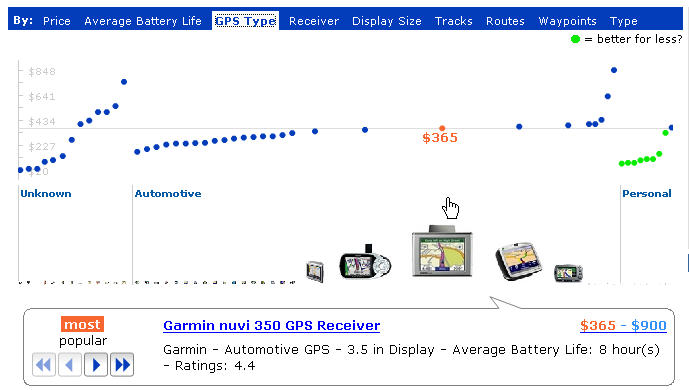
Crispyshop.com is a fascinating blend of data and shopping results that, sadly, doesn't quite work for me on grounds of overall design usability. I love to play with it, but I can't figure out how to use it to pick the GPS device I'm looking for. It has some very basic issues, which in this era of "user experience" shouldn't be happening! (Hey, I know, hire me to consult for you, guys!)

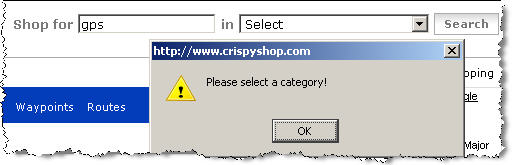
The main display is this very fluid graph showing price on the Y axis, and the dots represent products. The green dots are a great idea, but don't work in practice: you see one suggesting it's a better "deal" (by some number of unknown factors) and you head for it, and it disappears. The UI is simply too fluid. Also, you should never get an error for a simple search like the one I just got:

Whatever you do, you've gotta return results from any search done. Not an error and not a "not found" page. Finally, once I did find a product I wanted to look at, I did the usual thing -- clicked off to a merchant site to look at the details there to make sure it's what I was expecting. And an annoying popup error kept grabbing me back to the crispy page: "A script on this page is causing Mozilla to run slowly. Abort it?"

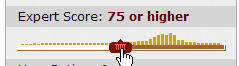
One last bash: the passion here is in the beautifully fluid graph details, clearly. To the left of it is a disappointingly "normal" set of filters that most people just don't use when searching, because they pose various cognitive problems when you're just browsing around and trying to educate yourself about a product space. These ones are particularly poor, in that the pulldown menus don't show the number of results associated with each choice (for instance, if I filter by "10% off and More" will any show up, or will I be wasting a click?). The way Kayak.com handles this is inspirational, of course, in that you get lots of information to help you manage your filters, including some little graphs showing ranges. Wine.molecular.com's demo app is a nice one too, but only works in IE for me. They show a small barchart, but only when you mouseover the slider:

Search is hard to design well: it's all about successful data reduction, for the end-user. People don't scroll through pages of results. But I'm always disappointed by cool ideas partly executed. Is the Crispyshop site intended to support a common task, or just showcase the author's brilliance in one domain (and I admit, he's pretty brilliant at that)? Is it meant to be done, or is it another beta like the endless Google beta empire?

This sadly reminds me of the conversation I had with a spokesperson for Tableausoftware at last year's Infovis conference: There was no usability testing done for that product during design, and it shows in use. I needed an in-person tutorial to get anywhere with it after having downloaded the demo version already. The functionality is excellent, but for a new user making a purchase decision, that's unfortunate in today's software world. Old software products, I will cut them some slack -- but a new product? Even just a professional once-over by someone like me can help catch a lot with the basics.

Wednesday, March 21, 2007

Past and Current Employees and Your Reputation

As my current contract winds down, and a friend quits a job I once quit too, I've been thinking about how employees can affect your company "word of mouth." Just in time, Scott Berkun posted about why you should treat your contractors and temps well :-) Not that I have in any way had a bad time of any contract, but that's relevant to the overall topic here. Manage your reputation by taking care with your own staff.

Scott makes the point that interns and temps are potential future employees, are sources of networking for your future hires, and may be top notch in the idea department, especially since they bring in fresh perspectives. "Treat them like idiots in a box, and you’ll get idiots in a box. But give them a chance to outperform your expectations and your next star recruit might already be in your office." This is a regularly delivered message on Joel Spolsky's blog too.

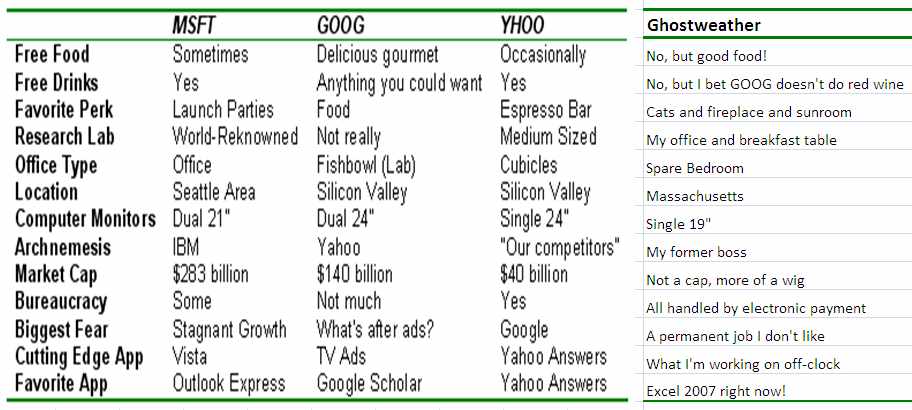
Don't miss the terrific post from the guy who interned at Google, Microsoft, and Yahoo, and compared the three in a blog post with a small chart. :-) (He ended up taking a job at Yahoo.) Here's how my situation compares in an added column on the right:
Another subject of relevance is what I call the "Departure Story," or how you mutually end it with someone who is not happy working for you. My advice is not to let anyone leave suddenly, especially someone in contact with your customers; not because they will badmouth you, but because it will cause a crack in your coherence as a place that can be depended on to handle customers carefully. Imagine how that customer feels when their email to the old account bounces, and they had no warning that their contact was leaving for other pursuits? Redirecting their email to another account where someone else gets it is probably even worse; if there's any indication to that customer that the person they were in touch with had any issues at the company, this will be damaging to the company.

Sudden departures also affect the morale of other employees, just like a big riff will; they'll wonder what happened, how safe their position is, how much of an asshole you were or the boss was. Rumors and stories will inevitably get passed around. Regardless of whether the departee signs confidentiality exit papers, this is still going to happen. So is the conversation they have with their professional industry colleagues at the next conference about whether that's a good place to work or not.

Finally, if you treat a departing employee as if they're a risk, they're more likely to become one. Just like idiots in boxes.

While I was interviewing with a local company that had gone through some troubled times with lots of layoffs, I talked with current and former staff and heard an earful about their last year. It was all on condition of anonymity, and I was grateful to hear it. It made me a bit wary, I will say, and played a role in my decision process. As a manager, you need to know this is going to happen and it isn't something you can "discipline" or "threaten" out of your staff and contractors. Equally likely is the good rep and good word of mouth, if you handle them all well.

A lot of managers moan about how hard it is to hire good people. Sometimes the problem isn't the market, it's you. Checking your street reputation due to former employees and contractors might be a good idea. Someone might like you enough to tell you the truth. Then you can go about figuring out how to change your practices and image.

The current issue of Harvard Business Review has a thought-provoking piece on how companies can't be all things to all employees, but knowing what they are and capitalizing on that is a starting point in attracting the right people for your culture who won't end up telling friends, "It wasn't like it was described in the job ad, that's for sure!"


Sunday, March 18, 2007

Tuesday, March 13, 2007

Organizing for Product Design and Production

I had an interesting chat yesterday with a manager in a large international company that is restructuring to support better innovative product creation. He asked my opinion on a number of topics, relevant to their effort:
  • Matrix organization of cross-disciplinary teams: marketing, engineering, and operations, for instance. I suggested that at the innovation phase before product development, the team might look different and have different skills, such as design!
  • Does long-distance collaboration really work during product design? I said it can, and that although video gets a bad rap, we used it effectively at Adobe in the same time zone. I am less sanguine about major timezone differences, and still a firm believer in regular face-to-face, especially at the start and during times of tension, for defusing it over a drink or meal. For designers, there's more artifact production to communicate ideas long-distance; and the whiteboard collaboration hasn't really been adequately replaced by any conference tools I've seen, but I'd love to be wrong if someone has a suggestion.
  • Quality of product: Get it out or get it right? I said this depends on ability to absorb risk in a brand, and first to market vs. competitor situation. A first-to-market product can get a few things wrong, and still have the advantage. Not if they got the major things wrong, though, and destroyed their own business and can't absorb the hit. Soft launches and long betas are another tried and true method. Google seems to live on eternal betas -- but of course they did get search pretty much right, first, as far as state of that art goes now.
  • Outsource concept design or do it inhouse: I said this depends on how much product innovation is meant to be a core competency. I think it should live in-house if it's meant to be core, because it's a risk to outsource all good idea creation. Also expensive.
It wasn't a specific question, but I pushed for the value of ethnograhic research for identifying new product areas and gaps in markets; and the value of design of both the industrial variety (closer and closer to home for software now) and the usability/interaction variety. The need to reward and remember failures is important here to encourage iteration and re-application of old ideas in new ways.

Tuesday, March 06, 2007

Pretty Visual Generators

I've been looking at online generators for the last few days (a recurrent interest) and was reminded of these pretty visual ones. Worth checking out.

Jared Tarbell's beautiful I'Ching interactive display. Hard to describe, and a little mysterious in practice, as it should be.

The Walking Insect Generator, which is also beautiful, but funnier. Seriously, do click and marvel.

A scribbler art project -- this one is fun to watch, like a lot of these visual noise generators. It tends to fuzz up your drawing.

Sunday, March 04, 2007

Test Your Psychic Powers

Participate in an online study of psychic powers run at Psi Experiments. Their first experiment is up, and all you have to do is guess (or divine) which cup the ring is hidden under. No, it's not a street hustle. You can sign up for the results, too.

Experiment One: "In Which Box is the Ring?"

Saturday, March 03, 2007

Product Idea Generator

This is addictive, like any good generator. It's especially well-done. Too bad the reload link is so tiny, but you won't miss it. Samples I got:
  • It's a rubber fish that shouts 'WARNING!' at the first sign of danger! It sounds better than it looks and mimics the movements of a lizard.
  • It's a blow-up doll that's inflammable! It kills weeds down to the root and talks.
  • It's a video recorder that scares dogs and stays exactly where you leave it.
  • It's like a normal shoelace, but it runs on six little wheels.
  • It's an aquarium that keeps track of your personal calendar!
  • It's a trouser press that flies like a rocket! It doesn't need batteries and may cause drowsiness.

Web Log Analysis: Site Flow Charts

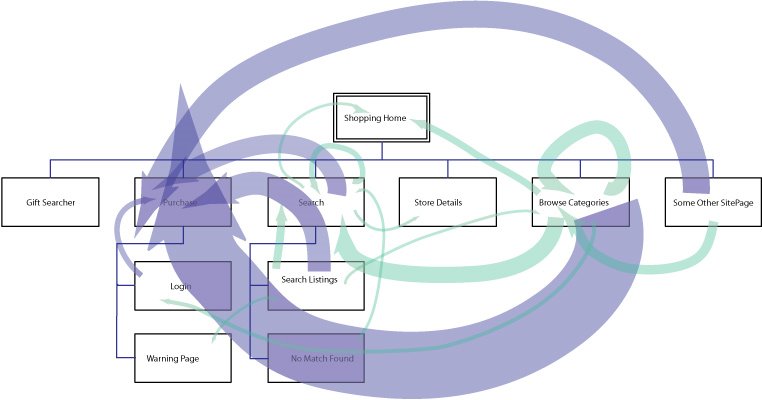
I've been working a bit on web log analysis recently (see my contracting info), and while I didn't deliver this for a client, I did spend a little time seeing if it would be worthwhile to do in the future. After doing the usual freqencies of referrers and requests and such, I also looked at median page views per visitor.

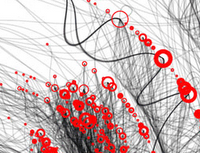
I then did a small sample extraction of page views of the users matching the median page view profile, and generated arcs corresponding to what page types they went from and to. I overlaid them on a site map I threw together, done by hand in Illustrator (and here anonymized): the width in pixels of the line directly corresponds to how many arcs there are between each node (or page type). Blue lines are going into the "purchase" process, while green are just the rest of the traffic patterns. It's a little more suggestive than the simple frequency counts that don't show actual paths; because in this I can see how few people in my sample subset go from, for instance, the "not found" search results to searching again. And it's quite obvious how relatively many people in these logs were buying products while browsing rather than after searching. It's probably worth doing this a larger scale and figuring out a good algorithm to automate the drawing, but I ran out of time on this contract project. If anyone else wants to pay me to do this for their site, drop me a note. :-)

Friday, March 02, 2007

Big Ball o' Mud: Code Tangles and Organizations

A friend pointed me to this a month ago, and I'm only getting around to this now: Foote and Yoder's Big Ball of Mud, on legacy code that no one can understand or modify without risk to, well, sanity and schedule.

They illustrate their points with physical world architectural examples, a lot coming from Stewart Brand's How Buildings Learn, because design in other domains and design of software aren't so different when you look closely.  I was, of course, thinking about interface design and organizational design while I was reading it, and about the book Architecture Without Architects, which I really like in both concept and fact after meeting a few (I'm kidding--mostly).  Foote and Yoder's interest in XP (extreme programming) is in part because of the need to accommodate changes in user requirements, but they don't talk a lot about UI design and the difficulties with keeping UI code flexible and modifiable.  (I still think it's a shame that agile and XP communities don't connect and work better with UI/UX/UE folks -- apart from the active agile-usability mailing list, of course.  The goal of a good designer is to get the right decisions made right and executed well; these goals are the same for both UI designers and code designers, and should be the goals of managers and executives who support them.  But.)

Selections from the Ball of Mud article:

  • One reason that software architectures are so often mediocre is that architecture frequently takes a back seat to more mundane concerns such as cost, time-to-market, and programmer skill. ... Architecture is a long-term concern. The concerns above have to be addressed if a product is not to be stillborn in the marketplace, while the benefits of good architecture are realized later in the lifecycle, as frameworks mature, and reusable black-box components emerge [Foote & Opdyke 1995].
  • In other words, the software is ugly because the problem is ugly, or at least not well understood. Frequently, the organization of the system reflects the sprawl and history of the organization that built it (as per CONWAY’S LAW [Coplien 1995]) and the compromises that were made along the way. Renegotiating these relationships is often difficult once the basic boundaries among system elements are drawn. These relationships can take on the immutable character of "site" boundaries that Brand [Brand 1994] observed in real cities. Big problems can arises when the needs of the applications force unrestrained communication across these boundaries. The system becomes a tangled mess, and what little structure is there can erode further.
  • Architecture and code quality may strike management as frills that have only an indirect impact on their bottom lines.

The same can be said of usability and design excellence, of course.  It's a special organization that doesn't erode the desire of people to produce quality work by saying "it's good enough to make us money right now."

A good closing quote: Alan Kay, during an invited talk at OOPSLA '86 observed that "good ideas don't always scale." That observation prompted Henry Lieberman to inquire "so what do we do, just scale the bad ones?"

Pretty often, both on the idea itself and the execution. In the short term, the prototype code works well enough, and the design is okay unless you look closer or start trying to add onto it. Same happens with UI design, without enough iteration, and tacking on new features without refactoring is like adding dirt and grass to a ball of UI mud.

I'm now using the new Office 2007 products, and I regret not seeing more refactoring of the UI, despite the famous ribbon. If you're going to start doing a UI refactor, you may as well go all the way once you've disoriented your users a little bit; for instance, why keep Word's header and footer commands under the "view" tab now, and I have to question whether "home" means anything real to anyone except on a website. Some of the changes are a great improvement, but I think a little card sorting might have helped them out a bit, too, and I find some of these choices surprising.

Sunday, February 25, 2007

Social Networks of Video Editors on LiveJournal

A few months ago, I did a talk at IBM Research in Cambridge on video (or "vid") editors and their online and offline communities. I made a few social network images, which I thought would be interesting to folks here, and I know I have readers on LiveJournal.

The basic gist of the talk was that hobbiest television fan music video editors existed long before YouTube and their history and organization reflect how they use the internet now -- which is verifiable with some simple data analysis. (NB: I used to be one myself, and in the talk I used a lot of personal examples and anonymized the rest, to protect privacy of anyone who wasn't contacted about this talk. So I'll say "we" here although I'm not practicing myself these days.)

In a quick sum of my talk: We used to do music video editing with VCRs. We existed before the internet was our main way of communicating, and we used fanzines and APAs to exchange tips and tricks (but truthfully, this was borderline before my time, although the friends who taught me all did this). We had and still have conventions at which we showed off our work, to supplement the now popular online posting mechanisms of distribution. (YouTube is not a major site for fan video editors, but another current social network tool that supports video has just become very popular among my friends who use LiveJournal for their conversations.)

Knowing the history makes for interesting cruising of the video communities on LiveJournal. The anime video makers turn out to be, for the most part, a distinct group. This isn't too surprising when you read the "about" text on one of the video community pages (slightly disguised here):

Anime "vidders" are told they may not be as comfortable here, and that VCR vidders are welcome.

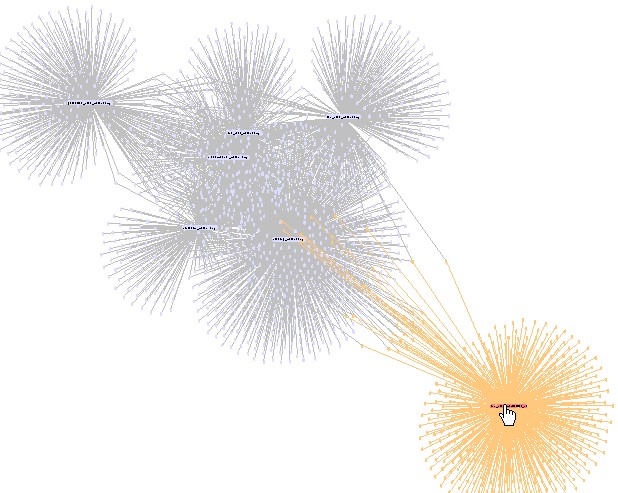
This image shows the network of members in the anime community (highlighted) which is somewhat separate from the group (and its affiliates) quoted above:

One of the communities that is closely related to this one is one in which an annual face-to-face convention is discussed, started and fed by some of the older VCR editors and now pretty much populated by the non-linear digital folks, of which former VCR people are now a part. The convention-discussion community members, highlighted below in orange, are closely interconnected to the community quoted from above, which is circled in red here:

The group circled in blue is a Battlestar Galactica video group, less closely related but more so than the anime group. The closely inter-connected groups in these images are the generic discussion groups, at which the craft and technique and technical discussions occur. More specific discussion groups are generally less connected.

I made these images with prefuse, and apologies for the quality of the uploads. I'm available to talk about this stuff anytime :-)