Sunday, March 20, 2011

PyCon 2011 - Data, Men, and Me

In the past couple years, I've switched from sending myself to research conferences (like CHI) to more down-and-dirty developery conferences. I'm looking for skills development and tools I can use day-to-day. This spring I went to PyCon in Atlanta, since I've been using Python more and more for data analysis problems. (Complete talk videos are here on blip.tv.)

The initial draw was the tutorials. I aimed for cloud data and machine learning. Olivier Grisel's tutorial Applied Machine Learning in Python with scikit-learn was a definite high point of the conference for me. His talk on text analysis was very good as well -slides here, and video here. His French accent was very nice, but I kept mishearing "scikit-learn" as "psychic learn." :-) I also really enjoyed the talk on Genetic Algorithms by Eric Floehr, a fellow who seems to do weather prediction consulting. His slides and a bunch of other interesting supporting material (including code) are up on his site.

There were a lot of talks on data, big data, cloud data, and scaling Python (to handle big data and data problems). Other examples: A talk on Pypes by Eric Gaumer included a good reminder that big data problems existed in the search engine space long before other kinds of big data became "hot" to work on. Pypes is a quasi-visual toolkit for doing data processing inspired by Yahoo pipes. (The gist being that since a lot of data handling involves discrete steps to clean and transform, you can put these steps into little modules that allow you to view the big picture of what's going on with your data munging.)

Hilary Mason's excellent keynote made a lot of us data geeks happy; she called for programming language evolution to get closer to the data problems, and to be less cryptic when it comes to support for multi-threading and map-reduce strategies needed these days. (I loved her "WTF?" comment on her multithreading code example.) Yelp's "mrjob" library for the cloud might answer some of her issues, but I missed that talk for some reason!

Another talk on big data that was well-tweeted was C. Titus Brown's "Handling Ridiculous Amounts of Data with Probabilistic Data Structures." Slides here - probably requires the video to fully interpret this, at least it does for me (yes, I missed this one too).

Not all talks were excellent, of course. My linguistics degrees got grouchy during one on the linguistics of twitter -- or maybe it was my geeky side asking "what can I do with this?" Some talks were nice surprises, too, kind of the point of going to conferences! Based on lunch table happenstance, I ended up going to a Blender API talk by Chris Allan Webber, a subject about which I knew zilch. Blender is apparently beefing up its API for external calls and automation; as a visualization person, I'm interested in tools that I can "drive" with data as input. I have big hopes for the evolution of processing.py and Nodebox2, two pythonic visualization options, but I am not sure they're there yet for me as a data vis person.

My sad female nerd note: I was one of 3 women in the Machine Learning tutorial. Out of perhaps 40? I later heard via Twitter a guess that there were only 8% women at the conference as a whole, based on t-shirt orders. I loved Hilary's talk, but was a bit bummed out by the Dropbox keynote that featured the social network of "friends of Arash" who started that company -- yeah, all men.

A final comment for any UX folks reading this: This would've been a great audience for a talk on UI design in open source, or UI design for Python UI's. There were a lot of companies presenting: Dropbox did their "we use Python" talk; Evite apparently has rewritten their entire java backend in Python; Threadless, a sponsor, is all Python... One of the reasons for its growth at these companies is the ease of writing things fast in Python; the "prototype and iterate" philosophy showed up over and over in various presentations as a real strength of Python. As a light coder myself, I can't agree more. I was there as a data-oriented geek, but I saw UX opportunity everywhere, for the right kinds of UX folks.

Sunday, August 08, 2010

Fan Video Editing Community and Copyright

In April, I gave a talk at UIUC's HCI department on fan video remix artists, or "vidders," as they are known within the fan media community. To build the talk, I drew on several years of LiveJournal network data, and a large 2-part survey I did in the spring of 2010 to document current attitudes, trends, and self-reported demographics of the community. Afterwards, I made my slides available in an annotated deck for the vidders themselves, as I had promised I would -- there were some interesting comments, including disagreement with certain aspects of the technical commentary (whether meta-data is really useful and available for management of clip collections) and whether the quote I pulled about "political correctness" as a dampener on some fans' "fun" was fair and balanced as a critique of the recent years' vidding discussions on issues of race and gender in vids. I haven't updated the annotations or the deck -- I'm posting it as I posted it to them; if someone is interested in hearing more about the community discussion, I'm happy to reply in comments or email.

I'm posting about this now because of two great things happening for this group of video editing fans -- this weekend is the annual meeting of Vividcon, a fan-run con all about vidding and vids as art and fun. I'm following the tweets with great jealousy -- I never made it off the entry waitlist this year.

The second great thing of recent days is the passage of the new DMCA exemptions from copyright-infringement laws for vidders (and other video artists) using copyright materials for artistic purposes. Since Internet sharing began, fans have regularly had their videos removed from many media sharing sites by copyright police. Some still post on password-protected private servers, rather than making them public and findable by "The Powers That Be."

Francesca Coppa posted on the blog of the Organization of Transformative Works that the case for the copyright-law exemption had been made in part based on the artists' need for high quality original source material for their remix works.

That said (and it's true), it's ironic to me that my own history goes back to the pre-Internet-sharing days, when we borrowed n-th generation tapes and made fuzzy vids with stone knives and bear skins. Check out my slide deck (pdf) for more on this. My talk includes some network analysis, one slide of which shows the "age" effect for when a vidder started vidding, and whose work they admire -- the VCR-era folks (including myself) are now off to the edges on the right and top. Fortuitously, right after my talk, Mimi Ito's article on anime fan editors came out in First Monday. I had already exchanged mail with her about her anime research, and it influenced my second round of survey questions to the vidders. Anime editors differ enormously from the vidder community; one major difference is that fan vidders are mostly women, while anime is more mixed, tending towards more male, and anime editors seem to be younger or to have started earlier, from what Mimi found. In my network graphs and quotes from the community, I show some points of overlap between anime and fan vidders, points and nodes which have increased in the past few years as the two groups learn about each other online and at cons like Vividcon.

Anyway, here are my slides: "Vidding Evolution: Community Change Among Fan Video Editors" (2010).

Sunday, January 10, 2010

My Take on Big Company Suckage

Scott Berkun wrote a good post on Why Big Companies Suck, at popular request on his site. It made me think about my own experiences at small, medium, and large companies over the past 20 years. I'm assuming Scott and his readers were mostly talking about "why it often sucks to WORK at a big company," rather than why big companies suck from the outside looking in.

The individual is lost in the machine. The opportunity to be noticed, to get feedback for doing a job well, or for improving someone's life in or outside the company, is that much less. Which may limit your chance of a promotion, or just make you feel your job is pointless. One company I worked at had a famous management mantra, "If you're not making the product or selling it, what are you doing here?" Which is absolute bullshit, and dismisses the administrative roles of accounting, the benefits department, travel and admin staff, tech support, and other critical team members at a large software business. Functional companies need a lot of people doing different things, otherwise the people writing the code can't do THAT job.

Communication from the top is often poor, intentionally or not. The message that trickles down from management, or that's delivered from main stage at company meetings, tends to be diluted for the common denominator, which means it's not really addressed to anyone in particular. Sometimes it contains no information at all, as a result. Scott may have covered this under "they believe their own bullshit," but I think there's another slant on it: They don't know what's going on. The more levels and divisions there are, the more distorted the signal is, and the more likely you are to hit people who aren't sure they're supposed to be telling you something that they know.

Secretiveness. I don't get it - but bigger companies tend to keep more secrets from their own employees. I have nothing to say about this right now, because I'm just baffled by it.

Managers are rarely evaluated well or fairly at any sized company. Even in times of turnover or economic distress, management are the last to go (unless they're a very public, board-threatened figure, like a CEO, in a very bad political environment). Scott mentioned the Peter Principle, but I think it's more profound -- with power working as sum of the people below you, the weakest point in the tree is the bottom. Even when the bottom is arguably the most valuable part of the workforce. Companies with a lot of management structure will have fewer people doing quantifiably good work, occupying the org chart and protecting themselves at the expense of the workers under them.

Evaluation of what's good or valuable often happens on idiotic scales. When I worked at AT&T Labs 15 years ago, the company didn't think about anything but a sure business that would pull in billions -- never mind betting on smaller startup ideas to see if they could create new markets or businesses. Other companies like 3M and Google have since made this a visibly stupid way to do business, but it's definitely an easy way that managers can avoid risky bets on new verticals or product lines.

The small company made crap, and now the big company has to support it. Staff in big companies are sometimes stuck in trying to repair what was made by the small company, or what was acquired from the small company. This really sucks for the people in the big company. Bad design that was produced in a "proof of concept prototype" as VC's pounded on the door and the cash ran out -- well, those guys saying the good old days were great got rich off that crap, and now it's everyone else's job to "fix it."

Because the small company made so many mistakes, and the bigger company learned from them, there is more process and review of decisions. Face it - a lot of the processes and checks and balances in bigger companies exist because of bad things that happened when the company was smaller. The big company "learned." It decided it was too risky to do that stuff again. Stuff like having no usability review of the most important feature of the release!

Smaller companies sometimes feel more homogeneous -- the individuals know each other better, and there's usually less role differentiation and processes involving a lot of people you don't understand. This can make it more pleasant, give the impression that you're "getting things done," but it can also mean less original or high quality work is produced in the end. See above, about producing crap and making mistakes.

People who have their own money at stake, or make a lot of money from something they did, tend to be very engaged and happier about their contribution. This is a guess, but I think this study about hourly workers supports it. The study says people feel a stronger correlation between happiness and rate when they are paid hourly, rather than by salary. There's a direct reward connection between money and time. People who got a lot of money from a startup --either from selling one, or being there and getting the stock profits -- no doubt feel they were rewarded by the world for something of value that they did. It's less easy to feel rewarded either monetarily or by subjective feeling in a big company. Because the individual contribution is much harder to make or to recognize.

Finally, a few ways in which small companies can suck, too: There's never enough money, or for long enough; there isn't enough staff to do things that need doing (travel booking, accounting, etc?); the hours can really suck, related to the money issue, no doubt; there are STILL cowboy coders and often secret politics about decisions and design directions and what we're hiring for next.

Sunday, November 15, 2009

Tips and Tidbits from the UI14 Conference

Back to blogging after a long hiatus of work and travel... UI14 in Boston had some good stuff for designers and managers! I heard a lot about techniques for creativity and design generation before winnowing; good reminders to generate multiple approaches before "settling."

Dan Rubin had his workshop group generate 20 different thumbnail sketches in 5 minutes. (Maybe it was less - it seemed like less.) Then combine the best aspects of their favorites into one bigger one. Hard, and a good way to make you get crazy early, if not go crazy, or just to think very broadly.

Leah Buley's charming "How to Be a UX Team of One" presentation is worth watching online. Her link includes her templates for wireframes with notes - useful for her excercise of 6 designs in 5 minutes (or less? again, I forget). After doing those sketches, she took a room vote on which idea in the 1-6 range the audience preferred out of their generated sketches. Most of the votes indicated it was not the first idea drawn.

There were some other interesting creativity exercises in Scott Berkun's excellent "Myths of Innovation" workshop (based on his excellent book of the same name). For a stuck team that's gone dry on good ideas, try brainstorming the worst product features possible for a while -- this will open up the wild and funny ideas. Then invert them, for the germ of some good ideas to pursue. Another alternative was to go from completely unconstrained brainstorming (such as "ideal features of the perfect cell phone") to slightly more constrained ("ideal features of a $10 cell phone").

I found Scott's most entertaining activity to be one in which the group listed 30-40 (again, early onset memory loss) random words - nouns describing things/activities/states and adjectives. Each small group had to pick 3 of them, brainstorm a new product or service around them, and create a pitch for it. All in ten minutes.

Strangely, from our workshop list with "TiVo" (I did not propose it!) and "guitar" and various sports... many of the groups picked the word "tomato." No idea why. But their weird product pitches were all very clever and funny. Scott pointed out afterward that this illustrates how a bunch of people who had never met before could self-organize, be creative, and even have a good time doing something that initially seemed impossible. On the "self-organization" topic, he noted that the person who takes notes in the group (self-nominated, of course) is usually the person who ends up delivering the pitch for the group, which also seemed to be true for several of these groups. As a conclusion to that one, he said that the reasons for this activity being difficult for many people (despite their success!) were these:

  • Creativity creates confusion
  • Unclear roles [group self-organization takes a few minutes or lots more]
  • Responses to uncertainty differ
  • Responses to subjective criteria differ
  • Group dynamics influence decisions
  • Time pressure [creates more stress]
  • Lack of trust / relationships [although I noticed that one team had a bunch of people from the same company, a team I wish I'd observed during the activity]

Scott gave out copies of his newest book, Confessions of a Public Speaker, at his second UI14 talk. That talk was great fun as well.

Dan Rubin's short talk on Visual Design tips was excellent as well. A couple of his tricks will definitely go in my toolbox, especially the use of an image that a client chooses for setting a color scheme using kuler. (My take on it: Choose a bunch of images that might convey the mood of a site or product that a customer wants, and be sure the palettes are sufficiently different. Ask her to choose the "mood" she likes, and generate the colors from sampling that image.) Another of his tricks - using a 1 pixel sample of a photo to generate a gradient lighting effect with layer blending - was deeply cool!

UI14 is a great conference, and this year it was in an even better venue than it has been before (a plush hotel in more accessible South Boston instead of cramped Cambridge). Some things that make it annually so good: power strips under every table, and working wifi; a great drinks party; long workshop sessions as well as sampler short talks; accessible speakers who hang out and attend each other's sessions (or else, just check the bar). For a tech-industry conference, it does an excellent job of being gender-balanced for speakers. UI14 also has the odd honor of being the funniest conferences I've been to in a while -- possibly because Berkun, Gerry McGovern, and Jared Spool are all very entertaining! Check it out next year.

Sunday, August 16, 2009

Recent Consulting Links

A few articles on consulting in the current economic climate, thanks to the Freelancers Union newsletter:

The Freelancers' Guide to Getting Paid On Time, or getting paid at all, from the Wall Street Journal. Some good advice in here, especially "deal directly with payroll" to avoid touchy discussions with your primary client; and advice on how to approach a suit if you need to go to small claims court.

For the Self-Employed, It's An Endless Work-Week, another one from the WSJ, this one about how difficult it is to go on vacation or take time off when you're constantly worrying about the next gig. While I don't personally have this problem, I will work on a vacation if an exec requires it, it turns out. So will a lot of other consultants out there, especially as the competition increases (more layoffs mean more freelancers, at least short term).

Now Hiring: Contract Workers? From Business Week, argues that employers are looking for non-perm employees now, and it means business for consultants. "In a recession, contract workers are often the first to go. But often, they're the first to be hired back, because in an uncertain environment, employers want to be flexible." This matches my observation of how the past 6-8 months has gone. The article notes that cutting of contract workers has slowed, and that contract workers are being hired back, but at lower pay than previously.

My own rates were cut by a long-term client a few months ago -- and my health insurance has gone up $100/month in the past year. My work expenses haven't dropped any, either.

Sunday, July 12, 2009

Cheap and Interesting Travel Resources

Since I've been busy vacationing, I haven't been busy blogging much - so I thought maybe I'd update with some references for travel sites and lists I use. A few friends have asked me for tips, so here is the collected recent lot.

The Caribbean

There are lots of deals right now. I just went to Turks and Caicos using Lastminute.com, but there are other options. With Lastminute, you often have to check carefully for catches, like overnight flights, or trips priced for 2 if you're not going with someone. (I like solo travel, because I get to read more.) CheapCaribbean is one site that I think a friend and I used for an all-inclusive Cancun trip a few years ago. It's not hard to find resources like this. I've enjoyed winter trips to St. Croix and Grand Cayman for snorkeling using these types of sites. You'll still want to find a good site on the destination itself, to help you pick your hotel location, if you're not driven solely by price.

Adventure Travel

A few years ago, a friend recommended this site Adventurecenter.com and their trips (she'd been on 2). I've been a drooling over their catalogs for the past several years myself, ever since going on a very wonderful trip to Morocco that they advertised. They offer group travel for active adults, sporty or cultural or no-frills, sometimes with an eco-orientation. I wouldn't go to Morocco alone, and I'm not sure I'd even go with just a female friend. But I had a terrific time in a group of young adult (mostly UK-based) adventurous travelers. It may have helped that an Irish woman brought along a bottle of gin. Note that their prices do not include the airfare, while the Caribbean deals above generally do.

Another adventurous option, solely in the UK, are the National Trust volunteer working holidays. These are also group trips, based in one spot, usually with lodging in a youth hostel; you are doing some type of local volunteer labor while there, with breaks for genuine sight seeing and socializing built in. The ages are quite mixed, without any young kids along. I myself did an archaeological survey trip in the Midlands. Lots of fun, albeit also some hard labor clearing off brush from a buried hill fortification. (I see their web site now says that for legal reasons they are currently only accepting EU and Swiss residents for their bookings. How sad!

A friend recommends EarthWatch expedition volunteer trips, but I find them a bit expensive for my tastes. There are some volunteer trips in the AdventureCenter catalog, as well. I'd like to know about more that are not extremely pricey, if you want to leave a comment or send me email?

Rentals in France

I know this is a bit specific, but since I did it recently (and have done it on and off for years), I thought I'd post the how-to's.

The primary source for good-value housing rentals in France (not Paris, but the rest of the country) is the French Gite system, on the Gites de France site (English available). Originally all arranged by paper catalog, it is now online, and many of them take internet bookings directly via the site. Normal reservations during high season are for weekend to weekend only; outside of high season, you can negotiate for different days or less than a week.

A few things to be aware of: You may need to pay a deposit or full amount in advance (by wire, or they may agree to hold a paper check); you often have to pay a surcharge for water, heating, and other fuel costs, and often for bed linen and towels. You are expected to clean before you go (they are not hotels - think of it more like a well-equipped private hostel). But if you can handle this, there are many beautiful farmhouses, cottages, and apartments, often old historic ones, for a steal - especially if you split the cost.

I admit I went out of the system for my recent Brittany vacation because it was easier to search for wifi on this UK site, French Connections. (Yes, it sounds like a bad dating site.) Some of these rentals are also cross-listed in the Gites listings.

Rental cars are easy to hire in France, from Avis, Alamo, etc.; use their sites, or a local European wholesaler like Nova. Pickup options that are most convenient are train stations in the main towns (I used Rennes) or airports. Even tiny airports that are taking RyanAir and other discount airlines have rental car options. It's much cheaper to get a manual transmission, but you can reserve automatics too.

The French train system requires reservations on many lines, and the TGV especially: You can use this RailEurope site instead of the SNCF site to book an electronic TGV ticket with a claim code that allows you to retrieve it at a kiosk at the station in France.

Paris rentals are a lot pricier. There are a zillion sites out there - use at your own risk, or get a hotel.

FYI, my trip recently was Boston-London, cross London by bus to Stansted airport, fly by cheapo Ryan Air (bought on their site) to Brittany (Dinan), pick up car there, drive to apartment with wifi. This was because I got a much better deal on a ticket to London at the time, and it saved me 2 train rides and a lot of time to go via Ryan Air direct to Brittany rather than travel via Paris.

Travel Deal Resources

I'm on a lot of lists and get notifications about travel deals. I recommend Kayak.com's airfare alerts, notifying me of current low prices from my home airport to wherever I care about, which is most of the world! Kayak also has email newsletters on deals they find. You need to register on the site, and then find their alerts section if you can. They let you set a price threshold, like "any flight under $600 to Europe." This will keep their notifications to the minimum you care about. (I use different price levels for different regions of the world.)

Other newsletters I subscribe to, which have been useful: Travelzoo, Booking Buddy's list, and Go-Today, a site I enjoy browsing too.

Friday, May 08, 2009

In Defense of Hard Skills for Designers

The other day I was in a meeting in which evaluation criteria for developers came up; nice concrete stuff, like writing code that other people can read and modify, putting in comments, resulting bugs, etc. It made me pause and admire the local weather of that strange country. In my experience, it's vanishingly rare for an interaction designer, usability specialist, or User Experience professional to have such nice hard criteria applied in evaluation of their work. Far too often, we're judged on mushy subjective factors like whether some team likes working with us, or feels we're doing something valuable--often outside their expertise or range of view to make this judgment, but that rarely stops anyone. I have some stories about this subjective mushiness in my article in HCI Remixed, titled "Designing 'Up' in the Software Industry."

Why is this--sign of an immature field? evidence of double standards, for sure, but also imprecision of job role? Poor management, perhaps contributing?

I suspect it's related to the observation that many designers have trouble achieving credibility in their role. Scott Berkun's seminar for UIE on Why Designers Fail advocated working on "soft skills" over hard skills, such as learning ways to win friends and influence people via negotiation, diplomacy, and other interactional condiments.

Not to pick too hard on Scott - it's hard to disagree that people skills are valuable and most of us in the computer industry are weak in some of them - but I think it's generally NOT true that designers have sufficient hard skills. I think gaining and using hard skills are our best bet for being taken seriously in places full of skilled workers. Most interaction designers spend too much time in "soft" areas that can too easily look like matters of opinion to others, or overlap and sometimes threaten other existing professional roles like product management: user testing (which often looks like "anyone could do this"), observing people work and suggesting improvements to their tools, pointing out issues in existing products that could confuse users (heck, everyone has an opinion on that), scheduling and managing stakeholder meetings, writing requirements documents and functionality specs. Most of these activities are politically difficult, and don't make other colleagues drop in their tracks and say, "Oh, you're so valuable and provide skills we don't have!" As I pointed out in my HCI Remixed article, a common reaction to much of this work is, "Didn't we already know that?" Finding problems with software is relatively easy; creating solutions is not.

We can convey solid, indisputable value when we focus on creating concrete, skilled deliverables that NO ONE ELSE CAN MAKE. In economic crunch times like now, consultants hear this from the front line. If a client or potential client has someone on staff who can apparently do what they do, they're not a clear asset. Never mind that they have 15 years of experience doing it, if their value looks like primarily "opinion" or "process," it's not very convincing when it comes to opening the bank account.

Here are some of my suggestions for hard skills, that many interaction designers and usability folks could stand a more training in:

  • Technical prototyping skills: Flash programming, javascript/ajax, css, html site design, Flex, Expression. Use of the tools that are used by developers, at a basic prototyping level, is a solid PLUS, because you can make things that everyone can see are relevant to the end product.
  • Ability to make high quality visuals: Visual design training, skills with Illustrator, Photoshop, page layout applications, and other design tools for good looking mockups. Low fidelity may be useful and helpful with fast user testing and concept evolution, but you want to be able to make something your client or non-designer colleagues can't make. I know one case of a visual designer hired into an interaction design role because of the caliber of his mockups. Never mind how wrong this was for him and his manager eventually-- it got him the job to start with.
  • Data analysis: For user research, learn some solid statistics. Even just pivot charts! Maybe some VBA for automating actions in Excel. Eventually, data mining, increasingly important with the large amounts of data around. (This is a career growth area all on its own right now.)

I'm with Scott that it's not a highly valuable proposition for a usability engineer to learn to do a cognitive walkthrough when they already know how to do 5 other methods for usability evaluation. But that's the wrong "hard skill," in my opinion. One who learns to make beautiful designs, which no one else could have made, will have a serious edge in their job role. Same goes for other skilled, niche deliverables. True story: A client with a budget problem told me recently that she had people in-house who could do an InDesign layout project, and that my value to her was in the data analysis and recommendations I could deliver for her that no one else could do. Good thing I'm working on that array of hard skills!

If only the university programs for HCI, UX, and usability thought like this, designer credibility issues would start going away a little faster. And performance evaluations for more designers could be done in concrete terms like how much good stuff we MADE during the design process, not how much we talked in meetings and if the other people there liked us when we did.

Saturday, April 25, 2009

Why Failure Isn't Working for Me

A response to a number of posts and talks on failure recently, particularly this one by Michael Krigsman, Five Reasons to Discuss Project Failure, linked from Scott Berkun's blog.

Based on Krigsman's points, I wonder, Is failure really instructive? In my observation, there are a lot of people who don't learn from other people, or even hear what they say. Maybe they're "experiential" learners. Maybe they don't think like researchers--who are trained to build on other work--or they aren't smart. I personally hope they are genetic dead-ends. It seems a rare person who takes on board the lessons or advice from others; at least, it takes a listener, and someone who isn't arrogant.

On the subject of arrogance: A lot of organizations suffer from "not invented here" syndrome. They're in successful companies, don't see why they should do anything different, don't think they need to do other than tweak their current environment. And they're unlikely to hear from outsiders or new people. No matter how much they say they embrace change, learning, growth, new ideas... in general, in practice, it's not so true. Or it's better coming from someone internal with an extremely tailored message for that environment.

Do success stories really not work? The fun book Made to Stick doesn't entirely agree. One of my issues with stories of failure is that they end up being a lot like usability test results: Show you everything you did wrong, but provide no solutions for how to fix things. And it's hard to get the "right" lesson, because lessons are almost always hypothetical. IF we hadn't cut this feature, it would have sold better. IF we had done user testing earlier, we would have caught this. IF we'd had longer to develop the right architecture, this would be faster and people wouldn't be complaining about performance. IF IF IF. No one really knows, it's all just opinion.

If you don't understand your successes, you can't replicate them. And you can't use them to inspire anyone. You had a project team that cleaned up a disaster in record time and shipped something people loved. What was different about that team? What did they do better? Okay, it may be partly a comparison with the failure before, but it's surely instructive!

Root cause analysis of failure always has to skirt around sticky, difficult, subjective personality issues. This is often unproductive to discuss, and doesn't lead to positive outcomes. The people who name names look bad, and often suffer for it later. That guy who's the blocker for a zillion projects - everyone hates working with him, but he's critical path. Yes, it's been elevated to his boss before. VPs have been involved. Multiple VPs, on one occasion, during which ego bristles poked everyone. Nothing has changed. That guy is going to continue being a root cause problem on a lot of things. Talking about it means VPs and bosses are implicated too. And isn't it just personality issues for everyone involved? (Note, I advocate firing his ass, or moving him to another role; but I'm not in charge. The organizational dysfunction, which is usually just human nature, is in charge.)

design is invisible, till it fails.

Now, to switch onto on the subject of design failure. A hot topic among design gurus right now (see Spool on "Failure is Not an Option, It's a Requirement" and Scott's recent talk on "Why Designers Fail"), we're being told that good design involves failure and failure is important for innovation. I'd argue that designers themselves often know that design is iterative and exploratory, with important dead-ends that lead to strong results, but their managers or other necessary stakeholders don't know this. I hope Scott and Jared are being heard by these other folks, too, and not just by designers.

The people with the money are the ones that matter. They determine what constitutes failure, in the short term, like it or not. Many design consultants worry that client judgments don't take this iterative process into account. We are paid to be fast, creative, and accurate, all at the same time. Mistakes or dead-end work aren't seen as productive value for the money by many hiring managers. And their own sometimes flawed design judgments are at play in their judgments of our work. What should be a success is seen as a failure, through the squinty eyes of a manager that doesn't get it. It takes design talent to recognize design talent, yet most hiring managers aren't skilled or talented in this way.

This phenomenon leads to failures that shouldn't have been failures - good work was thrown out, bad work was done instead. Happens all the time. Happens on every dialog, every icon, every wording argument. Most of us live with failure very regularly: The little voice inside blaming us for not arguing the point just a little longer, for not standing up to that bully on the team about this important issue, for not getting to that other issue that's probably more controversial and yet more important for the user in the long run, for not making one more mockup to try to show how it could be better, or moving to Flash to show how it would work for real.... Oh yeah, we've got a lot of failure all the time. And our failures are much more visible than the guy writing some code on the backend that thrown an uncaught exception, which may not be noticed for years!

My point of greatest concern about these homages to failure right now is that they don't take into account power dynamics in most engineering organizations. (To be fair, Scott's talk does, and he found that managers who aren't skilled in design are a major cause of failures.) Designers are a minority discipline, and often we're trying to change processes and methods while also delivering on our work. We're trying to set an example with our deliverables and methods. The odds of success are already long against, given the weight of org history and number of people we need to convince. As minorities, we're often trying to argue for more headcount, and every misstep can be seen as another argument against hiring more of us.

Visible failures aren't generally a positive option, when disciplinary credibility is at stake.

Friday, April 10, 2009

CHI 09 Panel: Moving UX Into Strategic Importance

At CHI 2009, I took a lot of notes at the panel "Figuring Out the 'One Thing' That Will Move UX Into a Position of Strategic Importance." This is a rather random summary of it; see a similar topic in my post on User Experience Organizations discussed at BostonCHI a couple years ago.

Jim Nieters, Director of UX at Yahoo!, advocated speaking the language of business, and addressing business concerns in our design work and priorities. UX at Yahoo is now in marketing, after another reorganization. They will be providing input on the product funnel, helping to prioritize company efforts.

He reminded us that even at the executive level, it's a life or death battle, and everyone has someone to answer to at the end of the day. Convincing stakeholders of the design profession's value is less important than delivering as individuals; we need to be personally accountable for our work and stay focused on the right projects.

Regarding the standard issue of having too few resources: Invest in projects carefully. A team too diluted on too many projects can't be as visibly effective. Turn things down, and focus on the most important. Work on the revenue generators, and work with the business to understand the right problems and the solutions that can come from design.

During questions, he revealed that for products to move forward at Yahoo, they need "3 in a box": key stakeholders from Product Management, Engineering, and UX have to all be in agreement before work proceeds. Sounds good to me!

Laurie Pattison, Senior Director of UX at Oracle, was up next. Her message was that you get one chance, and have to sell yourself well. You only get one chance to make that first impression. At the management level, you have a calendar quarter to make an impact. Since you can't succeed at everything, you need to pick projects carefully, and provide business value. Businesses are in the business of money, after all.

As part of the sales process, deliver something other peers at the company can't do themselves. Make smarter wireframes, prototypes, or more attractive deliverables. Come up with innovative ideas that they can't think of themselves and the value will be clear.

Her example case study was a project to help reduce tech support calls. The team did simple usability studies and discovered that users couldn't find answers to items that were in the documentation. Their redesign put answers in context and reduced the need for the search functionality; the number of calls reduced as a result, and the bottom line was visible. The CEO was educated about the process and methods and it was a clear win for the team and their methods.

One questioner asked her why not just do this on every project, it's the standard research and design process. But resources limit what you can work on. "Pick projects that matter to the bottom line. You pick mind share or market share."

In a somewhat depressing note, several panelists agreed that your team (or your contributors) are only as good as the most recent success, that failure follows them around forever otherwise. "If you spend only ten minutes working on something because you don't have time, and it fails, people will remember you were associated with it and blame you. Better not to work on it at all." I'm disappointed when I hear this sentiment, given the recent discussions in other places about taking risks and embracing failure during design. I'm afraid failure may be a luxury for very well established teams.

Craig Peters, consulting as Awasu Design, argued that we need to pay more attention to the individual contributors in our organizations and their basic skills and effectiveness. "No matter what the strategy, if we don't think about the individual level interactions, the big picture won't be helped." He described a situation at Wells Fargo in which a UX team had reached a limit on their effectiveness; and he investigated and found that non-UX colleagues had had varying types of interactions with the team and found no consistency in their expertise or work. (I'm reading this in - Craig was pretty vague about the actual details of the findings and recommendations for improvement.)

During the questions, the panel and audience debated some on whether we count as a "young" field after 20 years of CHI conferences. Regardless, it does seem that different skills may be needed to convince different organization types and sizes.

Lauri represented the absent Killian Evers, UX Program Manager at PayPal, who argues for the need for program management skills in larger companies. Program managers can successfully bring metrics and rigor to UX and bridge UX and development. (I myself agree with the need for project management everywhere, but think that UX teams need to be able to work with software culture metrics, processes and tools, and there's no excuse for requiring a third party to manage this. But I may have misunderstood the points here.)

Some comments made during the question period, not all of which I was on board with:

  • If your company doesn't value your contributions, move on to another one. Corporate Darwinism works.
  • Don't waste too much time on ROI attempts. Testimonials from internal folks can go a long way. If you can find someone who needs something and you make an improvement, communicate it afterward with a story. Could even create internal portfolio of examples to help support your value.
  • "If you're in a confrontation or argument, you're already lost." (I find this of some concern; many dev cultures produce lots of argument and confrontations, and if UX people aren't allowed to play in those, the field is not level and we're really handicapped.)
  • The impression of many UX teams is "often you come in too late, you don't understand our jobs, our deadlines, our deliverables." My comment: Who's fault is this, actually? Bring us in earlier, etc.
  • UX teams without domain knowledge can be seen as liabilities. Response: Get them educated about the domain, it's part of onboarding.
Finally, there was an acknowledged tension between the desirability of being an outsider brought in for point expertise ("like a lawyer") or a team member long term. These are obviously very different models, for staffing, for hiring, for seeking positions of corporate influence.

At this panel and at the one on "Fault Lines of UX," individual contributors asked how they can make change as single UX people alone in non-UCD environments. There were no simple answers for these folks. I particularly feel for the student who said to me after the Fault Lines panel, "I was taught UCD very rigorously in school, and I thought everyone did it. Now I find out most companies don't. How can I proceed, what should I be doing?"

An ongoing exercise for our profession, as mentors, educators, and colleagues... We need to help her.

Sunday, March 29, 2009

So You Need to Do a Usability Test... But the Product So Obviously Sucks.

Most of us in interaction design jobs have been asked to do a usability test on something that we don't think is ready for prime time. You think it needs some design work before it even gets to users. The usual scenario is that your company or client is unwilling to listen to another stakeholder with design opinions (yours, or your team's), but will believe it coming from users. Either that, or they don't know what design is yet, but do have an idea that usability testing is a good idea.

Some strategies for turning this to your advantage, if your ultimate goal is being involved in the design, not the evaluation:

  • Make it a test that's just Pass/Fail. Don't allow room for wiggling on the results, or you wasted your time getting them data they don't want to hear. Agree up front on what this thing is supposed to support, scenarios they think it has to handle, and be firm on delivering the news afterwards. It's too easy to get wishy-washy about informal usability testing, and leave room for argument, otherwise.
  • Create alternate designs for use in the usability test. One of the best ways to educate the organization about the value of design is to DO IT. And to turn the test into an evaluation of multiple designs will help build your credibility and turn post-hoc evaluation into formative, and more useful, usability testing. Throw in some mockups at the end, or at the start, and ask for comments on those in comparison to the product that so clearly has problems, from your perspective.
  • Write the report before the test. No, not as unethical as it sounds - you won't deliver it, but you're checking on your skills to predict what's going to be hard to use. So, you got all worked up about how this thing is hard to use, for obvious reasons; now check to see if you were right! Better yet, have more than one person on your team do their own reports, privately, before the test, and seal them up. Afterwards, see who was the best at predicting the disaster. Chances are, the users will fail in ways never imagined (thanks to Kevin Berni for this line), and you'll be a little less cocky next time this situation comes up. But if you get it all right, you're building your case and confidence for pushing back on this kind of request next time around.
  • Ask others in the org to predict what might cause the users problems in the current design before the test. I used this tactic once when a QA organization felt the way I did about the usability of the product we were testing. I gave an award to the person with the most accurate prediction of user difficulty after the analysis. You want everyone in the company to know who has good insights into design and usability, right? People with good instincts need to be making the judgment calls, in the future. And you need to be able to illustrate that not everyone's opinion is equally valuable when it comes to making design decisions. Design insight requires talent and skill. This contest before the usability test helps identify talent-- skill development can come later.
Again, the only way you'll get involved in the earlier stages of design is if you show you can do that part, and what it entails. Make alternatives, and show why they are better. Next time, you'll be at the table for that part of the job instead.

Sunday, March 22, 2009

R, for Open Source Data Goodness

After I left The MathWorks, I stopped being able to afford MATLAB for stats, and switched to the open source R. Recently, there have been a few articles on how R is being used at companies like Google and Facebook (here and here). I thought I'd post some names of books and sites to help out those new to R.

Some books:

  • Data Manipulation with R, by Phil Spector. One of the new Springer R series, and note that these books aren't cheap. This could be twice as long as it is, and I found a lot of the meat is towards the end. But still a good book to have. The power of R is that it's a programmable environment, allowing you to do data transformations on the fly, as well as automating your tests/displays/operations. You have to know how to move stuff around.
  • Lattice: Multivariate Data Visualization with R, by Deepan Sarkar. Lattice is a very powerful visualization library, highly recommended. This is The Book, another Springer one.
  • Interactive and Dynamic Graphics for Data Analysis With R and GGobi, by Dianne Cook and Deborah Swayne. You can check out the GGobi site for flavor. I will have to admit that while my initial forays into using it have been enticing, the UI has some learning curve, and I've backed off a bit and not gone in very far yet. YMMV.
  • Statistics: An Introduction Using R, by Michael Crawley. This is an excellent book; it has intro stuff and is very deep on the stats, in terms of application and big picture. Obviously all examples use R, so you can replicate anything you want. The almost artistic side of statistical modeling really comes through here. Don't be fooled by "introduction," though - it's not light and easy reading.
  • Introductory Statistics with R, by Peter Dalgaard. I think this is more basic than the one by Crawley. Or just not as deep. I don't look at it as much-- mainly for contrast.
  • A Handbook of Statistical Analyses Using R, by Brian Everitt and Torsten Hothorn. A heavy-duty guide with applications of different methods for different types of questions and data sets, including (e.g.) survival analysis, recursive partitioning, multidimensional scaling, longitudinal analysis. A good purchase.
  • R Graphics, by Paul Murrell. This is not my favorite book. You can customize anything in an R graph, but it's nasty and difficult to do so. The book doesn't make it easy, and neither did the course I took online from statistics.com from the author. Still, this could be kept around for extreme need. Some of the chapters and source code live here on his site. I think you're better off getting Lattice, which is slightly higher level; and if you must get very pretty output, get the numbers or basic shapes out and use another tool like Excel or Illustrator. Except this guy Steven Murdoch had some real success in his Tufte experiment with R, shown below:
Steven Murdoch's Graph in R

Some tools and helpful sites:

  • Quick-R, a great site for getting started, and getting readable nice overviews of different techniques. Lots of pointers and basic help for stuff like graph customization.
  • Togaware's Rattle GUI - a timesaver for a bunch of basic and advanced descriptive stats.
  • I use SciViews as my R UI, because it has a variable browser and a script area. Some people like Tinn-R. I haven't checked out the emacs client for R yet but intend to.
  • There is an R Python interface. Haven't used it, but it makes me happy. (Other languages are supported too.)
  • Since R is open source, most of the useful help lies in mailing list threads. There are a few R-specific search engines, including Dan Goldstein's and others listed here on Jonathan Baron's page.
  • A nice list of R "tips" lives here.
Well, this could go on for quite a bit... R is infinitely powerful, but has a learning curve. That flexibility really pays off, I find! Excel just doesn't scale for big data problems.

Friday, February 13, 2009

CAD is Just a Tool: SolidWorks World 2009

The guest speakers at SolidWorks World 2009 really brought home to me how wonderful a rigorous design process can be - driving the product development, rather than struggling to catch up! There were 3 guest speakers that hammered on this: Sir Richard Branson of Virgin, and design managers from New Balance and Sony Ericsson.

Branson was charming and very sharp, as one might expect from his serial business successes. Rather than just a greedy mega-money maker, he came off as a human being, and reminded me of the late Randy Pausch in his advice to "have fun, or find something else to do." His approach to business showed him to be a design thinker from the get-go: His prime advice was to talk to customers and do a ton of research before you ever start making anything. And that the details will kill you: If your airplane seat is second most comfortable, you lost your edge. Hey, let's have standup bars so people can stretch their legs on long flights. Think differently, and solve real problems no one else has tackled!

Then we met designers from New Balance. Jon Hirschtick, a founder of SolidWorks, was shown on video interviewing them at the office first. I was amused by his physical dismissal of the pre-CAD design - he pushed it behind them, visibly, and wanted to get to the CAD part. Makes sense for a guy from a CAD company, but it's not the reality of the design process for the customers.

They showed many iterations with industrial designers sketching the soles and talked about "capturing the designer's vision" in the CAD tool - because that vision is driving their design. It's not the CAD tool or what's possible in it that's driving the product design! Few of their industrial designers use SolidWorks, they use Illustrator--noted by the Sony Ericsson manager up next to be "at least as complicated as SolidWorks if not more" (I say, YES - CAD manufacturers need to comprehend that other tools are professional caliber, too, and also quite complex). New Balance designers were shown drawing by hand on the interview video, as well.

CAD is the "middle part" of their design process. We saw nice rounds of 3D printing, and then an excellent example of making a mold in-house for a real prototype sole to glue onto the bottom of another shoe for field trials (see smooth-on.com).

The physical prototype on the shoe bottom was the "end" of that interview, but I shook my head sadly. The design process isn't over: They're field testing it now! There's a whole range of feedback to process, and design revisions to be made, based on how it feels to walk on! The design manager himself was wearing prototype soles on his feet during his presentation.

Oh, the frustration of getting the truncated design process, to focus only on CAD. Design is computer-aided, not computer-exclusive.

Then came Sony Ericsson. SE works hard to stay competitive in a crowded mobile market. In keeping with Branson's advice, they do a lot of research up front, and employ more cultural and social anthropology approaches than most companies. They look at consumer and design trends or "tendencies," to try to predict what will resonate in 2 years, to keep ahead. (Hirschtick acknowledged this was "a great model for all of us.")

Again, SE design starts in 2D with sketches and Illustrator. About half of their industrial designers want 3D CAD in hand, the others use other tools to express their vision. Their prototyping works the way software prototyping should, using less detail and fidelity initially, to get the egonomics and scale right. He talked about a "form language" they are trying to express first. The design teams produces product animations early in the process, to show to customers for input and feedback, well before development.

Like (most?) other designers, when asked what their biggest challenge is, they said, "Internal politics." Apart from politics, the other challenge cited was "staying fresh." Sometimes it pays to go off on a "no rules, no assumptions" design kick and get crazy. Question what makes the front different from the back of the phone, and why? Why should we sell through normal channels? What if we didn't??

Sony Ericsson wants tools for design that are very accessible, with fewer features for quick and simple use. Again, Photoshop and Illustrator are already more complex than most CAD tools, and industrial designers are experts with them. What I liked about this was the recognition that their design expertise and skill wasn't seen as useless simply because they didn't use CAD: It's the tools that have to speak to the designers better. (And, quite possibly, an employer that could make more time for learning more tools on the job.)

As a software designer who has spent more than the last decade trying to get design pre-coding taken seriously, I could only hope that the owners of software companies in the audience were thinking about how these successful businesses might teach them something. Important points, for me:

  • Design requires a lot of customer input up front - take the time to do it, and do it seriously. Consider using skills from anthropology, sociology, or cultural studies while doing this - because those people see things differently. (They might not, for instance, shove the pre-CAD design behind them to get to the CAD part of the company process.)
  • Design is iterative, even before coding/modeling: Review ideas, discuss them, and revise the design. For software, this can be a simple as mockups and sketches.
  • Prototypes are a part of design, in that they give the designer and team something to feel and play with and revise.
  • Prototypes should start low fidelity and get higher fidelity, as the design progresses. This means breaking the problem down into "first part" and "second part" etc. In software design, this is also doable, but rarely done and requires sufficient time and analysis.
  • Tools of a variety of types might be wanted and needed. A designer might still be great, even if they don't speak your tool language. Can you tool be made to speak their language? Can you change your process to incorporate other tools and, even better, other voices?
  • Good design can save you expensive mistakes - the CAD world has been preaching this for years, but few software companies have gotten it yet. Design it before you code it, if you want quality products.
Go forth and design better software, folks!

Sunday, February 01, 2009

Brainstorming Doesn't Necessarily Help

At my last permanent job, an expert on brainstorming techniques came in to give a talk to the design and development managers. See, we had a phase of our dev process we optimistically called "brainstorming," the tiny moment in which ideas should be generated--regardless of plausibility and regardless of source--for the problems we wanted to address in the release. I think I invited this fellow in to talk to us all about tricks for doing this well.

Oh, my naivete! The response to the talk was not as expected. The last thing this development group wanted -- particularly the managers-- was ways to generate more ideas. Like many companies, we had way too many ideas, and way too few resources to assign to them; and way too many bullheaded managers who wanted to try it their way, not some peon's way.

Bob Sutton, author of the famous No Asshole Rule about which I've blogged before, has a nice post that gets at this issue and others related to brainstorming. It's must reading, amid all the talk about "innovation" and idea generation that companies produce today.

Some of the most relevant quotes:

But I assert that brainstorming only makes a difference if it is part of a larger create process, as you see at IDEO, Pixar, and other places that do real creative work. If the group doesn't do some preparation and doesn't use the ideas generated -- if they don't later battle over which are best, prototype some ideas, test them, try to implement them -- then it is just a bunch of useless ideas and perhaps a fun meeting. ... Brainstorming is something that doesn't work well in organizational cultures that are very authoritarian, where people view meetings as places to crush others and their ideas, where people have trouble with ambiguity, or where people do not feel otherwise psychologically safe.
At that old company, I think we changed the name from "brainstorming" to something dull but honest, like "idea discussion." And even that was optimistic in an unsafe, authoritarian, argumentative culture.

Monday, January 26, 2009

Why Consulting Might Be For You

Last week Greg Raiz and I did a half day version of our workshop on being a design consultant, which we call "Getting Started in Consulting: Being the Best Boss You Ever Had." In this economic climate, I wasn't entirely sure we should be recommending striking out on your own, but there are still some themes that work whatever the current job market.
  • Vacation Days: I don't believe in the American corporate two weeks off per year. Between family commitments and personal days for home emergencies, we are left with almost no time to recover from working hard here in the US. Beside comparable countries, we have the least vacation time of any of them. I know plenty of consultants who never take real time off, because they're too nervous to have down time between jobs; but I think they're not being good bosses for themselves when they live like this. (They would agree.)
  • Skills Development: Employers often talk a lot about skill development, but it's certainly secondary to the job that needs to be done now, or the job an employee was hired to do. Long term, I don't think it pays to stay in one company in the same role. Especially as an interaction designer. The resume looks best with a lot of types of design, lots of products on different platforms, and up-to-date technical skills. Now, as a consultant, one still has to pay for classes or software or take time off to do training -- but it's part of being a good boss for yourself to realize how critical it is to stay up-to-date.
  • Software Purchases: I can't tell you how many employers have quibbled about software I needed to do my job efficiently. Perhaps it's because I'm often doing both statistical work and design work, and that means a bunch of tools, many of which aren't cheap. If you're working for yourself, you don't have any arguments about tools that are necessary, and you're even more motivated to learn to use them well after paying for them.
  • Conferences: Somewhat related to skills development, going to conferences to keep up on hot topics, and just as importantly to network for future work, is a requirement for a consultant. It's not cheap, but with clever planning, it can be combined with vacation time for a less expensive trip. A good small business accountant will yell at a consultant for taking vacations that are not part of work trips.
  • Freedom to Fire Your Client: While you can definitely fire your employer by quitting if you're an employee, your level of freedom to move on from bad work situations will feel much greater if you're a consultant. In interaction design, the level of client and company understanding of what good design means and what processes allow it to happen varies tremendously. One colleague at a Big Name company I interviewed with told me, "The people who don't do well here are the consultants who expect everyone to just want good design, and to want to hear what they have to say." I laughed - I've been in her shoes at companies like that as an ignored employee, and why go back to a bad environment? I'm not sure why she's there, either.
  • Setting Your Own Goals: If you work for yourself, you are forced to do a much more frequent reset on what it is you want to be doing. You have to reinvent yourself more often, and that means checking in on your level of job satisfaction and on what you're interested in learning and doing. I think this is healthy, but some people really just want to pay the bills and aren't interested in introspection, which can be frightening.
  • Staying Fresh:Less obvious than working in multiple design domains, creative types need to re-charge by switching problems around. If you're cranking out specs for the same old stuff year in and year out, you're probably losing your design edge. You have a job, not a career. Do you want a career with legs?
There are good reasons to be in permanent jobs, especially now, but if you're interested in more freedom and constant career growth, consulting might be right for you. It's worth remembering that even if you work as an employee, you're still in control of your career long-term. Don't stick with something miserable just because you've been there a long time. And I'm not saying a good permanent job isn't a wonderful thing too: long-term relationships with a good company cannot be replaced, like family or old college friends.

Saturday, January 10, 2009

Animated Drawings (and Meta There-upon)

Today I ran across a whole class of items that are oddly similar, in different places: drawings animated, in not your usual way.

First, "Notebook," a video of a world in which paper and books are computers, in unexpected ways. What you draw is what you click on. It's more art than engineering, and I like the whimsy, especially the toaster.

Second, a wonderful new game you have to play to fully appreciate. CrayonPhysics Deluxe is remarkable. The demo video might look too good to be true, but it really does work exactly as shown, and I found myself grinning a lot as I played. Great for kids and casual gamers like me, it's forgiving, mellow, and can be played in short chunks. And I'd rather be playing it right now, to be honest! (I gather the iPhone version is not so impressive. You really need to be able to draw and immerse yourself in the screen world for this.)


Crayon Physics Deluxe from Petri Purho on Vimeo.

Last was a video I re-ran across while looking for some tips on animating stick figures. I pretty much stopped wanting to animate stickfolks after watching it: in case you haven't seen it, it's Animator vs. Animation. The sequel (Animator vs. Animation 2) is even more extreme, because the stick guy takes on the entire Windows OS. Satisfying!

Saturday, December 06, 2008

My (Renewed) Love Affair With Amazon: Video and Kindle Books

I remember when people sniffed at the idea of Amazon being more than books. When Jeff Bezos reinvested all his profit into opening up other shops, people said, "Diluting the brand?" and other naive things--I might have been one of them.

This week, I looked at my credit card statement and realized they were getting a bunch of my money. More than the usual regular book purchases for work and play. And I wasn't unhappy about it. I had a warm glow when I reviewed my charges for movies and other digital downloads. Amazon has become my main digital content provider. Other people are buying from iTunes more, but I'm a movie/TV/book girl, and Amazon has me covered right now!

I got two pieces of gadgetry this year that reinvigorated my love affair. The first is the Tivo Series 3 (HD), gotten in expanded and discounted form from WeaKnees.com. (Another highly recommended company with good service, by the way!) As you may know, I was a TiVo UI designer way back whenever (version 2) and still own stock and love for most things TiVo. The Series 3 works nicely with my Verizon FIOS which feeds me good bandwidth and HD TV.

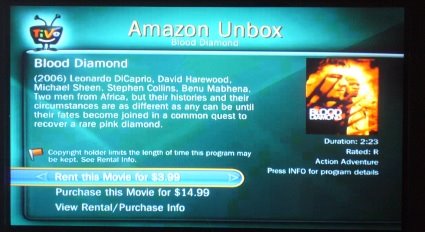
Back to Amazon. The other day my cat unplugged one of my TiVos and I missed an episode of Chuck. Remember the days of looking for friends who recorded stuff? I could've found it online in various ways for free, but it was convenient to just browse for it on Amazon Unbox via the TiVo, from my couch, and order that missing episode just like that. Worth the $2 for savings for my time and hassle.

Early in the year, I cancelled my Netflix subscription which I was never using, because of Amazon Unbox. I don't want to watch video on my PC, either. Now that Netflix and TiVo finally get their act together on streaming, I'll probably check that out over the holidays and see what it's like in terms of content amount and quality of streaming experience.

Gadget Two: This year I also got the Kindle, Amazon's ebook reader. In a year in which I got a new GPS, a Wii, an Ipod Touch, an eeePC, a new laptop from Dell, and a treadmill - this is hands-down my favorite new toy. Especially since I did a lot of international travel this year. I love that I can bump up the font, and read it in bed one-handed. The physical industrial design has gotten a lot of internet flack, but it does what it needs to do just fine. The book and blog experience are terrific, especially for fiction and feeds without too many pictures and long articles. (Pictures don't render fast or well on the b&w e-ink display.)

A typical Kindle set of experiences, which I can personally vouch for:

  • A list of Best Books of 2008 from Amazon editors' top picks -- I'm not so convinced by some of the capsule reviews, but hey, I'll send free initial chapters to my Kindle to check out! In a couple clicks, I've got 8 books to try out.
  • I read and like the first few chapters of one, so when I get to the last Kindle page, I click on "Order this book now." It checks that I'm not making a mistaken click, I confirm, and it downloads in seconds. Hooray! No regrets.
  • Make to Stick keeps getting good press among recent business books. I'm not willing to take up room on my increasingly groaning shelves if I can get this by Kindle - and yep, I can! Sample checks out as actually interesting, I can now read it as one of my background non-fic reads.
  • A friend recommended the Dresden Files books; earlier this fall I got hooked on the bad but addictive Twilight series. These literary wonders-- and more importantly, their sequels-- can be had by Kindle without driving to a store or waiting for mail to come. One click from a late night bed and I can keep reading.
  • I owned The Diamond Age in paper form but did get around to reading it. It's long and the font is small. You know what -- I read it by Kindle instead, since the font can be jacked up to a more reasonable size and carrying it doesn't require muscles. I also own the wonderful Jonathan Strange and Mr Norrell in hardcover, all 1000 pages of it. I will not have to carry THAT around again, I'll be able to read it on the Kindle next time. Er, no, it seems I can't yet - so I'm clicking that link on the left side of the page requesting it be made available by Kindle format. Same for Foucault's Pendulum!
  • I can't keep up with long blogs, or most blogs anymore. But I sure can read Cognitive Daily and MIT Tech Review and a few others by Kindle, when I have a spare minute for the short stuff.
  • Cory Doctorow and a number of other writers are making free ebooks available for their stuff. Cory's "Little Brother" got raves this year. I loaded it on my Kindle by USB cable.
  • Fanfiction - in a moment of weakness on a business trip, I started reading fanfic again, after a few years off. I can send PDF's and Word docs to my personal Kindle address, without having to even plug it into my computer. Yeah, I suppose you could use that feature for something worklike, too. It's unfortunately convenient. There is a LiveJournal community all about this fanfic-on-Kindle habit.
  • I like switching between genres and books and being able to bookmark pages, save clippings for later blogging, etc. I used the "lookup word" function a ridiculous number of times while reading The Diamond Age. It was all that Victorian English.
  • I don't love the web browser "experimental" functionality - it's slow by phone WhisperNet, but it will do in a pinch! I can read my twitter feed on it. I once settled a discussion of what the male version of "ballerina" is using my Kindle from a wireless-free zone of Northern Maine on a bird watching trip.
  • Tom Disch, a poet I liked reading on LiveJournal, killed himself this year. In a sad weekend, I copied and saved all his journal poems into a Word document and loaded it onto my Kindle. Now I can kind of keep him around.
  • Free ebooks... Manybooks is one site, and if you load this Feedbooks guide, when you click on any of the contained book title links, it will automatically download the whole thing to your Kindle. I got myself a bunch of old Rafael Sabatini adventure novels for one trip this way.

I could go on. The Kindle has something to do with me starting to read a lot again, like I used to as a kid. There are some minor negatives, like slow page turning (I would NOT use it for holding reference books), but nothing that overwhelms the good. I still order paper books, and always will; but I have a house busting at the seams with bookcases, and carrying them around isn't always convenient.

The combination of a very long battery life, and small form factor, WhisperNet with excellent Amazon shop experience and sample chapters, make the Kindle way more than the piece of white plastic a lot of people dismiss rather easily. I wouldn't get a Kindle if you expect great web connectivity, a multi-app computer experience, or a backlight... but get it if you read a lot of popular books, and especially if you travel a lot.

In sum, Amazon can take my money, for books and movies. Thanks, Amazon!

Friday, November 28, 2008

Jobs for a Stressed Economy: Smashing Stuff, and Psychics

What do you do when you're stressed? You can pay to throw things, at Sarah's SmashShack in San Diego. Sarah's site says you can come alone or in groups, and throw crockery and other nice breakables in her special smashing rooms. Along with whatever soundtrack you prefer.
Celebrate that break up...good riddance! Celebrate dumping that job you hated anyway! Celebrate that promotion you darn well deserved! You can write on the things you break -- we've got lots of markers for you to use. ... We don't use any "weapons" here...no hammers, sledgehammers, baseball bats, golf clubs, flame throwers (come on!), bb guns, etc. It's all YOU.
According to one article, business is really great right now, since people are understandably super stressed by the economy.

The "menu" is kind of - funny while still a little disturbing? smash shack menu excerpt

Women seem to have written the bulk of the testimonials. I find this rather interesting.

"The best cathartic release around (besides bashing a pole w/a bat). Peaceful angry destruction is very centering. :)" ...Vanessa

"I was a little trepidatious at first, but I loved it! I especially loved writing things on the plates and smashing the bad things. Terrific stress-relief for this stress-filled stay-at-home mom." ...Rachel R

Sarah is clearly a business genius. In another booming business, psychics are doing very well, and more and more men in business are using them, according to this NYT article: "Love, Jobs, and 401k's."

“Your mortgage agents, your realtors, your bankers, you can’t go to these people anymore,” said Tori Hartman, a psychic in Los Angeles. “...People are sensing that the traditional avenues have not worked, that all of a sudden this so-called security that they’ve built up isn’t there anymore. They come to a psychic for a different perspective.” ... Their clients, who include a growing number of men, are often professional advice-givers themselves, in fields like real estate and investments, and they typically hand over anywhere from $75 to $1,000 an hour for this form of insight.

“My Web traffic is up and up and up,” said Aurora Tower, a New Yorker who constructs spidery star charts for her growing clientele. “People will entertain the irrational when what they consider rational collapses.”

The fellow who runs LivePerson.com, a very cool site offering person-to-person consulting on any number of subjects, tracks the rise in his psychic experts' business against the economy. LivePerson.com offers technology and business consultants, home repair consultants, almost anything, and yet...

Live Person earned revenues of $30 million this year, about 70 percent derived from spiritual readers, Mr. LoCasio said. "In this day and age, a spiritual guide is an everyday therapist — that’s what the business has become," he said.

That's what good business sense is all about - staying tuned into what people will still pay for when times are tough. Or, in the case of smashing crockery, offer them things they didn't even know they wanted and could pay for!

Tuesday, November 18, 2008

Women in Computer Science and Tech Jobs: It's Getting Worse

Two recent reports of women in tech careers that are not encouraging. First a link to a NY Times article, "What Has Driven Women Out of Computer Science?" (Thanks to @joandimicco from IBM Research for the link via twitter!) Women have actively declined in computer science programs over the last few years, shown in their chart: Women in other technical and engineering disciplines have increased, but not computer science. Why not? The article recaps theories including lack of computer games for women; "nerds" not being who girls want to be (hey, Willow on Buffy and Mac on Veronica Mars made girl nerds look just fine, if you ask me); and women going into interface design rather than programming - via other college programs rather than computer science. And a possible perception that there aren't jobs for women who major in computer science.

The Stanford Clayman Institute for Gender Research recently published the report "Climbing the Technical Ladder: Obstacles and Solutions for Mid-Level Women in Technology," based on study of Silicon Valley companies. The findings aren't unsurprising for any woman who's been working in computer companies for the last 10 years, even outside Silicon Valley. Some of the observations that rang true for me:

  • "Women are more likely than men to perceive workplace culture as competitive. They do not see their workplaces as true meritocracies; rather, they see cultures that require connections to power and influence in order to advance."
  • "Consistent with prevailing gender stereotypes about women’s abilities, women in management positions are perceived as less technically competent than are their male counterparts. This can create an environment where women are viewed (and can view themselves) as “not fitting in” with the company culture."
  • "Survey results show that mid-level men and women strongly value teamwork. Further, men and women perceive that collaboration is key to success in technology. However, mid-level women see a sharp divide between cooperation and competition at their companies. Mid-level women describe this gap as being especially acute during the promotion-review process, where they find existing promotion and evaluation practices reward competition instead of collaboration."
  • "Mid-level women are more likely than mid-level men to suffer poor health as a result of work demands."
  • Family responsibilities remain a significant problem for women - staying late and flex-time are necessary and often difficult for women to arrange. Women are far less likely to have a partner at home who can manage the family life for them than men are. Men also perceive a "family penalty" in the competitive workplace.
One of the recommendations is to provide opportunity for ongoing technical for all mid-level staff, to allow men and women to retain and sharpen their technical skills, and as a side-effect, give them more networking opportunities. I would agree whole-heartedly; most companies don't invest enough in ongoing skills maintenance and new skill development, for male or female staff. (As a consultant, I'm responsible for my own development, and I've found it amazingly liberating not to have to ask if I can take a course or go to a conference!)

And then there's the supposedly obvious, but rarely acted on: Provide a workplace that shows it values teamwork, rather than competition (most company performance evals and bonuses are handled competitively). Cultivate a workplace with flextime and reasonable hours. Have a diverse executive staff and board (not just a female VP of HR), to signal respect for diversity and also help change the culture from the top down.

At a lot of companies where I've worked, it was well-known at the mid- and sometimes ground level that executives didn't "get along," that there were power games and competitions rather than cooperation and teamwork at higher levels in the company; that long hours were an unspoken rule for success on impossibly demanding jobs.

Most of the time, I just think women are smarter in opting out of the whole tech management game. So why is there any mystery about lack of women in technical management? And in computer science departments?

Sunday, October 26, 2008

UI13 and "Don't Build a Department" for Design

UIE's UI13 conference was fun, even for a volunteer up at 5am every day. A few of the talks really got the adrenaline flowing, including Peter Merholz's "16 (Mostly) Difficult Steps to Becoming a Customer-Experience-Based Organization", and Scott Berkun's talk on "Why Designers Fail".

Merholz's talk outlined a number of points describing successful user experience orgs, including some wise ones I've heard in other similar talks:

  • Execute a quick win [to show your value to the company].
  • Have an executive sponsor.
  • Move up the product planning food chain [i.e., be involved earlier, not just down stream].
  • Have an experience strategy [for the company/products/team].
  • Think systems, not artifacts [a point also made in a recent talk by Don Norman on operations and services, over here].

His final bullet was the admittedly controversial: "Do not become a department." I thought I heard similar sentiments from Jared Spool too, and I have heard this in different flavors from people who cite Amazon's success in building a business based on A/B volume testing of page designs by marketers without usability or interface designers on staff ("let the customers just tell us which one works"), ebay's early success without an empowered design org, etc. The gist of this argument seems to be: Executive mandate for good user experience trumps individuals in the trenches, and good execution requires everyone to play, not just designers. So, have a design-oriented company, not a bunch of designers trying to change a company.

While I agree we want holistic design-oriented companies for better customer experience, I think designers play an important role, if good design matters. Anything that requires skill, training, and practice to do well should be a job in itself, and therefore be a hired position, not a sideline role for someone who is paid to do something else.

Additionally, if you're talking about companies that succeeded despite not having a staff of interaction designers, you might be talking about companies that (1) might have done it faster or more cheaply WITH a staff of designers, or (2) had talented people who were doing design without that job title - have they checked into how they succeeded?, or (3) companies that won as first movers, but could lose in a crowded space with better design and real usability from their competitors. Yes, design isn't the whole story in business success, but it's often important, depending on the competition. And to me it's a moral requirement for a customer-oriented business.

Scott Berkun's pre-conference survey on reasons for designer failure found that the top 2 reasons were agreed to be "People in non-design roles [are] making design decisions," and the related and subsumed "Managers [are] making design decisions without design training." I believe that if you haven't got a strong design department with a recognized skillset and/or haven't empowered your designers in the org, you'll get a committee effect, and design outputs will be worse as a result. (See also Scott's excellent article "The List of Reasons Why Ease of Use Doesn't Happen on Engineering Projects.") Berkun's audience of designers, managers, project managers, and developers also seems to believe this, contrary to Merholz's last point. (Caveat: It's possible that Merholz's position was "hire designers but don't have them grouped in a department, have them spread throughout the company." But a department makes it possible to argue for headcount, achieve hiring and management consistency, enable organizational empowerment, and accountability; NOT having a department makes these things harder and really kind of a crapshoot long-term.)

Another broad theme of many of the UI13 talks was the importance of the strategic role of design in defining the right projects and requirements before design processes start in earnest. While it was valuable to see how many consultants and design agencies do this--often playing a "facilitation" role with their clients' ideas--the reality of most software companies is that product managers (or their equivalent) are making these decisions, and designers live further downstream. The ideal is otherwise, but that's how it often is.