

Berkun posted an idle conversation starter on what he called "asshole-driven development" and the responses brought down his server. Then Lost Cog did some content analysis of the styles of development described by the comment thread. It seems to be going on and on. Some of the original categories identified:
As some posters and Scott noted, bad development management may be subtypes of general Management Antipatterns, like "Death by Planning."
And I'd note that these techniques aren't limited to management of technical problems, but also exist in any other project context, in slightly different forms.
 And a friend sent a link to a great animation of a flash victim getting destroyed by the app. Lots of in-jokes for designers who use Flash, and hilarious anyway. You definitely want sound on for it.
Some highlights:
This said, I have seen the teamwork and normative workplace culture taken to extremes of unhealthiness, usually to the detriment of new hires with different ideas from other places. It's possible to be both infused with creative new ideas that threaten your status quo AND ship products, in my opinion. It's a challenge for mature management! To test your own culture: Check carefully how many managers, especially senior ones, were promoted from within versus hired externally. Then look at how experienced the people being hired are (sometimes, very). It might tell you something interesting about status quo thinking versus desire for fresh input.
Another test of your culture: In interviews, does the corporate "fit" come across as paramount, or the resume and evidence of work product elsewhere? I once watched a very senior statistician get turned down in favor of a more junior candidate who was just like everyone else in her skillset. I didn't fight hard enough myself on that one, I was part of the problem.
Defying authority certainly doesn't go over well in most corporate cultures I've worked in. Hierarchy is very much part of the American firm (Larry Prusack pointed this out recently at a great Boston CHI talk)-- the larger and more established the company, the more ingrained it is. I think there's a function related to size, corporate age, hierarchical position, and a person's tenure at a company that will predict how resistant she/he is to new ideas about doing things differently. Because large, successful companies are most reluctant to change what they do now (which is making money), for some sensible reasons: shareholders, golden handcuffs, employees to retain and feed, etc.
For designers, this often cashes out in how much change to an old shipping product you can make... a lesson it took me many jobs to really understand. (Note to designers hunting for jobs: Don't believe them when they say you're going to redesign it, especially if it's selling! The inertia will be strong and may become an actual undertow.) Historical success limits how much change you can make to processes that produced a selling product, even if they were flawed or painful in various ways for the people who worked on it. People are always more comfortable the way things are, regardless of what could be better.
Edited to add: It's a cultural failure mode to assume that everything is great or okay as is, but it's another one to fail to critically understand your successes, too. You can do root cause analysis for the good things too, and it might even teach you more than the failures do. If you aren't good at understanding success, you can't duplicate it, and you might make the critical morale error of celebrating the wrong factors.
Of all the weird ideas, the sensible-sounding "punish inaction" is particularly hard to see really happening in most offices. Few people are ever fired for not rocking the boat. People who aren't often noticed usually have a job for life, as long as their company keeps doing the same old expected thing.
I want a search agent that's heavily customizable to send me updates when certain things happen. What I specifically want is the ability to watch for fares of certain types to specific places FROM MY LOCAL AIRPORTS, or fares for vacation deals, again, FROM MY LOCAL AIRPORTS.
Sample criteria I want to have an agent look for:
PS. If someone wants to start this business, I'd be very motivated to help design it and to collect more requirements. Drop me a note.
I get challenged occasionally as to why a seemingly well-educated, presumably rational person would be interested in the paranormal. I'm always a little surprised by this question: Why not? Do we know everything? Isn't it rational and intelligent to assume we don't yet? Remember, a UFO is just unidentified, it's not necessarily from another planet. It's interesting to me that there are so many worth talking about, and the stories people tell about them are interesting in themselves. I'm certainly open to believing in many things, while being a strong skeptic about what counts as good data and strong argument.
Another really entertaining collection, equally amateur web-design but much easier to use: The Photo Galleries of Mystery from the MMMGroup. Truly, if you like archaeological mysteries, this is the place to browse. Make sure you hit page two, too. It might make you wonder about time travel... The phenomenon of OOPARTS, or Out of Place Artifacts, is a strong feature of the pictures of rock carvings (people with lightbulbs, space suits...) and fossilized items. Here's a blog post about this type of find with particular reference to a find in 19th century Massachusetts, a metal fossil apparently blasted out of solid rock.
On the other hand, sometimes these things are explicit funny fakes; here's a guy who briefly got away with rock art depicting a caveman pushing a shopping cart in a British Museum Exhibit (2005).
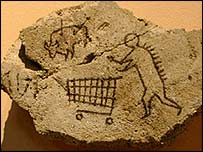
Banksy also hung a sign saying the cave art showed "early man venturing towards the out-of-town hunting grounds". It read: "This finely preserved example of primitive art dates from the Post-Catatonic era. The artist responsible is known to have created a substantial body of work across South East of England under the moniker Banksymus Maximus but little else is known about him. Most art of this type has unfortunately not survived. The majority is destroyed by zealous municipal officials who fail to recognise the artistic merit and historical value of daubing on walls."
Fortunately, respect for this sort of parenting outside the board room is dwindling as baby boomers disappear from the parenting picture and Gen-Xers take their place. Sylvia Hewlett presents research to show that while baby boomers are willing to work extreme hours, younger people scoff at the idea of doing that for more than a year. And recent polls (via Hole in the Fence) show that men are sick of the long hours and want more time with their kids: Almost 40 percent of working dads would take a pay cut to spend more time with their kids. It'll be a great day when CEOs are dismissed for neglecting their kids. Meanwhile, employees, beware: CEOs like Stringer and Immelt have a negative effect on your own ability to keep your personal life intact, because work-life policy starts at the top and trickles down.
Amen. Some ways to figure out what the real corporate values around work-life balance are: Do people regularly have email exchanges on weekends or at strange hours of the night? (When you start a contract, do the execs welcome you via email sent on the weekend? :-) Who's still working at 7pm in the office?
Another point I'd add: How effective are they if they have that much to do, even at the office where they spend all their time? Executives at one of my past companies-- who praised it as an "aggressive" company with no ability to promise new hires good work-life balance and reasonable hours during their growth plans-- were themselves too busy to pay attention to many of the critical management issues that cross their desks! They're way past the tipping point on being good parents at the office, or good peers-- blowing off visiting VPs, even-- never mind what their wife and kids think of them for neglecting them! (This is, of course, my own opinion on them as seen from the middle management trenches, and may not be their own or their peers' opinions.)


WHAT?
UX Boston Kick-Off Meeting AND presentation: "Design for Online Communities: Past the Hype!" by Lynn Cherny, PH.D. (User Experience Consultant & Author)
WHEN? 7 to 9 p.m. Tuesday, June 26th
RVSP by Friday, June 22nd required: please send an e-mail to: [redacted due to spam] with your name and your company information.
WHERE?
One to One Interactive
Schraft Center | Suite 209 (2nd Floor)
529 Main Street
Charlestown, MA 02129
There is a free public parking lot at the Schraft Center.
DIRECTIONS
MORE ABOUT THE PRESENTATION:
Successful online community creation requires an understanding of both social and technical design challenges, as well as skills you may not realize you need in your organization. Face-to-face study of community predates the Internet by at least two centuries, and has been done within sociology, anthropology, and linguistics. I will review some academic background on what makes a "community," whether online or offline, and then show how these notions apply online in the form of useful design principles. I'll wrap up with some metrics for evaluation based on your choice of definitions, taking you beyond simple page views and number of members.Bio: Lynn Cherny's books Conversation and Community (1999) and Wired_Women (1996) were classic web 1.0 studies of online community that were used in many graduate classes. Since her research days, she has been a designer and manager at Excite.com, TiVo, Adobe, Mathworks, and Autodesk.
ABOUT UX BOSTON:
UX Boston is a new local branch of the User Experience Network, (Uxnet.org.) Our goal is to foster cross- disciplinary conversations and create connections across UX-related disciplines in the Boston area, including design, information architecture, usability, and technology development. We also serve as a bridge between other local and national UX-related groups. Membership is free and open to Boston-area UX professionals. For more information, and to help influence our meeting content, please visit: http://tech.groups.yahoo.com/group/uxboston/
Here's my remapping to design:
One of my favorite parts is on the myth that "good ideas are hard to find." Why, no, they're not, but execution is hard. Which segues nicely to his other book; in my experience, a lot of organizations have grand product plans and grand business goals, but execute very, very poorly. The customer only ever sees a fraction of it, and often the worst fraction.
Some of the sentiments that kill good ideas before they even get to fail by execution include: "We don't have time," "That never works," "We don't do that here," "We tried that already," "That won't make enough money." A longer list lives here on Scott's Blog. I'd add the question: "Who are you, again?" Or the related, "You're here to listen, not talk" (which I've actually heard).
The issue of time is the biggie, from what I've seen in my past few companies. The execs may be reading books about innovation (for whatever reason), but at the operational level, everyone is signed up for way too much work. They can't succeed at what they've agreed to do, but they're trying anyway. Why would anyone want to sign up for more, regardless of how cool the idea is?
I have the same feeling about brainstorming; as a concept it's all warm fuzzies, considered obviously valuable, although it's often poorly or incorrectly executed (as Scott points out). In practice, though, not everyone's ideas ARE considered equivalent, precisely because of this economy of time available to the participants; given a small, finite amount of time to think and make decisions, why pay attention to the crazy sounding new kid's idea, instead of the seasoned manager who deserves to get his say because he's proved himself, right? In a more applied, problem-solution context, the more seasoned people are assumed to "know the code" or "know the users" better and therefore their opinions are worth more. It's been said out loud. It's basic human sense, right? And the less time people have, the less they're willing to extend themselves to be open.
Successful innovation might require fewer over-ambitious projects, acceptable risk and play (meaning: someone isn't working on your critical shipping "normal" work and that's okay, and not overtime work for them), plus a commitment to try to listen to all voices differently, no matter what the problem is: new product, new feature, or old ordinary problem you have to solve on an ordinary project. I'll come down strongly in favor of that last -- I think innovation can happen on "old" projects, too, and it should, to keep them viable and interesting to developers and customers.
But good project management is always needed to help you actually plan and then ship something! It's still innovation once it's in the development phase, even if it feels like just "work" then. The team needs to be supported, rather than having their work taken for granted as "a done deal" while managers go off looking for the next big idea.
I can't find it now, but one of my favorite lines from Myths of Innovation goes something like, "Successful ideas, like happy pets, are shared among many people who care about them deeply." Pet them, sometimes.
As a consultant now, and a survivor of (too) many companies, I do and have done a lot of interviewing. As a manager, I interviewed a lot of people while hiring (especially at TiVo and Autodesk). Joel is a good guy to follow on this subject, and I find his points can be extended to interviewing for designers and good employees in general. Failure to hire well (or take the right job!) is sometimes your fault!
Some things to consider when interviewing people to hire or interviewing for a possible job yourself:
Ways you can avoid bad interviewing, as an interviewer, apart from having design/code tests and the other things Joel talks about:
Following up on my previous post on this... On Sutton's blog, he has a No Asshole Rule Roundup of comments he's gotten. One is quite well-taken: the subtle asshole is just as bad or worse than the flamingly obvious asshole, in their effect on morale. Sutton agrees: "Indeed, these more subtle assholes actually can often get away with doing more damage than their more 'over the top' and less politically skilled counterparts."
While googling around, I ran into this well-observed book review: Disorganized, Incompetent and Dangerous: Workers Dislike Manager Incompetence Even More Than Abuse, Study Suggests. The review is for a book I have since ordered but not yet read, Dignity at Work, by Randy Hodson. Some points from the article about it:
He found that abuse by managers was significantly connected to negative employee actions such as absenteeism and withholding effort on the job. However, the research found an even greater connection between mismanagement and these same negative employee actions.
"Nobody likes abuse, but employees can find ways to work around abusive managers. But employees don't want to be involved with chaotic, mismanaged workplaces where nothing gets done well and people feel like they can't be effective," said Randy Hodson, professor of sociology at Ohio State.
"The thing that undermines dignity more than anything is incompetence and mismanagement."
I spoke with someone recently who told me how much he'd learned from someone competent who had managed with a big stick approach, arguably an asshole by Sutton's criteria. But he had respected the guy anyway. It seemed to me in listening that he had tolerated it while he was learning, and then moved on to a more humane work environment. You decide the moral, if there is one.

Work by Matthew Hurst on mapping the blogosphere has been blogged around recently, particularly because of his cool hyperbolic graphs of the huge data set of linkages, one shown above. I post here because I've got friends reading on LiveJournal -- I know LJ folks occasionally wonder why the press about social networking sites rarely mentions LJ, favoring MySpace and others. One reason may be that LiveJournal is a fairly close-knit and separate community site, with a lot of internal links via friends lists, and not a lot of other blogging post cross-over or linkage in. (I don't know how he handled syndication on LJ friends lists, if at all.)
LiveJournal's small network cluster is shown in the image as cluster #3. The others are (1) DailyKOS, (2) BoingBoing, (4) other political bloggers, (5) porn, and (6) sports fans. LiveJournal is further out than the porn fans, but bigger! Smaller than sports fans, though.
If you didn't, the gist is this:
The Story Map is a social network diagram of a wedding party, with the arcs annotated by relationship facts that link the nodes. It's beautiful and inspirational. Why are social network pics not funnier in general; relationships are, right? (Well, some. I guess professional ones aren't very. At least the publishable diagram versions.)

Next is a bigger investment, but worth it if you love detail (of the really obsessive type). An art project by Media A of massive size (10 meters), it's a representation of a fictitious designer's life spanning a century into the future. The Networked Designer's Critical Path is a PDF (3 MB) that takes time to download, but I guarantee it's very amusing and science fictional. Here's an excerpt (English in light gray):

Notice the chronic over-networking issue in the center there. Heh. My printer dialog says it would be 171 pages if I tiled to print this sucker at 100%. I'm tempted anyway.
These cool applications let you watch digg news stories being posted and re-dugg in real-time. They're all good at different things, and compelling for different reasons.
My favorite in terms of "hypnotic to watch" is the swarm. It's eye-candy for the ADD set.

It does have some issues as a tool, however -- if I were them, I'd have prioritized the display of the text identifying the article over the other graphics, rather than letting it mix in with the background (see above). Also, I don't entirely understand the beautiful mysterious arcs that sometimes appear, but I'm not sure I care, either.
While watching a bunch of these, the role of time gets problematic for me. I'd like to be able to replay, or step backwards (like if I missed a cool event in the swarm). And watching the big arc display for "newly submitted" in the category of science is really boring, or was on Saturday night. (See if you can even figure out how to do that that!) Finally, I would far rather go right to the article itself than click through the digg page first. That's a minor quibble, though.
There's a definite long-tail problem on digg, isn't there -- lots of the same stuff gets dugg, and it's hard to find high-quality new stuff that matches your interests.

