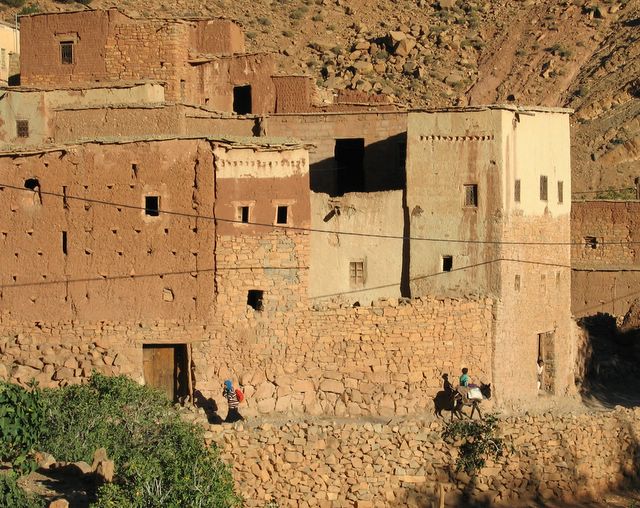
Morocco, Atlas Mountains, October 2006
Sunday, October 15, 2006
Atlas Mountains at Sunset
One of my vacation nights involved a hike into the mountains.

Saturday, October 14, 2006
The Powerset Blogstorm
Can anyone beat Google? Well, the natural language processing community is having a go at it. I got back from 2 weeks of vacation to discover that an old friend and mentor from grad school days is now at startup Powerset, co-founded by Barney Pell, whom I knew as a grad student in Cambridge years before. There've been a rash of articles in the blogosphere about their announcements, as Barney summarises:
Barney Pell's Weblog: The Powerset Blogstorm: 1 week later.
Yet more evidence that startups are back and interesting again! And this time they want UX people earlier rather than later, which is a nice change for the industry.
Tuesday, September 26, 2006

Sunday, September 17, 2006
Why Crunch Mode Doesn't Work
I have long been fascinated (and disgusted) by the lack of government, union, or HR care for the abuse of workers in the software industry. During the dot com era, I actually heard it touted as an intentional strategy by some Silicon Valley managers to hire young programmers right out of school who would work long hours for little pay and were considered "disposable." Mostly, they were disposed of, by burn out.
This attitude was reflected a little more indirectly in the cuts in benefits and pensions everywhere including major companies like AT&T, layoffs in which senior people were cut on the principle that they were easy to replace; among other people mismanagement decisions that seemed to me to be incalculably stupid. Incalculable, unfortunately, because the decisions and decisionmakers at these companies were protected by layers of indirection (about the reasoning, minimally) and because there is profound difficulty in measuring the damage to the company, products, and customers, both long and short term. Stupid, because the people in the trenches doing the work understood the impact every day, in terms of workload, quality of work, culture, their attachment to the company, belief in the industry and in what they were doing...
More than one person I knew who was young and abused in the dot com era decided they were "getting out," went to open a record store (or flower shop) and never looked at a computer again. In an era of declining enrollment in computer science programs, we as an industry can't really afford that.
Here's a guy in the game industry--one of the most famously abusive software sectors--trying to make the case with a fairly well-researched article on the subject: IGDA - Articles - Why Crunch Mode Doesn't Work: 6 Lessons. Tagline: There's a bottom-line reason most industries [except the software industry] gave up crunch mode over 75 years ago: It's the single most expensive way there is to get the work done. Of course, in the software industry, quality hasn't mattered that much, till recently. Will things change? Will software management change? Will the calculation become easier to make to argue against the stupid?
And here's an article, only tangentially related, but I think still related, on why America is lagging in R&D. The State of Research Isn't All That Grand. R&D is being outsourced, because it's cheaper that way; and R&D is "hard to measure" because it's a long-term investment. Most American companies aren't actually that good at long-term anything, in a profits-now-or-your-bonus-is-impacted business world.
Why hasn't Built to Last had more impact?
Sunday, September 10, 2006


Thursday, September 07, 2006
Cheap Tickets
Over the weekend I caught up on Lifehacker, and found a bunch of posts and comment posts related to finding cheap airline tickets. Some were quite surprising to me -- like shop between 12 and 1am on Wed morning when companies update their records.
TripStalker -- a bot utility that continually looks for your best price and notifies you when it finds it.
Lifehacker thread of comments on this topic.
Another link collection on cheap ticket gimics.
Lots of people mentioned Sidestep (I use occasionally) and kayak.com, and travelocity doesn't fare too badly in the listings.
A fluffy photo post: Rabbits and Flickr Stuff
A friend sent me this link to some hilarious rabbit photos: My Rabbit Disapproves.
Just after laughing a lot at the justice in this woman's photo captions, I found this new flickr tool for browsing pic categories, which I spent a fair amount of time enjoying when I should have been driving to Nantucket. The search on bunnies turns up some really nice rabbit pics, not disapproving in the least. Cats are okay, but not as nice a collection. Gargoyles are a good contrast, and turn up a surprising number of cat pics. Or, perhaps not surprising, to a cat owner.
Monday, September 04, 2006
Youth Hostel, Nantucket.
It's a good thing I'm not too old for youth hostels yet, or I would have missed this pretty building on the south side of the island.



Sunday, August 20, 2006
More on Skunk Works
Following up on yesterday's post, and pointed to some stuff by Steve C: some radically different skunk works innovation stories, with huge business success.
Firstly, the actual original Skunk Works at Lockheed, and a list of their principles for successful operation. A few of the more interesting ones, applicable to software:
The principles point to small, flexible, efficient, with well-understood budget and cost accounting procedures; and in sharp contrast to most other skunk works projects in software, blessed by directorial or higher level executive support who gives them autonomy.The contractor must be delegated the authority to test their final product in flight. They can and must test it in the initial stages. If they don't, they rapidly lose their competency to design other vehicles.
There must be mutual trust between the military project organization and the contractor with very close cooperation and liaison on a day-to-day basis. This cuts down misunderstanding and correspondence to an absolute minimum.
The number of people having any connection with the project must be restricted in an almost vicious manner. Use a small number of good people (10% to 25% compared to the so-called normal systems).
A very simple drawing and drawing release system with great flexibility for making changes must be provided.
Finally, I like this nice quote at the bottom of the principles list: "Reducing the time to evaluation of a system almost always leads to lower costs, greater flexibility for change, improved overall performance, and less risk."
For a sharp contrast, there's this classic and fun read on the creation of the Graphing Calculator at Apple by two unemployed guys who snuck into the building to work on it anyway. It reads like fiction, but you know it isn't. I admire them for their attitude towards teamwork and quality, if not corporate legality.
Next, we needed help writing software to draw the three-dimensional images that our software produced. A friend with expertise in this area took a weekend off from his startup company to write all of this software. He did in two days what would have taken me a month. My skunkworks project was beginning to look real with help from these professionals as well as others in graphic design, documentation, programming, mathematics, and user interface. The secret to programming is not intelligence, though of course that helps. It is not hard work or experience, though they help, too. The secret to programming is having smart friends.They have a nice page of lessons learned from designing for the PowerPC, and it has a nice list of UCD items in it, as well as some smart observations on how to do screen-drawing behavioral things that are important to users rather than just clever or fast because they can be.
The goal is to maximize use of whatever processing power is available in the design of the user interface...I suppose one of the things I like about their story, apart from the lesson that "it takes a team of different skills to make something really good," is that they did a good root cause analysis of their success. You can't replicate what you don't understand. Although their motives in doing this while unemployed were admittedly murky to the end of the story. This kind of thing wouldn't have flown at Lockheed.
- Tackle expensive computations when they can improve the interface.
- Eliminate dialogs and command lines in favor of direct manipulation.
- Drop old assumptions and idioms. Use the processing power to explore new interfaces.
- Provide a starting point for exploration.
- Avoid programming cleverness. Instead, assume a good compiler and write readable code.
- Invest development time in user-centered design.
- Learn the new rules for performance.
- Design tiered functionality: take advantage of whatever hardware you're running on.
- Test on real users.
Finally, here's a link to an article on What Drives Innnovation (pdf) with some case studies and lessons learned. Their heuristic process to decide if an innovative idea is worthwhile for the business or executable inside a business culture is simple, but it's hard for me to figure out what to take from it... Despite the "possibly" and "no" frequency in some of the case studies, the idea was still successful. So, hmm. But worth a read.
Saturday, August 19, 2006
Secrets of Great Teams
There are some nice short articles on teamwork in business at CNN's site for Fortune.
The top story, Why Dream Teams Fail, points out some of the failure modes also described in other resources on teamwork, but in somewhat different terms:
- Signing too many all-stars
- Failing to build a culture of trust
- Tolerating competing agendas
- Letting conflicts fester
- Hiding from the real issues
The article on the Motorola RAZR is a little painful; it's another case of skunk works innovative design breaking corporate rules and even breaking human factors rules. The importance of risk-taking and mold-breaking comes up a lot in these kinds of business success tales.
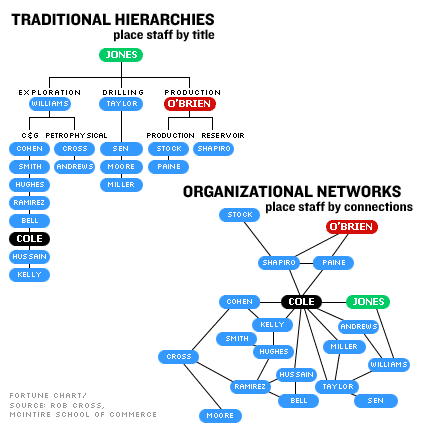
A good sidebar piece looks at optimal size of teams: 4.6 people. Another one looks at the network of communication in an organization and how it differs from the org chart. You know I love anything that looks beyond the tree and makes networks:
Sunday, August 13, 2006
Excel Tricks
Gotten off Information Aesthetics, and making my weekend a thing of beauty (well, also the good weather helps): Lightweight data exploration in Excel, from Juice Analytics.

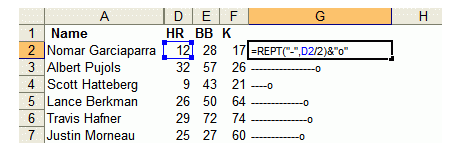
This is so simple it's genius. I feel like a dork for never thinking of it. These are some lightweight way to create visuals like sparklines inside your Excel spreadsheet using really simple formulae. (This will be built-in in Office 12, but meanwhile, why wait?)
The bar graphs are built using the Excel REPT function which lets you repeat text a certain number of times. REPT looks like this:=REPT(text,number_of_times)
For instance, REPT(”X”,10) gives you “XXXXXXXXXX”. REPT can also repeat a phrase; REPT(”Oh my goodness! “,3) gives “Oh my goodness! Oh my goodness! Oh my goodness! ”
For in-cell bar charts, the trick is to repeat a single bar “|”. When formatted in 8 point Arial font, single bars look like bar graphs. Here’s the formula behind the bars:

As the guy notes, when you're doing data exploration, you don't want to struggle to figure out which values created which outliers. Big plots are nice for an overview, but you still have to do work to figure out which items generated which points. ("Data brushing" is the common technique in infovis circles for getting this kind of info, but it's work to implement.) Why not get at what you want right in the spreadsheet itself, so you're looking at the data and the visual right at the same time? He has a good example showing the value of this in action.
The followup responses to his original post got even better. Check out these tricks to do this kind of stuff:
Updated to add: Here's even more fun off Juice! Tufte-style charts in Excel, with a downloadable file to play with.
Saturday, August 05, 2006


Saturday, July 29, 2006
The Anomalist Roundup
Every weekend I love catching up on The Anomalist. Here are some picks from last weekend (that I never had time to post):
Here's a link to a strangely sincere article about recording things backwards and finding coherent messages (not just in trippy albums).
Shortly afterwards, my little hobby took a dramatic turn when I accidentally stumbled across the phenomenon in normal human speech. One of the first examples I found in speech was in Neil Armstrong’s famous first words as stepped onto the lunar surface. Forwards he says, “That’s one small step for man,” and when this same track is played backwards, the words “Man will space walk” can be clearly heard.Suddenly my little hobby had turned into an obsession. I began taping as many people as often as I could and I found backward messages to be prolific, many of them as clear as the forward dialogue, occurring in grammatically correct sentences that often related to what was being said forward. I searched libraries and bookshops trying to find any other work on the subject and could find none. It then became obvious to me that this was a field that was totally new.
Uh huh. And here's a tangentially relevant piece on language oddity, a story of a feral girl who grew up with dogs in Ukraine. Like most stories of abandonned children, it's sad and disturbing. She's mentally handicapped. The worst part is how she treats her dog.
Here are three good pieces that collect strange stories. A piece from Pravda (unusually coherent for Pravda) on messages written in the sky throughout history; an article on sightings of flying people (without airplanes); and scary stories of Spring-Heeled Jack, a wacky killer ghost.
Finally from the land of dunes, King Tut's oldest gem may be from a meteor, because it's way too old; and sand dunes sing (sound snippets and article).
Sunday, July 16, 2006
Puffin Pics Album
Finally, after about 15 years of missing the puffin season everywhere I travel (Scotland, Maine, UK...), I went on a special puffin trip to Nova Scotia. I got a few good pictures, although not many of them in flight, the classic silly puffin shot. Surprisingly, I like the water ones best!

Saturday, July 15, 2006
Social Isolation Growing in U.S.
A much blogged social networking article: Social Isolation Growing in U.S., Study Says. Putnam's famous Bowling Alone was on this topic, and things have only gotten worse, apparently.
A quarter of Americans say they have no one with whom they can discuss personal troubles, more than double the number who were similarly isolated in 1985. Overall, the number of people Americans have in their closest circle of confidants has dropped from around three to about two. The comprehensive new study paints a sobering picture of an increasingly fragmented America, where intimate social ties -- once seen as an integral part of daily life and associated with a host of psychological and civic benefits -- are shrinking or nonexistent. In bad times, far more people appear to suffer alone. "That image of people on roofs after Katrina resonates with me, because those people did not know someone with a car," said Lynn Smith-Lovin, a Duke University sociologist who helped conduct the study. "There really is less of a safety net of close friends and confidants."
Barry Wellman, known for his studies of internet community networks, suggests that people have more diverse network connections and spread out their needs among different links. Hmm. I'm reminded of Oldenburg's Great Good Place, about the increasing lack of "third" places like bars or community centers, not work or home sites, in which people hang out and have social lives. Suburbia is particularly prone to this problem (except in NJ, where all the kids hang out and smoke at the all-night diners).
Some of the concerns this raises are that isolated people are more depressed, more prone to illness, potentially to crime...
Sunday, July 09, 2006
Reforming Project Management
This is an excellent blog on project management and development: Reforming Project Management. It also, coincidentally, happens to be written by someone who works in the AEC industry (architecture, engineering, construction), which might interest some people I work with.
I like it because it has good stuff on quality (lots on Toyota right now), some good book pointers, and some nice commentary on methods in projects and leadership. I just read the entire current page of articles from the top down, without realizing I was still on the same site.
Hal's definition of project: "A project is a single-purpose network of commitments undertaken by a temporary social system."
Face it. Projects are temporary organizations. People come together on projects as strangers. We're not likely to change that. What we can do is make sure people share a context, have intentions that are aligned, and have a relationship that allows them to successfully coordinate action together.
And while I'm at it, this isn't at all a bad article on Dr. Dobbs about short-term-high-profile-crisis projects: Quick-Kill Project Management. The authors suggest 3 things are indispensable, for project success under really crappy crisis conditions:
- Vision and scope document
- Work breakdown structure
- Code review
Simple Names and the Stock Market
Not a result that will please some businessmen, but it seems that there is statistical evidence that companies with simpler names and/or companies with simple stock ticker symbols perform better on the market. Human processing may be the reason. Note, however, that it's not a sole predictor -- TiVO would have done better long term if it were, sigh.
In fact, across the entire NYSE and AMEX markets, Alter and Oppenheimer calculated $1000 invested in shares with pronounceable ticker codes would have netted $85.35 more profit after one day compared with an equal amount invested in companies with an unpronounceable ticker code.Citation: BPS Research Digest: Why you should invest in shares with simple names.
Saturday, July 08, 2006
Nova Scotia Animals Pics
A bunch of animal photos are up on this gallery.
 It was a hot day -- so there are lots of sleepy, cuddly looking animals and only a few scary ones. Check out the bunnies, otters sleeping on their backs, porcupine draped over a tree branch, and fierce eagle in a kiddy pool.
 It was a hot day -- so there are lots of sleepy, cuddly looking animals and only a few scary ones. Check out the bunnies, otters sleeping on their backs, porcupine draped over a tree branch, and fierce eagle in a kiddy pool.

Subscribe to:
Posts
(
Atom
)