Sunday, August 20, 2006

More on Skunk Works

Following up on yesterday's post, and pointed to some stuff by Steve C: some radically different skunk works innovation stories, with huge business success.

Firstly, the actual original Skunk Works at Lockheed, and a list of their principles for successful operation. A few of the more interesting ones, applicable to software:

The contractor must be delegated the authority to test their final product in flight. They can and must test it in the initial stages. If they don't, they rapidly lose their competency to design other vehicles.

There must be mutual trust between the military project organization and the contractor with very close cooperation and liaison on a day-to-day basis. This cuts down misunderstanding and correspondence to an absolute minimum.

The number of people having any connection with the project must be restricted in an almost vicious manner. Use a small number of good people (10% to 25% compared to the so-called normal systems).

A very simple drawing and drawing release system with great flexibility for making changes must be provided.

The principles point to small, flexible, efficient, with well-understood budget and cost accounting procedures; and in sharp contrast to most other skunk works projects in software, blessed by directorial or higher level executive support who gives them autonomy.

Finally, I like this nice quote at the bottom of the principles list: "Reducing the time to evaluation of a system almost always leads to lower costs, greater flexibility for change, improved overall performance, and less risk."

For a sharp contrast, there's this classic and fun read on the creation of the Graphing Calculator at Apple by two unemployed guys who snuck into the building to work on it anyway. It reads like fiction, but you know it isn't. I admire them for their attitude towards teamwork and quality, if not corporate legality.

Next, we needed help writing software to draw the three-dimensional images that our software produced. A friend with expertise in this area took a weekend off from his startup company to write all of this software. He did in two days what would have taken me a month. My skunkworks project was beginning to look real with help from these professionals as well as others in graphic design, documentation, programming, mathematics, and user interface. The secret to programming is not intelligence, though of course that helps. It is not hard work or experience, though they help, too. The secret to programming is having smart friends.
They have a nice page of lessons learned from designing for the PowerPC, and it has a nice list of UCD items in it, as well as some smart observations on how to do screen-drawing behavioral things that are important to users rather than just clever or fast because they can be.
The goal is to maximize use of whatever processing power is available in the design of the user interface...
  1. Tackle expensive computations when they can improve the interface.
  2. Eliminate dialogs and command lines in favor of direct manipulation.
  3. Drop old assumptions and idioms. Use the processing power to explore new interfaces.
  4. Provide a starting point for exploration.
  5. Avoid programming cleverness. Instead, assume a good compiler and write readable code.
  6. Invest development time in user-centered design.
  7. Learn the new rules for performance.
  8. Design tiered functionality: take advantage of whatever hardware you're running on.
  9. Test on real users.
I suppose one of the things I like about their story, apart from the lesson that "it takes a team of different skills to make something really good," is that they did a good root cause analysis of their success. You can't replicate what you don't understand. Although their motives in doing this while unemployed were admittedly murky to the end of the story. This kind of thing wouldn't have flown at Lockheed.

Finally, here's a link to an article on What Drives Innnovation (pdf) with some case studies and lessons learned. Their heuristic process to decide if an innovative idea is worthwhile for the business or executable inside a business culture is simple, but it's hard for me to figure out what to take from it... Despite the "possibly" and "no" frequency in some of the case studies, the idea was still successful. So, hmm. But worth a read.

Saturday, August 19, 2006

Secrets of Great Teams

There are some nice short articles on teamwork in business at CNN's site for Fortune.

The top story, Why Dream Teams Fail, points out some of the failure modes also described in other resources on teamwork, but in somewhat different terms:

  • Signing too many all-stars
  • Failing to build a culture of trust
  • Tolerating competing agendas
  • Letting conflicts fester
  • Hiding from the real issues
The most interesting notes in there were on the difficulty of finding dream executive teams, because as you climb the ladder, you're supposed to be an all-star. So of course there's less likelihood of collaboration and trust at that level. When there is, it's usually a pair consisting of one famous "outward-facing" figure, and a lesser known, internally focused-on-execution person.

The article on the Motorola RAZR is a little painful; it's another case of skunk works innovative design breaking corporate rules and even breaking human factors rules. The importance of risk-taking and mold-breaking comes up a lot in these kinds of business success tales.

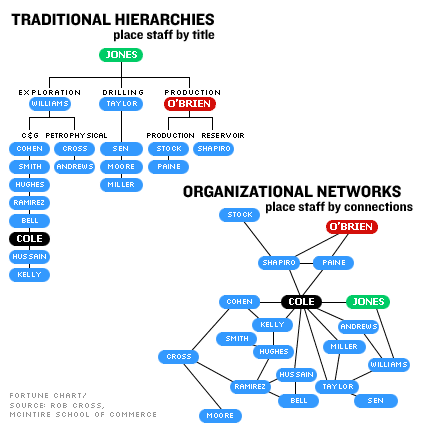
A good sidebar piece looks at optimal size of teams: 4.6 people. Another one looks at the network of communication in an organization and how it differs from the org chart. You know I love anything that looks beyond the tree and makes networks:

Sunday, August 13, 2006

Excel Tricks

Gotten off Information Aesthetics, and making my weekend a thing of beauty (well, also the good weather helps): Lightweight data exploration in Excel, from Juice Analytics.

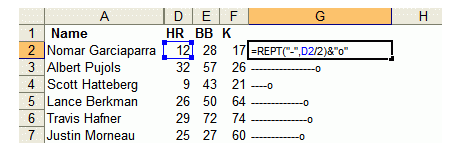
This is so simple it's genius. I feel like a dork for never thinking of it. These are some lightweight way to create visuals like sparklines inside your Excel spreadsheet using really simple formulae. (This will be built-in in Office 12, but meanwhile, why wait?)

The bar graphs are built using the Excel REPT function which lets you repeat text a certain number of times. REPT looks like this:

=REPT(text,number_of_times)

For instance, REPT(”X”,10) gives you “XXXXXXXXXX”. REPT can also repeat a phrase; REPT(”Oh my goodness! “,3) gives “Oh my goodness! Oh my goodness! Oh my goodness! ”

For in-cell bar charts, the trick is to repeat a single bar “|”. When formatted in 8 point Arial font, single bars look like bar graphs. Here’s the formula behind the bars:

As the guy notes, when you're doing data exploration, you don't want to struggle to figure out which values created which outliers. Big plots are nice for an overview, but you still have to do work to figure out which items generated which points. ("Data brushing" is the common technique in infovis circles for getting this kind of info, but it's work to implement.) Why not get at what you want right in the spreadsheet itself, so you're looking at the data and the visual right at the same time? He has a good example showing the value of this in action.

The followup responses to his original post got even better. Check out these tricks to do this kind of stuff:

Updated to add: Here's even more fun off Juice! Tufte-style charts in Excel, with a downloadable file to play with.

Saturday, August 05, 2006

Graves in the North End, Boston

Joanna Grant, Copps Hill, Boston

Here Lyeth

Saturday, July 29, 2006

The Anomalist Roundup

Every weekend I love catching up on The Anomalist. Here are some picks from last weekend (that I never had time to post):

Here's a link to a strangely sincere article about recording things backwards and finding coherent messages (not just in trippy albums).

Shortly afterwards, my little hobby took a dramatic turn when I accidentally stumbled across the phenomenon in normal human speech. One of the first examples I found in speech was in Neil Armstrong’s famous first words as stepped onto the lunar surface. Forwards he says, “That’s one small step for man,” and when this same track is played backwards, the words “Man will space walk” can be clearly heard.

Suddenly my little hobby had turned into an obsession. I began taping as many people as often as I could and I found backward messages to be prolific, many of them as clear as the forward dialogue, occurring in grammatically correct sentences that often related to what was being said forward. I searched libraries and bookshops trying to find any other work on the subject and could find none. It then became obvious to me that this was a field that was totally new.

Uh huh. And here's a tangentially relevant piece on language oddity, a story of a feral girl who grew up with dogs in Ukraine. Like most stories of abandonned children, it's sad and disturbing. She's mentally handicapped. The worst part is how she treats her dog.

Here are three good pieces that collect strange stories. A piece from Pravda (unusually coherent for Pravda) on messages written in the sky throughout history; an article on sightings of flying people (without airplanes); and scary stories of Spring-Heeled Jack, a wacky killer ghost.

Finally from the land of dunes, King Tut's oldest gem may be from a meteor, because it's way too old; and sand dunes sing (sound snippets and article).

Sunday, July 16, 2006

Puffin Pics Album

Finally, after about 15 years of missing the puffin season everywhere I travel (Scotland, Maine, UK...), I went on a special puffin trip to Nova Scotia. I got a few good pictures, although not many of them in flight, the classic silly puffin shot. Surprisingly, I like the water ones best!

Saturday, July 15, 2006

Social Isolation Growing in U.S.

A much blogged social networking article: Social Isolation Growing in U.S., Study Says. Putnam's famous Bowling Alone was on this topic, and things have only gotten worse, apparently.
A quarter of Americans say they have no one with whom they can discuss personal troubles, more than double the number who were similarly isolated in 1985. Overall, the number of people Americans have in their closest circle of confidants has dropped from around three to about two. The comprehensive new study paints a sobering picture of an increasingly fragmented America, where intimate social ties -- once seen as an integral part of daily life and associated with a host of psychological and civic benefits -- are shrinking or nonexistent. In bad times, far more people appear to suffer alone. "That image of people on roofs after Katrina resonates with me, because those people did not know someone with a car," said Lynn Smith-Lovin, a Duke University sociologist who helped conduct the study. "There really is less of a safety net of close friends and confidants."

Barry Wellman, known for his studies of internet community networks, suggests that people have more diverse network connections and spread out their needs among different links. Hmm. I'm reminded of Oldenburg's Great Good Place, about the increasing lack of "third" places like bars or community centers, not work or home sites, in which people hang out and have social lives. Suburbia is particularly prone to this problem (except in NJ, where all the kids hang out and smoke at the all-night diners).

Some of the concerns this raises are that isolated people are more depressed, more prone to illness, potentially to crime...

Sunday, July 09, 2006

Reforming Project Management

This is an excellent blog on project management and development: Reforming Project Management. It also, coincidentally, happens to be written by someone who works in the AEC industry (architecture, engineering, construction), which might interest some people I work with.

I like it because it has good stuff on quality (lots on Toyota right now), some good book pointers, and some nice commentary on methods in projects and leadership. I just read the entire current page of articles from the top down, without realizing I was still on the same site.

Hal's definition of project: "A project is a single-purpose network of commitments undertaken by a temporary social system."

Face it. Projects are temporary organizations. People come together on projects as strangers. We're not likely to change that. What we can do is make sure people share a context, have intentions that are aligned, and have a relationship that allows them to successfully coordinate action together.

And while I'm at it, this isn't at all a bad article on Dr. Dobbs about short-term-high-profile-crisis projects: Quick-Kill Project Management. The authors suggest 3 things are indispensable, for project success under really crappy crisis conditions:

  • Vision and scope document
  • Work breakdown structure
  • Code review
Since Dobbs is a software journal, the insight into doing good work breakdowns and code reviews was useful even independent of the topic of crisis management.

Simple Names and the Stock Market

Not a result that will please some businessmen, but it seems that there is statistical evidence that companies with simpler names and/or companies with simple stock ticker symbols perform better on the market. Human processing may be the reason. Note, however, that it's not a sole predictor -- TiVO would have done better long term if it were, sigh.
In fact, across the entire NYSE and AMEX markets, Alter and Oppenheimer calculated $1000 invested in shares with pronounceable ticker codes would have netted $85.35 more profit after one day compared with an equal amount invested in companies with an unpronounceable ticker code.
Citation: BPS Research Digest: Why you should invest in shares with simple names.

Saturday, July 08, 2006

Nova Scotia Animals Pics

A bunch of animal photos are up on this gallery.
It was a hot day -- so there are lots of sleepy, cuddly looking animals and only a few scary ones. Check out the bunnies, otters sleeping on their backs, porcupine draped over a tree branch, and fierce eagle in a kiddy pool.

Thursday, July 06, 2006

This owl could be a muppet, but he's not -- he's real and he's just hot. I'm trying to get my pics from my recent vacation online in a web gallery, but it's taking the usual too-much-work...

Sunday, June 25, 2006

Despair.com and Demotivation

I'm a big fan of despair.com. But handing out their posters could potentially get managers fired at the wrong companies-- maybe for the best! They've got other good products, including a funny book ("The Art of Demotivation"). I can think of a few people who need the pessimist's mug.

If you're having a bad day, I recommend their video podcasts. They will make you feel your life could be a lot worse. However, take care with the one on signs of a demotivated workforce. This one is on ZD Net, and the transcript lives here. It sounds a lot like the previous post I put up on "how to discourage innovation." An excerpt:

The fourth sign of a demotivated worker is acute defensiveness. As a result of their feeling defensive, they do extra work as a means of ingratiating themselves to executives. Now any time you can get an employee to do extra work, particularly for something as irrelevant as ingratiation, that's a good thing.

The fifth sign is employees feel acute self-doubt. As a result of their self-doubt, they will work very hard as a means of salvaging their identities.

The sixth sign of a demotivated workforce is the employees tend to feel a lack of emotional resilience. Now this is very important, because employees don't want to feel badly about themselves, and so consequently they will work extra hard to avoid humiliation. Though they tend to avoid seeking recognition, they will work very, very hard to avoid humiliation.

And then the seventh sign of a demotivated workforce is intense risk aversion. And this is very, very important, because employees are so unwilling to take any risks on their own, they will tend to be satisfied with simply being an extension of executive ambition. As a result of that, they will essentially do whatever you're asking for, and really that's what we're looking for.

Saturday, June 24, 2006

Top ten tips for preventing innovation -Tyner Blain

Apropos the bad mood I have about innovation rhetoric: Top ten tips for preventing innovation by Tyner Blain. Gotten off Scott Berkun.

This funny but painful list covers:

  • Hire employees looking for safety in their roles. Find people who primarily want security and a nine-to-five role, stay away from those troublemakers who want to “change the world.”
  • Hire incompetent employees.
  • Keep salaries below the 75th percentile. Innovators know their value - and when they aren’t applying for jobs with intrinsic utility to them, they are commanding higher salaries. If we keep our salaries low, there’s much less risk of one of these innovators sneaking into our organization. As a bonus, we’ll save a fortune!
  • Treat employees like garbage. Yell at them. Whenever possible, call them at midnight to yell at them some more. They work for us. If they get uppity, make them work on the weekends. Make them dig holes and fill them back up again. Threaten them - especially when they need the job. If you can’t yell, at least be condescending in public forums. Remember we are smarter than they are. Punks.
  • Reward conservative and marginal successes. The old rule of thumb for office politics was “It takes ten good projects to recover from one bad project.” Stick to it! If we punish people for mistakes when they ’swing for the fences’, and reward them for marginal and safe projects, they will quickly get the idea. This is the most subtle of all the tips - but don’t worry - people will figure out the reward system and shy away from those risky projects. This technique has the added benefit of propogating itself up and down the management hierarchy.
  • Micromanage. We’ve been promoted because we understand their jobs so well that we could do them in our sleep. Whatever those pesky little people think, it’s wrong.
  • Only create customer-requested features. Let our customers tell us what to do. ... Oh - and don’t second guess the customer. If they say they want the menu items in alphabetical order, well, that’s what they want. The customer is always right. If Henry Ford had listened, think of how fast horses would be today. Even better, appoint a user-representative, then we don’t have to talk to the customers at all.
  • Build a kingdom. When we have information, that means we have power. With that power, we can grow our organization. The more people we have, the more important we are. We need to make sure that those other teams don’t get our information. They might apply it in ways that we didn’t intend. While we’re at it - make sure our people don’t find out what we know. Not only will it protect us from them, but it will keep them from accidentally discovering a more important problem, or an alternate way to apply what they already know to a new problem domain.
It's an excellent list.

Sunday, June 18, 2006

Business Innovation & Design on BusinessWeek

There's a new portal site with articles on Business Innovation and Design at BusinessWeek Online.

I'm trying not to be in a bad mood about the rhetoric around innovation right now. One of my favorite industry commentators, Scott Berkun, is writing his next book on innovation, and innovation has somehow gotten nicely linked with the concept of design, "user experience," and good customer research. There's an article on ethnography's role in market research on the new portal site (The Science of Desire). Google claims in its recent job ads that one of their core philosophies is "Focus on the user, and all else will follow." eBay claims in its last job ad for a UI designer that the position involves "contributing to a culture of innovation and teamwork."

It all sounds like Mom and apple pie, but the truth is it's oversugared store bought corporate pie, not the kind you want to get from your own oven. The truth is that innovation on the job isn't what most managers can handle or want to see because it's disruptive, and management is hard enough without people being creative right and left while you have schedules to meet. (Er, but not me. Did I say I'm hiring? And to be fair, this report by Donna Bear does point out the difficulties inherent for management execution of the innovation goal.) But, clearly, innovation and good design don't necessarily run together at all times.

Google is an excellent case in point. It's foolish to conflate the new, different, and envelope-pushing with stuff my parents will understand, if they make a good yardstick. Flickr doesn't yet pass the parent test for me. Yes, I know that Yahoo -- with a better history and culture of usability than Google -- owns them now. But that fact also gives me hope that one day Flickr will really work for my photoblogging needs. Google's eternal early-launch betas with iffy design and functional incompleteness aren't yet professional caliber user experience, no matter what they claim in their job ads. And I think the stock market forgives them and even celebrates it, which goes a ways to explain my bad mood. Gmail is incomprehensible to my massage therapist who doesn't understand the difference between what's on her hard drive and what's in her email. It's undoubtedly different -- hence "innovative" -- but is it too different for ordinary people to use? Perhaps.

My massage therapist does not care about Google Earth, incidentally.

eBay. Many of their UI designers (and other customer-focused staff) are now bailing for new gigs; what does this say about their culture of "innovation" for designers?

Finally, what does it mean as a company to say you are focused on customers and design, but to employ no researchers with social science background or designers who are non-technical? Where is the diversity that leads to true creativity? I've seen this at a number of companies, of course.

Remember when the major R&D labs shut down or radically downsized in the late 1990's? I don't see enormous evidence of a change of heart, apart from perhaps the new Yahoo Labs. I have friends at other research labs that are feeling underappreciated, underpaid, actually bored, and are looking around now; some of those labs are profiled on the innovation portal.

It's not very convincing, is it, even if you want to believe. Ethnographies of companies that claim to be doing ethnography, or more mundanely, claim to be promoting "innovation" and/or claim to be focused on design and customers, could be damning. Business hype is easy, execution is a different thing.

Daily Hassles

I've been tracking my time, in part because we were asked to (for budgeting better on the next release cycle) and in part because I just love the data-centered view of the world. Buried in the details of everyday life, we don't see the big picture, and this kind of time tracking exercise helps. (God forbid I do it for my non-work life, that would provide a level of big picture insight I don't feel prepared for right now.)

A while ago there was a small kerfuffle on the 37signals blog about the uselessness of meetings -- the gist of the post from the ballsy, tiny small startup was "meetings are a waste of time, just get down to doing the work." This caused the usual response from the less big-mouthed, possibly more mature crowd of readers with experience at larger companies or on more software teams: "Not all meetings are a waste of time, and maybe you guys are a special case in some ways." I was one of the readers who was irritable, because I genuinely believe that without meeting-time, we can't produce coordinated design work on complex products and we can waste a huge amount of time in email (delaying critical work) and acting on poor or poorly understood information. Project risk increases without meetings as a forum to be sure everyone understands what's going on and what's next.

That said, I do believe there are inefficient meetings, and teams that revisit decisions made in meetings undermine meeting usefulness; and meetings that go badly have the ability to damage relationships and project work as much as they could have improved things and made projects more likely to be successful. To add to the list of my many opinions on this topic, meetings are a place -- sometimes the only place, which is worrying in itself -- for necessary social chitchat interactions (on the meeting margins) as much as for making project progess, and folks who don't care about that aspect of face-time are more likely to have meetings that go bad and cause project damage.

But I went off and did some research on the topic of meetings and stress and found this article: Meetings and More Meetings: The Relationship Between Meeting Load and the Daily Well-Being of Employees (pdf, Luong and Rogelberg).

Defined in the stress research literature as “annoying episodes in which daily tasks become more difficult or demanding than anticipated,” hassles have been found to predict stress symptoms better than most other predictor variables (Zohar, 1999, p. 265). Varying from equipment malfunction to inappropriate behavior of coworkers (Zohar, 1999), such obstacles predict an array of stress-related effects, including burnout (Zohar, 1997), anxiety, depression, and other negative emotions (Koch, Tung, Gmelch, & Swent, 1982; Motowidlo, Packard, & Manning, 1986).

More or less, one of the article's findings is that meetings annoy people because they aren't seem as a goal in themselves, they're a necessary evil that's often, in poor cultures, really evil in practice. They are seen as hassles, instead of work in themselves.

Digression: I remember a friend, on moving from engineering management in which he still wrote code to higher level strategic management, having the realization that meetings weren't getting in the way of work, but instead, "Meetings ARE my job now!" I also remember a developer at Adobe realizing that the number of meetings my UI colleague and I had to have with his project team to move that design forward were the tip of the iceberg in our lives; you effectively multiplied those meetings times the number of projects we were assigned to, to reach the total of some ridiculous number of meetings we were responsible for calling, preparing for, and documenting afterwards in order to produce specs, which was our perceived "real" job. We were always borderline psycho, of course, in a constant state of frenzied stress, prone to freaking out if a pen ran out mid-use or the video conference system needed rebooting and we lost 10 minutes of meeting time.

But back to the above quote. Say meetings are a necessary evil, and viewed in a better light, a significant part of work in themselves rather than a blockage to doing "real work." Then, maybe the other hassles in our workday that are genuinely just hassles rather than misunderstood work might be "fixable." Like the bad pens and video systems.

In one of my favorite books, Management of the Absurd, Farson cites Maslow on the hierarchy of grumbles in organizations. The gist is that people always complain -- it's a human fact -- but the category of complaints is significant. Grumbles about equipment, the "hassles" of the above quote, are the most worrying, because they mean that low-level needs aren't even being taken care of. Hassles that interfere with the "real" work add significant stress, and are invisible to many managers. These could be the equivalent of the food and safety level of office needs. (Admittedly, the threat of arbitrary job loss is something that's a bit more "safety" related and counts as more than a "hassle." So my parallel may not be entirely fair here...)

Farson says that a better company will have people complaining about higher order issues like the source of credit for work, whether there is truth and justice in the office, about the opportunity for creativity and self-expression on the job.

Everyone is working at capacity these days, it seems. But folks who are most stressed may be stressed because of too many daily little hassles. I'd put on the hassle list the inability to schedule a meeting room, or frequently-used intranet software that fails 50% of the time because of a server issue that hasn't been taken care of. People who are already working at capacity are especially prone to not coping well with the little hassles -- but they are actually a lot more fixable than the higher order issues people face at higher order companies. So I guess there's some good news if you go looking deeper at the sources of workplace stress.

(Here's another citation from Zohar's work on work stressors: "When things go wrong: The effect of daily work hassles on effort, exertion and negative mood" (pdf).)

Saturday, June 17, 2006

I found a turtle in my backyard today! He scurried away, slowly.

Sunday, June 11, 2006

Critical dragonfly, Garden in the Woods, Framingham MA

Jobs on BayCHI

This weekend, Don Ahrens announced that he wouldn't be posting the BayCHI job list anymore. This important job listing is on hiatus till another owner can be found and trained.

It's easy to say Don did the user experience profession a great service with this list, but it's very hard to imagine where some of us would be without it. The BayCHI chapter of the Special Interest Group of Human Computer Interaction (SigCHI) is a major force for professional good, offering great talks by industry stars and important networking opportunities. (I just looked at their page and discovered that a friend from the UK whom I haven't seen in 10 years is speaking this month, and I'm missing it!) The Bay Area is the spiritual home for user experience professionals, rivaled only by some odd corners of Scandinavia. That job list, to which many non-locals subscribe, is one of the best ways to track industry opportunities in interaction design and usability. Watching that list gives one important insights into what's going on at major software companies. Jobs outside the Bay Area are regularly posted there, because of its large readership and the recruiting pool that exists in the Bay Area. I myself have been reading it since grad school.

In honor of Don's tenure (how long HAS it been? I can't remember when he didn't run it!) I've made a few retrospective graphs of the job list contents from 2003 to 2006.

Unsurprisingly, the growth of the stock market matches the growth in the raw number of job postings appearing on the baychi list. We're averaging around 70 to 90 jobs every weekend right now, incidentally. This picture shows the raw counts of job posts overlaid on the percentage growth of the NASDAQ.

If we look at the actual companies posting jobs, it gets more interesting. By raw counts, you see some of the big tech names you'd expect to see.

Check out the major players in user experience on the left edge.

Now, these are dumb data points -- we know nothing about actual filling of positions, or how many times a job was reposted or how many positions each posting represented. One major caveat there: the Google NY jobs have been open for almost a year, I think, without disappearing, so this is inflating some of their stats. The Trend Micro positions in East Asia were likewise open forever.

Regardless of the potentially misleading nature of these numbers, the stats do get more interesting when you compare the size of the company with the number of UX jobs posted on the baychi list. For the public companies that I could track down, I resorted by the higher ratios, and this shifts the list tremendously. Microsoft, for instance, falls way back down, as does Oracle.

As a former TiVo employee, I am not surprised to see them leading the pack (even when I know that their numbers are probably inflated by difficulty of hiring, and recent departures of key folks -- but then, everyone has this problem, right?). More interestingly, Shutterfly comes in second now. Shutterfly is where my former UX Director from TiVo, Kyrie Robinson, landed post-TiVo departure. Ah, suddenly not so surprising to see Shutterfly second to TiVo. (She has just left Shutterfly to take a VP role elsewhere with the words "User Experience" in the title, a rather rare position name.)

Now, what jobs are being posted? Simple word frequency on the titles shows us an interesting pattern...

Senior interface designers top the most wanted (or bottom, in this graph). Usability and user research positions trail rather in comparison. This is actually a nice trend for the industry, since Don Norman noted a few years ago that "design is where the action is." As a hiring manager seeking senior UI designers, their popularity is bad news for me; it's very, very hard to hire them. There aren't enough, and they're clearly in high demand.

Sunday, June 04, 2006

From the founder of Motek

A couple of months ago I posted about Motek, a woman-owned company offering sufficient vacation days to let employees come back to work enthusiastic, practicing enlightened management policies that secure quality of life on the job, not just despite the job, like most companies.

I received a number of interesting comments on that post, one of them from the founder. The authors of Peopleware would pretty much agree with Ann Price, I think. I snip here, since summer is a good time for a reminder about big life lessons.

I'm honored by your blog. Motek’s a small company making a difference in an ominous world that left millions behind. While Microsoft creates more software for the desktop we give computers to the desk-less. We automate places still using paper & pencil to track inventory. In case you're wondering that's 85% of the nation's warehouses.

Along the way we try to improve the quality of people’s lives by shunning sweatshop environments that expect people to work nights and weekends. Our product enables companies to get more done than they did before so they can eliminate overtime. This delivers cost savings for our customers and quality of life for their employees.

...I started taking 1 month vacations when I was 22 year old GE software consultant. No, GE's vacation policy didn't accommodate me. As an employee who'd only been there 1 year I was given 1 week off. So I told my manager I needed to take 4 weeks off for personal reasons but never provided details. I didn't care if he thought I had breast cancer or a death in the family as long as he understood it was non-negotiable. Sure it was gutsy, but the lesson was invaluable. I learned I could do it. I learned I could live by my own rules and have done so ever since.

Anyone waiting for their employer to enable them to live is missing the point. Try to understand. You don't look the same on the beach in your 40's. You don't feel like climbing the steps at Machu Pichu at 35. As I tell all Motek employees: the time to go is now. Once people realize their employer isn’t the obstacle money comes up. People inevitably say they can’t afford to take a month off. When I was 22 I didn’t have any money either. And back then (20 years ago) there were no frequent flier miles on credit cards. I found a book called Air Courier Bargains. Yes I actually flew as an air courier to Asia. Even though I can afford to fly anywhere I want these days I still put every expense I can on my credit cards to accumulate miles. You can pay your electric bill and mortgage on a credit card today. I always have enough miles to travel and get away. I believe strongly in recharging your batteries and although I spend 3 weeks a year on vacation with my husband I always start or end my trips by spending at least 1 week all alone.

Yes, I’m passionate about this topic. I truly believe all my other business ideas have come from my ability to step away from work and think about how I want to work. Success is 1% inspiration and 99% perspiration. Without the inspiration you may be working hard but not necessarily smart.

Saturday, June 03, 2006

Design Success Factors

About six months ago I was interviewed as a followup to a survey I had answered about factors that influence successful adoption of design and usability practices in the corporate world. The survey ended with a writein box asking for the most important factor, and I was unable to write just one. The phone interviewer wanted me to pick a single response from my two, and I still can't; in fact, I'd add a third.

Executive Support, or more generically, management support up the ladder to the top. There are subcategories on this one, of course, because support manifests in different ways as needed and where needed. The most important is in recognizing the need for design as a value of the company, and investing in it. This means funding the right teams and instigating the right processes to allow it to happen. "Processes" are a bit vague as a concept, but essentially entails setting up a context in which "design is being done by the designers," i.e., they are enabled to do it, and other people who want to do it or aren't skilled at it are disabled from doing it. Of course, this cashes out in the daily nitty gritty of development meetings in which everyone may have an opinion about design (they will), where there must be a culture and a recognition of the fact that someone in the room has a better track record at being right in their judgments. Even if they make it look trivial and easy. In fact, especially if it looks trivial and easy.

Hiring well is the second factor, most important when you are trying to make the case for good design in a culture-change way (a pretty common experience for most of us, although getting less common, thankfully). I used to think this was a matter of just finding good designers, but that's only a small part of it. You also have to hire people who can work with good designers, which is not usually a factor considered by hiring managers in the rest of the organization. The more design "thinking" pervades the culture (from management messaging) the likelier it will subtly influence hiring in the non-designer roles, I believe. (Trivially, for instance, it's less likely that a product manager or engineer will be hired on the grounds that they are also "good at making icons" if there is someone on staff understood to handle that job already.) There are a lot of other personality and skill factors that influence doing successful design work, though. During the hands-on, day-to-day interactions in which design discussions happen and decisions are made to do one thing or another, the person on the ground has to be able to deliver when the context is good in which to produce and other people are listening.

(Hiring good designers is shockingly hard. Most UI designers can only list a handful of others they think are good. The "why" of that is another topic.)

The third item I'd add, which may seem obvious, is Development of good designs must be possible. This could conceivably fall under the management of processes, but I think it's worth calling out as a first class item. It does you no good to have designers who are good in a company that theoretically wants good design to happen, if there is no way to execute technically. The code itself and the timetables for work must allow design to be implemented; not just features, but designed features. I think Don Norman has a riff on this somewhere, and I know people who live in UI standards "police" roles wrestle with it all the time -- the toolkits used should enforce easy compliance with standards, not make it hard to honor them, etc.

And that's my third, for this six months of reflecting on the professional topic I care most about.