Sunday, September 30, 2007

Visual Personality Tests

Random personality tests of recent discovery: tests that rely only on visuals. Or, kind of.

This first one is "psychogeometrics." Go here and pick the shape you are most drawn to. If you want to really test the test, before you click on it to read about yourself (!), take a short questionnaire (not visual) here and see if the shape it picks for you matches what you chose by look alone. (Mine: "You appear to be a complex personality. Or perhaps you didn't take the questions seriously.")

Then, for a really visual one, take the Dewey color test. This one is entirely based on response to colors, and comes with an interesting color chart for the month, kind of like biorhythms in flavor but all in hues.

I found out about the latter because another former colleague of mine dropped out of interface design management to become a color and interior design consultant, and she uses the Dewey system. She says she got sick of fighting for good software. That makes 4 colleagues (2 junior, 2 exec level) who have quit the UI design fight in mid-career. Who's next? Are other software professions like this?

Tuesday, September 18, 2007

Stats on Remote Viewing Tests

There are lots of bogus stats studies on parapsychology tests, but this looks more promising: UC Davis statistician analyzes validity of paranormal predictions. Pity it's in something called "The California Aggie."
In 1995, Utts was hired by the American Institutes of Research, an independent research firm, along with psychologist Ray Hyman from the University of Oregon to analyze data from a 20-year research program sponsored by the U.S. government to investigate paranormal activity.

After doing initial research, Hyman and Utts found statistical support, she said.

"The two of us did this review and we both concluded that there were really strong statistical results there, but [Hyman] still didn't believe that it could be explained by something psychic - he thought there would be some explanation [that he] can't provide," Utts said.

The research program involved remote viewing, in which test subjects were asked to describe or draw an unknown target. The target could be anything and could be located anywhere. According to Utts' meta-analysis of the 966 studies performed at Stanford Research Institute, subjects could identify the target correctly 34 percent of the time. The probability of these results occurring by chance is .000000000043.

In contrast, statistical support for the effect of aspirin on heart attacks: "The results demonstrated that aspirin reduced the number of heart attacks in people likely to have heart disease by 25 percent, with a probability of it occurring by chance equaling .0003."

Hyman's concern is valid, of course; the stats don't tell us causation, just that there's a pattern in the data that's unlikely to be due to chance. All sorts of biases could have been introduced during the experiments to produce the results.

But it's still provocative!

Sunday, September 16, 2007

BostonCHI Panel: User Experience Organizations

There was a good cross-company discussion of organizational models for User Experience (UX) teams at Boston CHI on Sept 11 (check that link for full bios on the speakers). Companies represented by managers, directors, and VPs of UX: EMC, Oracle, Symantec, and Fidelity (with Sun and others in the audience).

Some themes that emerged:

  • Need to maintaining standards and cross-company guidelines requires having high level management or at least view that spans the organization — with creative org charts and management across sites often happening as well;
  • Difficulty getting enough staff to meet demand (settle instead on doing fewer things well rather than over-extending, and making the case for more people that way);
  • Organizations have more interaction designers than usability, by 2-to-1 or more (again, a separation of design from testing roles);
  • Assumption that "good user experience" is no longer something that has to be argued for, it's seen as an obvious competitive advantage (the only mild disagreement from Fred at Fidelity);
  • Engineering pay scale for their UX staff (common except for Fidelity, where pay didn't come up — since Fidelity hires a lot of low-paid contractors, I suspect they don't pay their internal folks by engineering scales ).
  • Get the design right up front, or pay for it later. Very broadly assumed to be understood here!
Less obvious themes that resonated from my past few years in the field as manager and individual:
  • UX people can get bored working on the same thing, or the thing with too small a scope. Being able to move across projects will help with this issue.
  • Not having to be accountable for all your project time means being able to do cross-product things and user studies that will improve design work downstream (it doesn't mean goofing off on long lunch breaks!).
  • Long-distance management working remarkably well with the right management attitude.
  • From Oracle, being responsible for good products, not just good specs (teamwork in an organization). [Adobe, while I was there, was terribly concerned with the checkoff that UI had delivered a spec on time and were not "blockers" on the product schedule; this was an ill of centralized UI management that wasn't very flexible in the development process or in terms of their deliverables on each team.]
  • Value of being managed and reviewed by people who know what you do, not being dependent on managers who don't understand your process, contributions, and work products.
  • Investment in prototyping and development.

Relevant past post on my blog: my study of the job postings for UX folks on the BayCHI mailing list for 3 years. Oracle, Symantec, and EMC are on the graphs, but not very high in terms of number advertised for relative to overall size of the company. Fidelity doesn't appear at all, but it hires mainly in MA, I believe.

I have a full report (albeit sketchy) from the panel and the questions posted here. Scroll down to get past this recap on the top!

Wednesday, September 12, 2007

Infovis at Yahoo

Apparently infovis is the new design black -- except design always had black, so that's not quite right. In any case, the new Yahoo Design Innovation Team site features more infovis displays than actual design work. By this I mean it features projects that display nice visuals of data, usually over time, in the form of movies. There is a lot of rhetoric in the intros about "unexpected patterns," but I must admit to finding a lot of them a little opaque. Only one of the projects is interactive, a cute but not very compelling "design a plant" flash application.

There seems to be an explosion of information visualization artwork suddenly, I suppose because the tools to create it are ripe and available. (Data is available as well, especially if you work inside a Yahoo or Google, but that's not even necessary.) But, curmudgeonly, I'm irritable at it, because so few of them feel polished into usefulness or offer useful interactivity. Infovis needs usability (and evaluation), too, like other design artifacts.

Other observations on infovis displays of recent months: time series data is the current black of infovis -- showing changes over time, usually in animation format. Perhaps it was last season's black, because it's everywhere in the current crop of visualizations, including those on Yahoo's design site (traffic issues in LA, trips -- similar to the beautiful one in processing of airline flight patterns). This makes tremendous sense -- as humans we live in 4 dimensions and it's nice to get information about that 4th one. However, just because it's visible, doesn't make the story it's telling useful. Sometimes you want to take an insight from the time progression you watched and flatten it back into 2 or 3 dimensions to get the story summarized in a form that's useful without it disappearing in time. I don't see this option to convert easily from "playback" to flat summary of a time window in most time series animations, and would often like it. (Bar charts that move over time aren't what I'm talking about, because those are still moving!) Notice that this request asks for not just visualization, but actual interactive tools to play with the data and explore it!

The other thing many folks are exploring, and I think less successfully, is text data. Unstructured text offers a few obvious and old hooks: context around specific words and word or phrase frequencies. Beyond that, things get hard fast, because you have to think about parsers or other complex data mining models. Text vis is the ultra-violet of infovis. There are a couple projects on Yahoo's page that inspect word use at the basic level: the pronoun context display, and the answer cloud frequency display (why are piercings and hysterectomies showing up so often? Is this an artifact of the time window she looked at or something about the user populations issues?).

Regardless of the curmudgeony post, it's nice to know where Joy Mountford is these days.

Tuesday, September 04, 2007

Pavel's Puzzles

Thank goodness, just when I was dreading starting my post about strategy and tactics, Pavel Curtis gave me a good excuse to avoid it: he's launched an online puzzle shop! Since I'm currently reading the slightly evil yet fascinating The 4 Hour Workweek: Escape 9-5, Live Anywhere, and Join the New Rich which describes many such businesses, I'll be fascinated to watch his progress. (Updated to add: Here's his announcement post about it, on his regular blog.)

Pavel is not only a Lisp hacker with mathematical talents, ex-PARC denizen, and founder of famous online community LambdaMOO, he's a gentleman who co-hosts an annual games party on New Year's that attracts an interesting crowd. I went once attached to one of his invitees, and it was more fun than I would have expected, being your typical uncompetitive, non-gamer who freezes under public performance pressure. His and other puzzles dotted the house, I recall. That was back in the hills of Palo Alto, before the more recent Seattle move! We are all getting old and moving too often.

If you like puzzles with interesting stories, go help Pavel retire from the Evil Seattle Empire and become the new rich!

Thursday, August 30, 2007

Classic Software Mistakes: Steve McConnell

Steve McConnell's blog is advertising a survey on the prevalence and severity of software management mistakes. It's worth taking it, just to see the long list of possible disasters. I don't think it's a wonderful survey as surveys go (they are very hard to do well), but it might make you feel slightly better about your current development environment when you see all the things that can go wrong. Or, not.

Some examples:

  • Insufficient planning
  • Abandonment of planning under pressure
  • Subcontractor mismanagement
  • Lack of effective sponsorship (at executive level)
  • Outsourcing to reduce costs
  • Unclear project vision
  • Switching development tools in the middle of a project
  • Lack of automated source code control
They're all defined during the survey, so it may feel a little long to take (plan on 20 minutes). My biggest difficulty was that a lot of them overlap, and it's hard to tell which one to "vote" for! I also wondered what he meant by "catastrophic" results -- I decided it meant people quitting, rather than projects getting killed, since it's often hard to consider the latter a catastrophe instead of a mercy killing.

I admit to mixed feelings about McConnell and this survey doesn't help reduce them -- he and his books are written as if no one but developers are involved in building software, which alienates me as a designer. His discussions of requirements, planning, and design don't seem to allow for the involvement of user researchers or even product managers, let alone interface designers who may have to write the specs. One "classic mistake" I see is to leave all the interaction design, visual design, requirements collection, and user testing to developers who also need to be writing code; may not know how to do the non-coding work well; and may not want to do it "all" themselves.

Software is and has been a multi-disciplinary effort for a long time now. McConnell has a huge readership, but hasn't helped spread that word, which set us all back a bit, I think.

Wednesday, August 15, 2007

Create the Future Design Contest: My Press Release

I am very pleased to be able to make my own press release for a project I've worked on the last few months, the NASA Tech Briefs Create the Future Design Contest website. The contest this year is co-sponsored by SolidWorks, a great company and my current client. The contest is open to all inventors regardless of their software choice, however!
Design Contest Graphic

Grand Prize is $20,000, and there are significant other prizes in the prize list, too. Plus, a great t-shirt if you enter with a qualified entry. (The contest image was acquired--legally--from the patently absurd inventions archive.)

The Create the Future design contest has been running for at least 5 years now. They regularly receive around 1000 entries. In previous years, the folks at NASA Tech Briefs handled this contest entirely on paper, which was a lot of work for them. There was no website featuring the entries, so the entrants had no idea what their competition was, and the public didn't get to play at all.

SolidWorks (and I) wanted to make the fun more visible and reduce the work for the NTB editorial team. So we've dragged the contest into, okay, about the year 2004 -- the site is pretty basic, was done on a shoestring dime, and next year will be a lot fancier and more dynamic. But I'm still very pleased at what we've done.

We wanted to help people who enter have a better shot at winning, too -- I emailed all the past year's judges and asked them what advice they had for entrants, and we got excellent responses. Anyone considering entering should definitely read the Tips page.

I was particularly struck by how important clear communication is in creating a good entry. Some example quotes:

  • One judge recommends: “Write at least 4 drafts of your presentation and have 2 or 3 people of various levels of understanding review it. This will provide for a presentation suited for the diverse backgrounds of the judges.”
  • "I look for a concise description of the design and ask, ‘Have I seen this before?’ and ‘Do I think this is useful?’ If it passes those tests, it makes it to the ‘for further review’ pile. “Then, I’ll look again at the entries I initially discarded and ask if they are trying to take something similar and existing to a new level. If the answer is ‘yes’ and the idea is useful, it goes on the final’ pile.”
  • “For models of good technical presentations, check out Science, Nature and other well-known technical periodicals. You’ll see a good cross-section of abstracts and structured papers. The contest emphasizes content, not structure—but in a professional setting, structure is important."
The CAD world has a tendency to think it's all about the beautiful image, but the text is enormously important in this contest.

Although the main prizes are awarded by the NASA Tech Briefs' invited judges panel, there are 10 prizes for the entries that most captured the public eye. You can help by coming to view them yourself, and posting links to the entries you particularly like. While you're looking around, try finding the guy who has a real beef with NASA (whoa), the personal cooling system, the strangely redundant (IMO) salt and pepper shaker. You may not be surprised by the entry with the current top page views -- apart from being a very cool idea, it's extremely well-written, too.

Help us advertise the contest and the best entries! And consider entering yourself. There's still plenty of time: the contest closes for entries in October. Even if you're afraid you're not up to NASA Tech Brief's judging panel, you might capture the public eye and get blogged and get famous (and get $250 too).

(After the next round of contest entry validations, when we've got more visible on the site, I'll post some links to my own favorite entries to help them out on their page views.)

Sunday, August 12, 2007

Dream Jobs and the Test Drive

I had a brief exchange with someone about creative burnout recently, moving this post topic to the top (under bras). The fact is, sometimes burnout is more serious than just a temporary task malaise and means you should think hard about what you're doing for a living, not just the current task or current boss.

BUT: Sometimes the current job is just the current job, so don't over-react, either. I've seen 3 people have a bad time from either overwork (dotcom era) or bad roles (at a good company) and change careers very dramatically. One opened a record store in Seattle, and 2 became chefs. I'm not saying they were bad decisions, except maybe the record store; but sometimes you need to try out another company first.

Or, you need to try out the job you think you want, and see if it's really better. That's the service provided by this interesting company, Vocation Vacation. That bookmark goes to the photographers' page, which I occasionally stare at.

The idea is that you go on a vacation where you work with someone in the career who acts as a mentor and shows you the ropes. It's like an internship, only shorter, and probably for older folks like me. If you saw the movie "In Her Shoes," there's a great career switch in there, from high-powered stressed lawyer to something much more fun, along these lines:

Dog Day Care Owner.Do you sit in your office and wonder what Rover is doing at home? If you dream of your life going to the dogs, then this VocationVacations® holiday is for you! Dog Daycare owner Heather Stass would love to share her passion as Top Dog at K9 Capers Doggy Daycare.

Heather has extensive experience working with animals. She has a Bachelor’s degree in animal behavior and multiple years of kennel management experience. As a Dog Daycare owner she belongs to the North American Dog Daycare Association and the American Kennel Association’s Dog Daycare Division. She has owned K9 Capers for four years. more...

Before you completely ditch your job and current career, try out a new one and see if it's really that much more fun. Or, in another bold move, do two at once for a while. That's how one of my friends did it -- she sleep walked through her old bad job (remember, virtually no one gets fired for not doing much) and started up her new career after hours and on weekends, till she was ready to quit the first one.

If you're self-employed, having two jobs at once, either two clients, or two different professions, is another way to stay energized. You always have a backup and an escape from what you have to do Right Now.

Finally, if you're thinking about changing jobs, here's another kick-in-the-pants if you still need it: The Right Career is Yours for the Taking.

Saturday, August 11, 2007

Victoria's Secret Market Research? Or not.

From my huge backlog of things to post, today I choose Victoria's Secret's online survey -- because I'll be tickled by the effect on my web logs.

Yes, in the past I have bought from VS, and do still buy their bras from time to time, despite the price tag. So I got sent an online survey. I always take these market research surveys for professional reasons, since I write them myself for clients from time to time. This one was, well, just strange.

It's hard to judge it as bad or good without knowing what branching logic they have built in. Branching means: If a respondent picks option (a), show them a different followup set of questions than if they had picked option (b). So I may not have seen the whole thing, and may have ended up in a strange cul-de-sac for people who buy bras because they're sexy. I hope not.

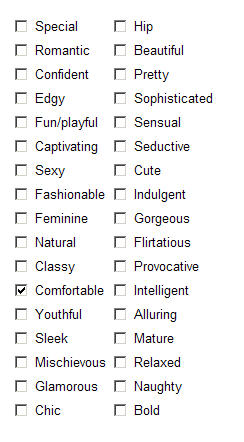
When I got to this checklist of "how does your bra makes you feel" (or somesuch), I was genuinely surprised. There are no negatives in here, and the word "supported" doesn't appear. I wonder what they can learn from this, apart from what they want to hear? The only way to avoid their positive bias is to check nothing, which I suspect will be tough for that helpfully-minded customer set that like to fill out surveys.

Previous to this question, they asked about other retailers you buy from. Now, if they had the usual sort of market research plan, I would expect to see an attempt at a basic SWOT analysis on the results: analysis of their strengths, weaknesses, opportunities, and threats.

How do you do that? Well, the logic is roughly this:

  1. Ask:Where do you buy your bras?
  2. Ask:What's important to you about your bra?
  3. Ask:What's your feeling about the bra you bought?
  4. Data analysis: For people who bought from us in (1), what's the difference between (2) and (3). If there's a big gap, that's our opportunity, going forward. (And roughly, strengths and weaknesses, when you compare against people who bought from Sears and Macy's and Frederick's of Hollywood on the same dimensions.)
If they're going after pure brand image and evaluation of their own success at achieving it, I think they still screwed up. Or at least they lost a serious opportunity in their data collection. They know where I shop (or where I said I shop, where I remembered I shopped), and they didn't have any adjectives that don't seem to be their personal target brand image in the list.

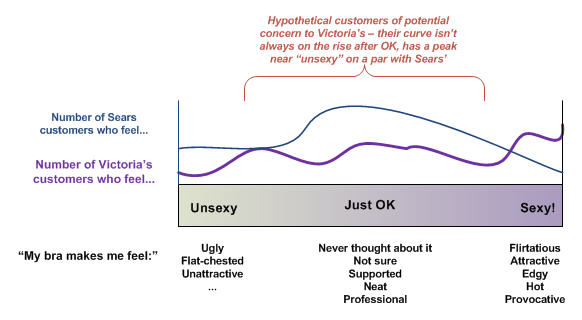
With the right vocabulary choices, including negatives and neutrals, they could have done some interesting segmentation based on where their own customers fall in "feeling" versus the other retailers' customers. Something like this:

They can always conclude from their data that some of their customers aren't that interesting to them from a marketing perspective (e.g., the people who shop at Sears, like their stuff a lot, and only occasionally go into a VS store -- because they'll be hard to capture if they're not dissatisfied enough with Sears).

In any case, some other common mistakes I see in market research via survey:

  • You try to collect too much in one survey, and can't do the analysis (plus you irritate the people who filled it out). You can always get more data later in other forms.
  • You don't know what you're trying to get out of it, so you can't construct the instrument well to get anything at all.
  • You set it up to learn what you want to hear (which is what I think was going on with VS -- I won't even tell you about the underwear questions), so you learn nothing and waste time, money, and your customers' patience.
  • You collect the data, then don't know what to do with it. You either don't do much, because of lack of skills in data analysis (clustering, mining, etc), or worse, you do nothing. You have it, but didn't take advantage of it. (This makes me quite uptight when I run into it. Good data is gold. My consulting tagline is "data-driven" for a reason.)
  • You solicit data from the wrong people, but don't even know it, because your survey didn't check on their credentials for answering and providing input. So you can't toss out any of the responses to clean the rest of the data.
End data rant of the week... I think I'm going to Sears now.

Monday, July 30, 2007

Waterfire Photos

On Saturday, I visited Providence's town-wide art installation, Waterfire. Picture a huge number of bonfires in the middle of the river and a large crowd of fire watchers, some lucky gondola riders with glasses of wine in hand, fire volunteers in black boats with logs, and eerie music. Very pagan. You can smell the smoke and wood from the river banks.

Sunday, July 29, 2007

Asshole-Driven Development on Berkun

Time for my weekly post on assholes in corporations, I guess; this is a few weeks behind, but I needed to space out the AH stuff, and I was busy.

Berkun posted an idle conversation starter on what he called "asshole-driven development" and the responses brought down his server. Then Lost Cog did some content analysis of the styles of development described by the comment thread. It seems to be going on and on. Some of the original categories identified:

  • Asshole Driven development (ADD) - Any team where the biggest jerk makes all the big decisions is asshole driven development.
  • Cognitive Dissonance development (CDD) - In any organization where there are two or more divergent beliefs on how software should be made.
  • Cover Your Ass Engineering (CYAE) - The driving force behind most individual efforts is to make sure than when the shit hits the fan, they are not to blame.
  • Development By Denial (DBD) - Everybody pretends there is a method for what’s being done, and that things are going ok, when in reality, things are a mess and the process is on the floor.
  • Get Me Promoted Methodology (GMPM) - People write code and design things to increase their visibility, satisfy their boss’s whims, and accelerate their path to a raise or the corner office no matter how far outside of stated goals their efforts go.

As some posters and Scott noted, bad development management may be subtypes of general Management Antipatterns, like "Death by Planning."

And I'd note that these techniques aren't limited to management of technical problems, but also exist in any other project context, in slightly different forms.

Wednesday, July 25, 2007

Zen Error Dialog and Flash Victim

I especially like the title bar on this guy: And a friend sent a link to a great animation of a flash victim getting destroyed by the app. Lots of in-jokes for designers who use Flash, and hilarious anyway. You definitely want sound on for it.

Saturday, July 21, 2007

User Experience 2007 Survey Report

The Usability and User Experience Report 2007 from e-consultancy costs money, but the sample data are interesting enough to post about. There were 756 respondents to the survey that fed this report. (Hopefully it represents more than just the UK, where the consultancy that did the survey is based.)

Some highlights:

  • On average, organisations are investing 11.5% of their overall website design and build budgets in usability, and 13.2% of their design budgets. [If you're spending none, or you don't even know what you're spending, this may be an Issue for you.]
  • A quarter of agency / consultancy correspondents say their clients are typically indifferent whereas only 9% say their clients are extremely committed. [I admit I find this surprising -- if you've been hired as a consultant, doesn't that suggest they care? Or is the evaluation of caring based on more complex factors, such as "are you listening to my advice," "is there anyone else in your organization advocating for this," "is it likely anything will change after I leave."]
  • Top benefits/ROI for commitment to user experience and usability included as number one and two, improved perception of brand, and increased conversion rates. [Since brand is now being defined as what a customer thinks of you and what and how you do it, rather than your logo and graphic design [see, e.g., the Brand Gap], this makes a lot of sense to see here.]
  • Two thirds of the respondents say their agencies plan to increase their spending on usability in the next year.
  • The activities that are being "done" in organizations are, in order of frequency, user testing, expert evaluation, information architecture; and lagging behind, "full user-centered design" [a rigorous process that incorporates testing and design during the definition and development cycle].
  • The largest barriers are time pressure to get things done and lack of resources. [We still have a ways to go to educate businesses about the risk factors in not being more rigorous about the processes for good design up front, it seems.]
  • Project management is either not done, or being done "ad hoc." [Coincidentally, I've just written an article for interactions, a professional journal for designers, on the ways in which designers get lured away from doing design and into project management, in order to be sure that things get done. Timely!]

The full report costs $179.

Monday, July 16, 2007

Sutton's Weird Ideas

I've been reading Robert Sutton's Weird Ideas That Work, which is Yet Another Book on Innovation. I like his Assholes bookand Evidence-Based Management, and this one is entertaining and provoking too. Here is the summary of the weird ideas, which he counts as 11.5, but this is hard to do automatically in html so for me it's 12:
  1. Hire "Slow Learners" (of the Organizational Code)
  2. Hire People Who Make You Uncomfortable, Even Those You Dislike
  3. Hire People You (Probably) Don't Need
  4. Use Job Interviews to Get Ideas, Not to Screen Candidates
  5. Encourage People to Ignore and Defy Superiors and Peers
  6. Find Some Happy People and Get Them to Fight
  7. Reward Success and Failure, Punish Inaction
  8. Decide to Do Something That Will Probably Fail, Then Convince Yourself and Everyone Else That Success Is Certain
  9. Think of Some Ridiculous or Impractical Things to Do, Then Plan to Do Them
  10. Avoid, Distract, and Ignore Customers, Critics, and Anyone Who Just Wants to Talk about Money
  11. Don't Try to Learn Anything from People Who Seem to Have Solved the Problems You Face
  12. Forget the Past, Especially Your Company's Successes
He says executive audiences responded to him with an "all very amusing, Bob, but we need to get things done here." I admit I'm a little bit with them on this -- it's great for consultants to come in and be creative at you, but end of the day, most of us need to ship code/product, which means teamwork of some variety, goals and means mapped out, achievable successes. But an innovation factory is a different thing, perhaps.

This said, I have seen the teamwork and normative workplace culture taken to extremes of unhealthiness, usually to the detriment of new hires with different ideas from other places. It's possible to be both infused with creative new ideas that threaten your status quo AND ship products, in my opinion. It's a challenge for mature management! To test your own culture: Check carefully how many managers, especially senior ones, were promoted from within versus hired externally. Then look at how experienced the people being hired are (sometimes, very). It might tell you something interesting about status quo thinking versus desire for fresh input.

Another test of your culture: In interviews, does the corporate "fit" come across as paramount, or the resume and evidence of work product elsewhere? I once watched a very senior statistician get turned down in favor of a more junior candidate who was just like everyone else in her skillset. I didn't fight hard enough myself on that one, I was part of the problem.

Defying authority certainly doesn't go over well in most corporate cultures I've worked in. Hierarchy is very much part of the American firm (Larry Prusack pointed this out recently at a great Boston CHI talk)-- the larger and more established the company, the more ingrained it is. I think there's a function related to size, corporate age, hierarchical position, and a person's tenure at a company that will predict how resistant she/he is to new ideas about doing things differently. Because large, successful companies are most reluctant to change what they do now (which is making money), for some sensible reasons: shareholders, golden handcuffs, employees to retain and feed, etc.

For designers, this often cashes out in how much change to an old shipping product you can make... a lesson it took me many jobs to really understand. (Note to designers hunting for jobs: Don't believe them when they say you're going to redesign it, especially if it's selling! The inertia will be strong and may become an actual undertow.) Historical success limits how much change you can make to processes that produced a selling product, even if they were flawed or painful in various ways for the people who worked on it. People are always more comfortable the way things are, regardless of what could be better.

Edited to add: It's a cultural failure mode to assume that everything is great or okay as is, but it's another one to fail to critically understand your successes, too. You can do root cause analysis for the good things too, and it might even teach you more than the failures do. If you aren't good at understanding success, you can't duplicate it, and you might make the critical morale error of celebrating the wrong factors.

Of all the weird ideas, the sensible-sounding "punish inaction" is particularly hard to see really happening in most offices. Few people are ever fired for not rocking the boat. People who aren't often noticed usually have a job for life, as long as their company keeps doing the same old expected thing.

Sunday, July 08, 2007

Travel Need: Can someone help?

I'm a frustrated impulse traveler. It takes way too long to search through even existing ajax-rich travel websites for deals that meet my criteria. I'm on travel deal mailing lists (BookingBuddy, for one) but haven't found what I need. I know it's possible today, and it's a business that might already exist:

I want a search agent that's heavily customizable to send me updates when certain things happen. What I specifically want is the ability to watch for fares of certain types to specific places FROM MY LOCAL AIRPORTS, or fares for vacation deals, again, FROM MY LOCAL AIRPORTS.

Sample criteria I want to have an agent look for:

  • Boston to Greece, unusually low, no more than 1 stopover (and it can't be a 12 hour stopover)
  • Long weekend vacation packages to certain Caribbean islands, from Boston, flights no longer than 4 hours (including any stopovers). Under a certain price threshold.
  • Extraordinary low prices on fares to certain continents, again from Boston or local airports here.
  • Alerts for fares from Boston to key cities I care about (e.g., Paris, London, Cleveland, San Jose).
  • Unusual travel packages like volunteer work, adventure (er, not athletic, but cultural), educational. I get to rate these as they come in and get more like them or less like them, till it learns what I like.
  • A home page where I can tune and browse, and easily set up new email alerts; something like Amazon's Recommendations system. I want it to know me and learn about me.
Again, all this is possible. Am I missing someone's service somewhere? The cheap travel browsing sites are all very similar, too much work, and too manual for me.

PS. If someone wants to start this business, I'd be very motivated to help design it and to collect more requirements. Drop me a note.

Saturday, July 07, 2007

Declassified Defense Research and Archaeological Mysteries

Wired online has had a couple recent pieces on defense research on ESP, paranormal, remote viewing, homing pigeons, etc. -- there are a bunch of abstracts now visible in the Scientific and Technical Information Network (a .mil site). Note: It is, in fact, extremely hard to use. Good luck.

I get challenged occasionally as to why a seemingly well-educated, presumably rational person would be interested in the paranormal. I'm always a little surprised by this question: Why not? Do we know everything? Isn't it rational and intelligent to assume we don't yet? Remember, a UFO is just unidentified, it's not necessarily from another planet. It's interesting to me that there are so many worth talking about, and the stories people tell about them are interesting in themselves. I'm certainly open to believing in many things, while being a strong skeptic about what counts as good data and strong argument.

Another really entertaining collection, equally amateur web-design but much easier to use: The Photo Galleries of Mystery from the MMMGroup. Truly, if you like archaeological mysteries, this is the place to browse. Make sure you hit page two, too. It might make you wonder about time travel... The phenomenon of OOPARTS, or Out of Place Artifacts, is a strong feature of the pictures of rock carvings (people with lightbulbs, space suits...) and fossilized items. Here's a blog post about this type of find with particular reference to a find in 19th century Massachusetts, a metal fossil apparently blasted out of solid rock.

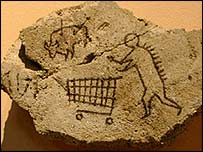
On the other hand, sometimes these things are explicit funny fakes; here's a guy who briefly got away with rock art depicting a caveman pushing a shopping cart in a British Museum Exhibit (2005).

Banksy also hung a sign saying the cave art showed "early man venturing towards the out-of-town hunting grounds". It read: "This finely preserved example of primitive art dates from the Post-Catatonic era. The artist responsible is known to have created a substantial body of work across South East of England under the moniker Banksymus Maximus but little else is known about him. Most art of this type has unfortunately not survived. The majority is destroyed by zealous municipal officials who fail to recognise the artistic merit and historical value of daubing on walls."

Wednesday, July 04, 2007

CEOs Who Work Too Much

A great article in the Huffington Post on CEOs who neglect their families but get written up in Fortune for it. Low-income fathers who work too much get critizied, but Fortune blithely praises it in executives. Towards the end there's a nice bit on the long hours phenomenon more generally:
Fortunately, respect for this sort of parenting outside the board room is dwindling as baby boomers disappear from the parenting picture and Gen-Xers take their place. Sylvia Hewlett presents research to show that while baby boomers are willing to work extreme hours, younger people scoff at the idea of doing that for more than a year. And recent polls (via Hole in the Fence) show that men are sick of the long hours and want more time with their kids: Almost 40 percent of working dads would take a pay cut to spend more time with their kids. It'll be a great day when CEOs are dismissed for neglecting their kids. Meanwhile, employees, beware: CEOs like Stringer and Immelt have a negative effect on your own ability to keep your personal life intact, because work-life policy starts at the top and trickles down.

Amen. Some ways to figure out what the real corporate values around work-life balance are: Do people regularly have email exchanges on weekends or at strange hours of the night? (When you start a contract, do the execs welcome you via email sent on the weekend? :-) Who's still working at 7pm in the office?

Another point I'd add: How effective are they if they have that much to do, even at the office where they spend all their time? Executives at one of my past companies-- who praised it as an "aggressive" company with no ability to promise new hires good work-life balance and reasonable hours during their growth plans-- were themselves too busy to pay attention to many of the critical management issues that cross their desks! They're way past the tipping point on being good parents at the office, or good peers-- blowing off visiting VPs, even-- never mind what their wife and kids think of them for neglecting them! (This is, of course, my own opinion on them as seen from the middle management trenches, and may not be their own or their peers' opinions.)

Sunday, July 01, 2007

Dutch Near Death Experiences

A fascinating Lancet article (pdf) on a study of NDEs (near death experiences):
  • No relationship to any pre-existing medical conditions found, although young people may be more likely to experience them
  • Corroborated evidence of out-of-body experiences, despite flat EEG and coma states which should indicate impossibility of observation or recall during "death"
  • Long-term excellent recall, from interviews at 2 year and 8 year periods, of the phenomena experienced
  • Life-changing effects, even for non-religios etc. who experience them

Angry Bluebird, Happy Bunny

Both of these fellows were seen at Drumlin Farm, an Audubon site in Lincoln, MA.