Wednesday, May 30, 2007

LiveJournal in the Blogosphere

Work by Matthew Hurst on mapping the blogosphere has been blogged around recently, particularly because of his cool hyperbolic graphs of the huge data set of linkages, one shown above. I post here because I've got friends reading on LiveJournal -- I know LJ folks occasionally wonder why the press about social networking sites rarely mentions LJ, favoring MySpace and others. One reason may be that LiveJournal is a fairly close-knit and separate community site, with a lot of internal links via friends lists, and not a lot of other blogging post cross-over or linkage in. (I don't know how he handled syndication on LJ friends lists, if at all.)

LiveJournal's small network cluster is shown in the image as cluster #3. The others are (1) DailyKOS, (2) BoingBoing, (4) other political bloggers, (5) porn, and (6) sports fans. LiveJournal is further out than the porn fans, but bigger! Smaller than sports fans, though.

Tuesday, May 29, 2007

Goat Mockery

From a nice day at Drumlin Farm, in Lincoln, MA:

Monday, May 28, 2007

Design for Online Community: Past the Hype

I've posted my slides (PDF) from a recent "mini" Usability Professionals Conference talk about online community design. The talk was well-attended! Thank you if you came.

If you didn't, the gist is this:

  • In Web. 1.0 we talked about community off the web as well as on it, in IRC, USENET, MUDS, BBSes, etc. (My dissertation and books are from that era.)
  • There are a lot of sociology, anthropology, and linguistic studies of "community" that predate the internet. What can we learn from their definitions?
  • Designing community requires special skills and ongoing commitment to the group.
  • Good definitions help you understand "when you got it." This can influence your metrics.
Virtually every slide here could be a separate full talk, especially the metrics part. Let me know if you want any more references or help on the subject. This is my first in-depth look at this topic since 15 years ago, and like then, there was a lot to digest!

Saturday, May 26, 2007

Funny Networks

I really appreciate a sense of humor in a network diagram. Here are two unusual ones found on visualcomplexity's feed, introduced with such sober and boring description that I was saddened for the VC readers who are probably missing the fun here.

The Story Map is a social network diagram of a wedding party, with the arcs annotated by relationship facts that link the nodes. It's beautiful and inspirational. Why are social network pics not funnier in general; relationships are, right? (Well, some. I guess professional ones aren't very. At least the publishable diagram versions.)

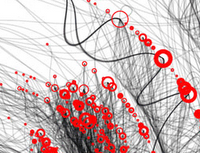
Next is a bigger investment, but worth it if you love detail (of the really obsessive type). An art project by Media A of massive size (10 meters), it's a representation of a fictitious designer's life spanning a century into the future. The Networked Designer's Critical Path is a PDF (3 MB) that takes time to download, but I guarantee it's very amusing and science fictional. Here's an excerpt (English in light gray):

Notice the chronic over-networking issue in the center there. Heh. My printer dialog says it would be 171 pages if I tiled to print this sucker at 100%. I'm tempted anyway.

Sunday, May 20, 2007

Digg Labs Infovis

I've been enjoying the latest infovis apps from Digg Labs, co-created by Stamen Design (I want to be them when I grow up) and funded by Intel.

These cool applications let you watch digg news stories being posted and re-dugg in real-time. They're all good at different things, and compelling for different reasons.

My favorite in terms of "hypnotic to watch" is the swarm. It's eye-candy for the ADD set.

It does have some issues as a tool, however -- if I were them, I'd have prioritized the display of the text identifying the article over the other graphics, rather than letting it mix in with the background (see above). Also, I don't entirely understand the beautiful mysterious arcs that sometimes appear, but I'm not sure I care, either.

While watching a bunch of these, the role of time gets problematic for me. I'd like to be able to replay, or step backwards (like if I missed a cool event in the swarm). And watching the big arc display for "newly submitted" in the category of science is really boring, or was on Saturday night. (See if you can even figure out how to do that that!) Finally, I would far rather go right to the article itself than click through the digg page first. That's a minor quibble, though.

There's a definite long-tail problem on digg, isn't there -- lots of the same stuff gets dugg, and it's hard to find high-quality new stuff that matches your interests.

Friday, May 18, 2007

Design and Risk and Innovation (and CEO Pay)

Over on NussbaumOnDesign, there's an interesting thread on the role of designers in innovation. Designers thrive on risk, learn from it, and move on from it, so they're useful as models for innovation processes at companies. That's is the gist of a piece by IDEO folks summarized here on BusinessWire. Given this, design as a process reduces corporate risk during innovation, Nussbaum recaps:

Let me repeat--the design process cuts risk. When you do design (or innovation--whatever you want to call it), you use ethnography, prototyping and story-telling to develop a product/service/experience. These processes actually reduce risk. This is a fact that most CEOs simply do not get. It is far riskier to come up with a new technology in the labs, make it into a product and then throw it at consumers than it is to first start with your consumers to find out what they really need and want (the essence of design).
This admirable sentiment requires a definition of design as a process that involves good customer research, a definition not all would agree with, although I myself certainly prefer it and sell that as a service during design :-)

But for any good interaction designer, intuition counts, as well as the prototyping, empathy for the customer, focus on the desirable, and grounded research to inform that process. The risk in design is that there's never perfect and complete data, and at some point, you have to just follow that intuition and make something which might be a failure if one of a million details doesn't go right. And those final details are usually a team effort, whether the designer wants them that way or not: building a product is (usually) expensive and complicated, unless it's a garage Flash app.

There are a few provocative comments following up on this later on Nussbaum's blog, suggesting that until designers put up their own capital, they are less risk-taking than their clients or the businesses that run with their ideas. A quote from the comment by Chris Conley:

Actually one could argue that designers simply ask their clients to take risks on them and their work. Few designers put their own capital at risk. I would also argue few understand the notion of investment and return which is how risk is manifest and monetized in business. Designers mostly have a cost mindset just like most business managers. An investment mindset is something that needs to be taught and is part of a innovation toolkit. Until designers put up their own capital (and not just the proverbial sweat equity) and take real equity positions in ventures, the risk is truly being born by someone else.

But there are other real risks for designers apart from personal capital, which Conley doesn't acknowledge: loss of credibility, reputation, credit (including financial reward), missed opportunities at other companies/agencies while betting on this job or client, and others that may be more important to an individual designer. Personal risk management is about all of that, too.

Edited to Add: Actually, after drafting the above and going to bed, I've woken up fairly incensed at the idea that designers should be putting up their own money in order to experience "real" business risk. Point one: Many of them do, because what they're motivated by is seeing their ideas in the world. They quit and go to startups, they do their own thing online, etc. This is fairly clearly "their own money." (At one company, when I couldn't get usability bugs taken seriously, I considered bribing engineers to fix the bugs I had filed. I was a hair away.) Point two: CEOs and other executives certainly don't put up their own money, and they're paid outrageously in comparison, so don't talk to me about money here, Mr Conley! Hmmph. Here are some articles on the pay issue, if you want to get educated about this:

Note especially that even if they "fail" they have enormous severance/retirement packages, suggesting there isn't much financial significance to their failure.

Monday, May 14, 2007

Wow: Lotus Blossom

This is fast (no load time waits and a genuinely frenetic pace), simple (text and music -- turn it on because you need it), and even better, genuinely funny: Lotus Blossom.

Go watch! Where you can do it with the sound on. (Don't watch if you might have issues with strobe effects in place.)

Sunday, May 13, 2007

Mathematica Graphs and Other Demos

More fun stuff for people who like pictures, but don't necessarily follow all the math: Wolfram has a downloadable viewer and a bunch of fun interactive demos that let you play with sliders and manipulate pictures to generate fun stuff. There are a whole bunch of categories, including "unsolved problems" that might really pique the interest of the math folks. I personally like the graph theory demo section, because of the issues I have with making sense of social network visualizations.

Note to dowloaders: You download the app. Then you start it. It launches a splash screen but seems to do nothing else. Then you click on a demo link on the website and choose "run." That runs it in the application viewer on your machine. To put a demo through its paces, try "Autorun" from the menu under the small + in the upper right corner of the little applet!

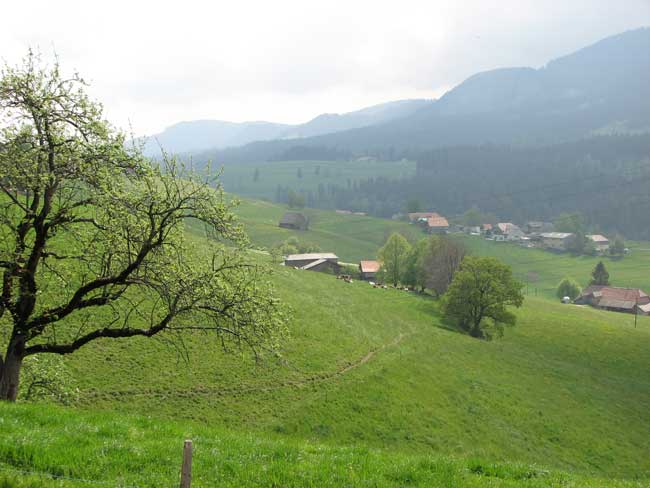
Swiss Farms in the Spring

It was early, and the mist was burning off the valleys, so these look a bit like watercolors.

Monday, May 07, 2007

The Asshole Test

Surprisingly apropos of recent posts on management, there's another popular book going around now: The No Asshole Rule: Building a Civilized Workplace and Surviving One That Isn't, by Robert Sutton, one of the authors of the well-cited and enjoyable Hard Facts, Dangerous Half-Truths And Total Nonsense: Profiting From Evidence-Based Management.

Sutton also has two blogs, on which he's posting rousing, blood stirring commentary on the reception he's getting for the assholes book. One is "official" at Harvard Business Review: The Working Life. There's a pointer there to an online test you can take to determine if you are an asshole, and it includes gems I've posted about before, such as: “You are constantly buttering up your boss and other powerful people, and expect the same treatment from your underlings.”

His other is his personal blog, Work Matters, which has even more about the book's reception. If you're interested in asshole managers and hostile workplaces, they're both good reading.

Sadly, I suspect even assholes are passing these on -- consistent with the "Incompetent People Don't Know They're Incompetent" findings I've posted about before. And I fully understand the potentional implications of my pointing this out. :-)

Saturday, May 05, 2007

Swiss Bunnies

I've been away for a week and a half, looking at green hills and mountains, tinkling cows (their bells, not relieving themselves), and other cute animals. These are Swiss checkered rabbits, who are good friends. They live in Ballenberg, an outdoor folklife museum. I think it's fair to say that their disapproval is less intense than that of your average American variety, although it seems to be a basic trait of the species.

Sunday, April 29, 2007

Workaholics in Consulting and Engineering

Really more about type-A personalities, or at least very driven people: An article in Fast Company on Boston Consulting group trying to get a grip on employees who work too many hours.
"A hero at BCG is not someone whose light is on at 10 at night," says Kermit King, the firm's head of recruiting for the Americas. "The emphasis should be on productivity per hour, and I think there's a point where productivity diminishes."

That's why the firm--which doesn't bill by the hour and explicitly states that hours don't figure in promotions--launched a program called the Red Zone three years ago to spot and tame chronic overworkers.

It's not quite working yet -- perhaps because the workload makes it impossible to succeed within the green zone. They have had a slight decrease in the percentage of employees who say their load is not manageable, though, up to 63% from 67%. (At one place I was salaried, 100% in my department said it was unmanageable. The hours we worked reflected this of course, which is one reason I charge by the hour now.)

A related post appears in the increasingly interesting 37signals blog, on development type A's: Don't Be a Hero. Their gist is that if you haven't finished a task in estimated time allowed, don't push on to do it in more time:

That’s where the concept of sunk cost gives us a guide on what to do. It doesn’t matter what you’ve already spent. That time and money is gone. It only matters whether spending what’s left is worth it or not. Business school 101, but one of the hardest lessons to internalize.
Unfortunately, the switching cost is often high for creatives and execution-driven folks. In morale if not attention to task measures. But in general I think their point is very good.

Sunday, April 22, 2007

Fractal Art

I've been playing with 2 fractal-generating applications recently, and recommend them for different reasons. If you'd like to quickly generate random beautiful 2d images, of often breath-taking beauty, use Apophysis.

If you like to play with dials and sliders and 3d imagery, and generally do a bit more work yourself, I recommend Chaoscope, a "3d strange attractors" rendering package.

Samples from both:

Thursday, April 19, 2007

12 Breeds of Client

Freelance Switch, a site for freelancers of all types, has a nice post about different types of client personalities and how to handle them. It's applicable whether you're a genuine freelancer or working in a consultative role inside a large organization -- I recognized a lot of it from traditional dealings with consumers of interface design and usability, including previous managers. Some of my favorites, in the "recognizable but not so nice" category:
  • The Hands-On Client: The hands-on client is a frustrated artist, as soon as they walk in the door they will be telling you about their skill as an artist, illustrator, photographer or writer. The hands-on client already has a very specific idea about what they want and usually has very little interest in your thoughts on the matter.... If you feel you have an ethical responsibility to point out the flaws in your hands-on client’s directions, you are headed for conflict. Hands-on client’s secretly believe that they could do their job much better than you and that there is little or no specialist knowledge you could possibly impart. One oddity about working with a hands-on client sometimes occurs when you give in your creative ambitions and agree to do it their way. All of a sudden your hands-on client may accuse you of making them do all the work or not doing your job.
  • The I’ll-Know-It -When-I-See-It Client: The I’ll-Know-It-When-I-See-It client shares much in common with the uninterested client except in a more frustrating way. Their indecisiveness and inability to articulate what they are after makes them one of the few clients that it is generally best to steer clear of.
  • The Always-Urgent Client: All their emails are ‘highest priority’ and their couriers are always red-hot. They work on weekends and late into the night and think that everyone else does too. Additionally the always-urgent client often seems to think they are your only client and that their job should therefore be your highest priority as well as theirs.
  • The Decision-By-Committee Client: Usually inhabiting the world of large corporate clients, the decision-by-committee client can still be found in smaller operations where they share their decision making with a spouse, neighbour or dog. The decision-by-committee client is one who lacks a single point of authority and for which every decision must be approved by many people.
I'm breaking in a new tag for this one, a consulting tag.

Friday, April 13, 2007

Crazy Bosses Hall of Fame

An entertaining read at CNET: the Crazy Boss Hall of Fame, featuring stories of swearing CEOs and bathroom reading that's circulated daily. Weird stuff in there, it might make you feel better if you work for a nutcase. I don't like the suggestion that I always get in these articles that because they're aggressive and nasty they succeeded in business (maybe I read it in, but it's caused by close juxtaposition of wacky antisocial story with glory story of million dollar business win).

But there are some good failures in there too, like Craig Benson of Cabletron who also failed in politics. Anyone else find irony in a guy who ran a company like a "military environment" and then ran for office on a libertarian-bent of "less government in people's lives." He had a virtual staff and virtual volunteers, with whom he had (virtual?) affairs. He ran standing meetings from behind a standing desk -- leading to a great quote from the article link above:

"It is," Peterson said, "the most efficient way to reach the wrong answer in the shortest amount of time."

Best-selling books touting surprising management styles keep coming. First Break All The Rules: What the World's Greatest Managers Do Differently has 227 positive reviews on Amazon right now. Hopefully, being a great manager isn't just about finances but includes something about work culture, too. I'd like to think you don't have to be an asshole to do good things for the company. Meanwhile, breaking the rules doesn't make you an asshole either -- a senior VP at a former company criticized a move I made as a manager for an employee of mine on the grounds that "I've never heard of anyone doing that before!" Yes, it really was intended as a criticism, and probably said more about him than me, alas.

Relevant past posts on ghostweather: Is Your Boss a Psychopath? And Past and Current Employees and Your Reputation, not to mention, Demotivation and Burnout.

Thursday, April 12, 2007

Logos of Web 2.0

In case you haven't seen this -- at FontFeed, there was a nice deconstruction of the look of web 2.0 company logos. (Thanks to a graphic designer I worked with recently for the link. Same could be done on the websites with probably similar results; I feel like I've seen the 37signals look all over the place in the last couple years.) In a non-graphic designery vocabulary, I myself note a lot of blue and orange, more "soft" rounded fonts rather than angular in this selection, and greys and gradients.

Monday, April 02, 2007

Adorable Monsters

Two cute monster-related items for early April:

Daily Monster, an online growth of cool monster art. It's Stefan Bucher's site (thanks Steve): And while I was poking around on Jared Tarbell's site for a friend, I found his combinatoric monster art, which made me grin wide. I want to be Jared when I grow up.

Sunday, April 01, 2007

Passionate About Your Job? Your Career? Your Company?

A while ago, Creating Passionate Users had a post about employees who are passionate about their employer versus passionate about their work. The gist was that people who are passionate for their company are like this:
  • Defends the company to anyone, anywhere that criticizes or questions its products, policies, or practices
  • The ultimate team player who goes along with the group rather than voice dissent
  • Is well-liked because they do whatever is asked, enthusiastically
  • Accepts (and uses) phrases like, "this is what corporate needs us to do."
  • Cares a lot about his career path in the company; focused on getting management recognition.
Whereas employees who are passionate about their work are recognizable because they:
  • Would spend his own money, if necessary, for better tools
  • If they were NOT doing this as their job, they would still do something related to it as a hobby
  • Works late nights when, "I'm just one-compile away from this awesome refactoring that's going to make this thing run 40% faster." In other words, they work late when they're driven by something they know they can do better on.
  • [And somewhat controversially:] May not be extremely well-liked, but is highly respected and tolerated because he's known as one who, "cares deeply about doing the best possible job, and is very good at what he does." CPU's update was: The person must be liked well enough for people to want to work with him again...
While I enjoyed the post, I had some issues with the distinction between work vs. employer, or company. In my experience the distinction is really about "career at this company" vs. "the work I do." I've rarely seen a place where loyalty to the company is a major factor anymore (although I can think of one strong candidate in my employment history). When people talk critically about employee loyalty to the company, they really mean something more sinister about "fit" and "culture" and "not making waves." Look out for this rhetoric, it's usually covering for something else that's going on. But that's not the point here right now.

Career motivated people are a hair away from appearing motivated by the work they do, but it's a really important hair. They can be recognized by some similar signs as CPU's indicators of company loyalty:

  • Excessive concern for what management thinks, or what the promoting, salary-raising decision-makers think
  • Covering their asses behavior: blame assignment, rather than taking ownership and responsibility individually for tough problems that need resolution
  • Star behavior: Taking credit and not giving it to others. Often excused by managers as "my team did it so I did it." Not quite what the team thinks...
  • Competition for the plum jobs (some may be genuinely hard, but it's notably the ones that are visible to CEOs and Senior VPs that they go for)
  • Wangling to get on the speaker list at important events attended by senior management; this may look like it's for "good" but often it's self-promotion
  • Teamplay gets sacrificed for their ambition, when it's useful to them -- less pushy voices and personalities get the uglier tasks and less interesting roles if they have something to prove.
  • Resume-building; a key distinguisher between loyalty to the company versus themselves -- they're figuring out how to make their tenure there useful to them for the next, better move.
This behavior, especially in a teamwork environment(see my old post about requirements for successful teams), can be fatal for morale of others. Unfortunately, it may be difficult to identify this behavior as different from dedication to the work itself, if no one is paying very close attention. Most of their managers probably aren't, actually, either because they have incomplete information, or aren't able to make this distinction. And some of the managers may fall into this category I've just described, which will make it even harder for them to tell that difference in their own employees or to think it important.

Sad postscript: Kathy Sierra at CPU has been receiving death threats. Her posts are always controversial to some, which is part of why she's a good read; but now she seems to be a target for it. It's hard not to read this as a response to her as an outspoken woman, rather than just an opinionated smart blogger.

Saturday, March 31, 2007

Visualizing Poetry

April may be the cruelest month, but it's also the month of poetry, and Knopf does an annual poem-a-day mailing list, which I highly recommend. Thanks to my friend Tina in Seattle, I've been on this list for the last 3 years and loved every day of April.

Nine years ago we began a Knopf tradition. To celebrate National Poetry Month, we sent a poem a day by e-mail for 30 days to anyone who asked to receive them. Now, with over 25,000 subscribers, we are proud to continue with a whole new series of daily poems. Each day during the month of April you will receive a poem from some of the best poets in the world including Mark Strand, Sharon Olds, and Laurie Sheck, as well as classics from Langston Hughes, Robert Burns and more. If you know of someone who might like to join the poem-a-day party, they may visit http://www.randomhouse.com/knopf/poetry/poemaday/ to sign up.

In honor of poetry visual and written, here are some samples of Boris Muller's visualizations of poems for the annual Poetry on the Road conference in Germany.

And see the great summary of other notable vis work in Ping Mag's article on beautiful data visualizations, based around an interview with the editor of the popular Infosthetics blog. (Thanks for the pointer, MJ.)

Thursday, March 29, 2007

Engineering Rewrites and Old Code

Closely related to my Balls o' Mud post about old code bases, the latest Silicon Valley Product Group blog posting is about the necessity of engineering "headroom" for code maintenance during product lifecycles. And about inevitable rewrites to scale, perform, and I'd say, accommodate design of new features, although the article doesn't focus on that issue per se.

I knew ebay had gone through growing pains, but the article suggests some absolute heroics in the form of two mid-growth rewrites of their code that barely touched their business performance. I know of some (plenty) UI designers who've left ebay because of their unwillingness to touch their UI (it sadly needs it), but I do applaud their engineers for their effectiveness at communicating the need to do code work to survive. From the SVPG article:

The deal with engineering goes like this. Product management takes 20% of the capacity right off the top and gives this to engineering to spend as they see fit – they might use it to rewrite, rearchitect or refactor problematic parts of the code base, or to swap out data base systems, improve system performance – whatever they believe is necessary to avoid ever having to come to the team and say “we need to stop and rewrite.” If you’re in really bad shape today, you might need to make this 30% or even more of the resources. I get nervous when I find teams that think they can get away with much less than 20%.

If you are currently in this situation, the truth is that your company may not survive this. But if you are to have a chance of pulling through, you’ll need to first do a realistic schedule and timeline for making the necessary changes that engineering identifies.

If your product is slow, hard to modify, and your code base is really old and hard to understand by your own developers, you should be worrying about your future in the business. Can the people you want to modify your product succeed in actually modifying the product without total internal collapse, at version N? Here's another pointer to that ball of mud article on software architecture growth issues.