Sunday, February 25, 2007

Social Networks of Video Editors on LiveJournal

A few months ago, I did a talk at IBM Research in Cambridge on video (or "vid") editors and their online and offline communities. I made a few social network images, which I thought would be interesting to folks here, and I know I have readers on LiveJournal.

The basic gist of the talk was that hobbiest television fan music video editors existed long before YouTube and their history and organization reflect how they use the internet now -- which is verifiable with some simple data analysis. (NB: I used to be one myself, and in the talk I used a lot of personal examples and anonymized the rest, to protect privacy of anyone who wasn't contacted about this talk. So I'll say "we" here although I'm not practicing myself these days.)

In a quick sum of my talk: We used to do music video editing with VCRs. We existed before the internet was our main way of communicating, and we used fanzines and APAs to exchange tips and tricks (but truthfully, this was borderline before my time, although the friends who taught me all did this). We had and still have conventions at which we showed off our work, to supplement the now popular online posting mechanisms of distribution. (YouTube is not a major site for fan video editors, but another current social network tool that supports video has just become very popular among my friends who use LiveJournal for their conversations.)

Knowing the history makes for interesting cruising of the video communities on LiveJournal. The anime video makers turn out to be, for the most part, a distinct group. This isn't too surprising when you read the "about" text on one of the video community pages (slightly disguised here):

Anime "vidders" are told they may not be as comfortable here, and that VCR vidders are welcome.

This image shows the network of members in the anime community (highlighted) which is somewhat separate from the group (and its affiliates) quoted above:
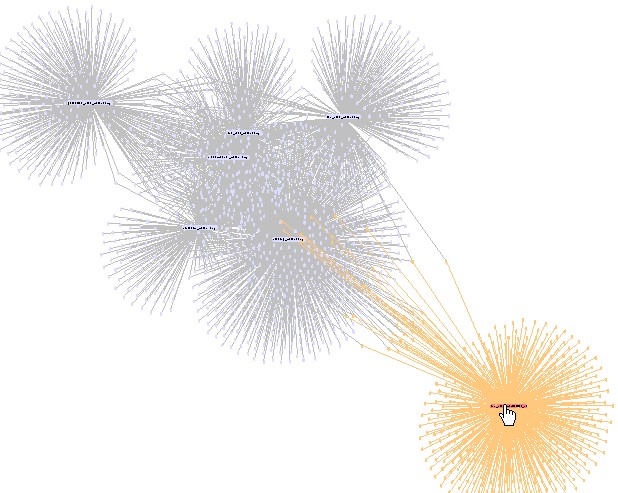
One of the communities that is closely related to this one is one in which an annual face-to-face convention is discussed, started and fed by some of the older VCR editors and now pretty much populated by the non-linear digital folks, of which former VCR people are now a part. The convention-discussion community members, highlighted below in orange, are closely interconnected to the community quoted from above, which is circled in red here:

The group circled in blue is a Battlestar Galactica video group, less closely related but more so than the anime group. The closely inter-connected groups in these images are the generic discussion groups, at which the craft and technique and technical discussions occur. More specific discussion groups are generally less connected.

I made these images with prefuse, and apologies for the quality of the uploads. I'm available to talk about this stuff anytime :-)

Sunday, February 18, 2007

A Postcard to Windhouse

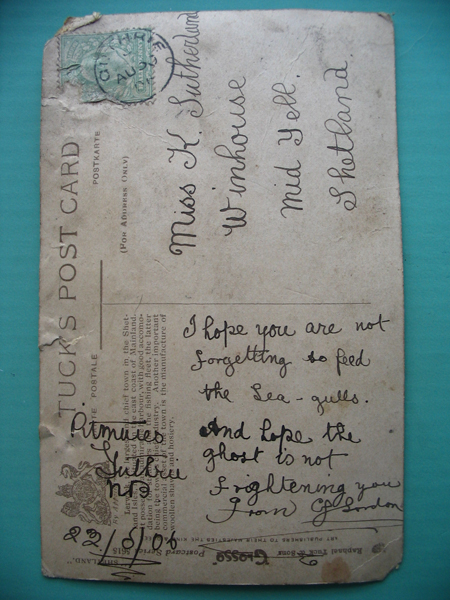
Since my last update a month ago on the haunted Windhouse stories, I received email from a reader in Stirling, Scotland, whose family lived in the house in Shetland at the turn of the (last) century. Even then the house was known to be haunted, well before it turned into a picturesque ruin on the hill. Justine scanned and sent me a copy of a postcard her great-grandmother's sister Katie received referring to the ghost.


windhouse postcard

I updated the essay again, and posted some more photos and links to the family history. They're at the bottom: my Windhouse story.

Saturday, February 17, 2007

Mayan Art

From Chichen Itza this January. The eagle is eating a heart.

I am reading a great book, Breaking the Maya Code, by Michael Coe. The first paragraph says, "It was 12 cycles, 18 katuns, 16 tuns, 0 uinals, and 16 kins since the beginning of the Great Cycle. The day was 12 Cib 14 Uo, and was ruled by the seventh Lord of the Night. The moon was nine days old. Precisely 5,101 of our years and 235 days had passed since the creation of this universe, and only 23 years and 22 days remained until the final cataclysm that would destroy it. So the ancient Maya scribes and astronomers would have calculated, for the day was 14 May 1989, and we were in Leningrad."

Saturday, February 10, 2007

Owls in Massachusetts

Last weekend was an "owl festival" at my local Audubon nature preserve. First was a great presentation on snowy owls at Logan Airport (not given there, about owls who hang out there) by Norm Smith of the Blue Hills Audubon nature preserve. Yes, there are snowy owls all over Logan's landing strips. No, this is not good for the airplanes. Yes, they are hard to spot if you're flying out from there, as I discovered a day later-- white could mean snow, trash, or owl.

Norm has some great pictures of them, and points out how little we understand them -- they don't seem to be migratory in the usual sense, and might even be circumpolar. They are able to filter out the sounds of the jets to tune in on squeaking rats. They all look a bit different, and have different personalities, too.

Some articles and links worth looking at on this work:

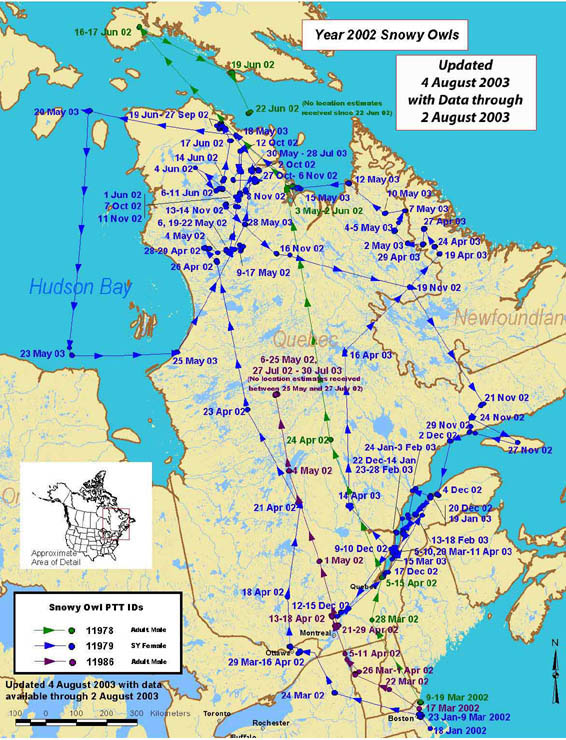
This is a map of where some of the owls he attached transmitters to ended up in Canada -- mostly up towards Hudson Bay. Some have been tracked to Siberia, though. (Hey, I've been there. I saw no owls, however.)

The day after Norm's terrific talk and slides, a guy brought in some birds living in captivity because they've been hurt or grown up with people and now identify too much with people to hunt properly. These were beautiful birds. Below you'll see this fellow with a screech owl, incredibly cute, and a wonderful great horned owl. None of my pictures turned out very well due to the interior lighting, but you get the idea.

After the demo of the birds, we went on an "owl prowl" walk in what was probably 14F degrees at best. In the gathering dark, I add, because at the point where I'd had enough of the cold, I didn't think I could see my way back to the lodge. We crunched all over the grounds of Broadmoor making dumb owl calls, and hearing not a peep back except for the bored kids shifting around while we listened and whining a little and sometimes pretending to be owls themselves which didn't really help us. It was so cold even the CD player with some real owls on it wouldn't perform properly. An owl bust, all around. Now that I know what screech owls and saw whets sound like, I can confirm I have never heard them where I live beside the reservoir. Too bad! They are really cute.

Saturday, February 03, 2007

New Moon and the Stock Market

I've been quite busy recently, and am getting a backlog of post material. Here's on oldie I never got around to blogging, which is weird and short: there is evidence that the lunar phase affects stock market performance.
We find strong lunar cycle effects in stock returns. Specifically, returns in the 15 days around new moon dates are about double the returns in the 15 days around full moon dates. This pattern of returns is pervasive; we find it for all major U.S. stock indexes over the last 100 years and for nearly all major stock indexes of 24 other countries over the last 30 years. In contrast, we find no reliable or economically important evidence of lunar cycle effects in return volatility and volume of trading. Taken as a whole, this evidence is consistent with popular beliefs that lunar cycles affect human behavior.
You can see the abstract and download the paper here: Lunar Cycle Effects in Stock Returns, on the Social Science Research Network.

Sunday, January 28, 2007

Windhouse Haunting Updated

I'm pleased to announce that I've updated my article about the haunted Windhouse in Scotland, based on a very interesting reader story I just received. I've added his account at the end as a postscript with a few more photos; and below that I added the Shetland online forum stories I found that appeared after I posted the original piece last January. (I got "seems to be the best researched" in the forum citation :-)

Saturday, January 27, 2007

MultiTouch Display

I guess it's a Tipping Point phenomenon, but I wonder who the cool kids are, everytime this happens. The iPhone demo features a multitouch display, and Jeff Han's demo of this functionality on YouTube has been getting a lot of blognoise; but this idea has been around in the research community for a while. What makes something finally get out of R&D "interesting idea" and into "must have innovation wow" in a product seen as widely as the iPhone? It was even around at Apple, and ignored for years. What does it take to get visibility and get on a product development and business radar? Some links:
  • The Jeff Han video that's been circulated a lot (ok, points for music, for high density of info and fast cutting to demo points -- is this what makes it spreadable?)
  • The Tog column that discusses some of the design history that went into the iPhone (many many ideas over many years, including random access voicemail -- we discussed and prototyped this at AT&T and at Excite 10 years ago too), some of it (but not most of it) at Apple itself.
  • Bill Buxton's article referenced by Tog on multitouch displays. I know some of the people he's referencing, and I feel their mystification too.
I guess this is one of the reasons I stay as plugged in as I can to what's happening in R&D--the best of that work will eventually make it into products, and I'd like to lessen that time by figuring out the tipping point for it.

Wednesday, January 24, 2007

Democratizing Data Insight

It's an exciting world right now... i-Stuff and the spread of "design" as a buzzword aside, I'm thrilled by the spread of data and graphs into the public world. A few recent pointers on the theme of public data exploration:
  • Gapminder.org's Hans Rosling presented to TED a year ago, with the beautiful animated charts that his site made famous. His final comments say, in paraphrase, "Publically funded data is public, but hard to get at, hard to search, and presented in boring ways. We can and should change this." One of his great takeaways, for me, from his data illustrations of "third world" healthcare is that the error in the data is no doubt much less than the truth in it, at the magnitudes he illustrates.
  • Swivel is a new site for data upload and exploration, with a fun blog. They also allow community discussion around their charts. I like their enthusiasm and enjoy the blog a lot.
  • Friends from IBM (Martin Wattenberg and his group) have just announced a similar concept to Swivel's, but with even more graph types and they're all nicely interactive. Upload data, create a picture, and post it... other people can play with your data and present their own insight pictures, or modify yours. And comment on them. It's Many Eyes, and it even has a nice website!
  • Google claims to be making real time stock quotes available, which means live data plotting is possible. Found on swivel's blog, a post on Googleblog: Real Time Quotes for Free.
  • And don't forget processing.org. There's a nice visualization of State of the Union speeches highlighted there, including word frequencies and grade levels of the speech. (It's by Brad Borevitz.) They've been averaging around 9th or 10th grade level, but notice the great spike of Jimmy Carter's at grade 15.

Sunday, January 21, 2007

Friday, January 19, 2007

Annual Site Stats and Changes

I don't have time to do real stats on my server logs, but I offer the annual impressionistic ones, at least, as well as some updates on the site.

Search phrases that strike me as funny, that show up every single week (usually with multiple counts):

  • girls on boats
  • alcohol induced blackouts
  • temporary wallpaper
  • real ghost photos/ghost photos/real life ghosts (etc)

Posts or pages with high hit counts, regularly:

  • The crop-circle google-montage (I should put a Google ad or two here, it's ludicrous; and no one ever comments, but it's hit 68 times or more per week.)
  • The weird red tree in Shropshire that almost made me drive off the road. It has 67 comments, which I should really trim/clean/purge most of. Also, add a Google ad.
  • An incredibly short post on Bara Hack, haunted village in CT. With a lot of chimers-in on the illegality of going there, or not.
  • My travel essays, especially the Siberia one. They're low on the page, but very popular, and the Windhouse and Fair Isle one are catching up in hits.
  • The bio/resume page is visited at least 20 times a week. I've added some info to it recently.
Visitors in sizable numbers are coming from images searching (no surprise there), a few companies where I think I know the folks :-), and increasingly from Stumbleupon, which is nice.

I spruced up the blog template a tiny bit, since Blogger has added tagging ability. Now you can click on a link to items in categories I post on regularly: design, tech industry, management, archaeology, funny stuff, weird stuff, information visualization and data analysis, etc. It took hours and hours to do a cursory tag job on my 504 posts of the last few years, so if you notice a mislabel, let me know. The tags list is on the right side under the index of recent posts.

Thursday, January 18, 2007

Powerpoint Hilarity

Le Grand Content by Clemens Kogler is an animated riff on powerpoint presentations of data and Big Questions (mostly those found in bad teenage poetry). It's very funny. Go and click on "view movie" and giggle.

Ancient Curses

A 1700 year old tablet with a curse on it was recently unearthed in Leicester (UK). This one immortalizes some guy who stole a coat. It's amazing the things we leave behind us for posterity.
One of the most interesting finds from a site on Vine Street was a 'curse' tablet – a sheet of lead inscribed in the second or third century AD and intended to invoke the assistance of a chosen god. It has been translated by a specialist at Oxford University, and reads: 'To the god Maglus, I give the wrongdoer who stole the cloak of Servandus. Silvester, Riomandus (etc.) ... that he destroy him before the ninth day, the person who stole the cloak of Servandus…' Then follows a list of the names of 18 or 19 suspects. What happened to them is not recorded.
There's another famous curse in Carlisle from the 1500's, recently carved on a stone art object that has supposedly caused all sorts of problems for the town since its installation in 2001: see Curse of the Cursing Stone. The curse itself is in old Scottish dialect, about 500 words, "one of the longest on record"-- it's addressed to the raiders on the Scottish borders, and was read out by priests to advertise their great displeasure with the illegal activities.
I curse their heid and all the haris of thair heid; I curse thair face, thair ene, thair mouth, thair neise, thairg toung, thair teith, thair crag, thair schulderis, thair breist, thair hert, thair stomok, thair bak, thair wame, their armes, thair leggis, thair handis, thair feit, and everilk part of thair body, frae the top of their heid to the soill of thair feit, befoir and behind, within and without. I curse thaim gangand and I curse thaim rydand; I curse thaim standand, and I curse thaim sittand; I curse thaim etand, I curse thaim drinkand; I curse thaim walkand, I curse thaim sleepand ; I curse thaim rysand, I curse thaim lyand; I curse thaim at hame, I curse thaim fra hame; I curse thaim within the house, I curse thaim without the house; I curse thair wiffis, thair barnis, and thair servandis participand with thaim in their deides.
Curses are like legal documents, at least the good ones: they are comprehensive and leave out no body part or aspect of life, and usually they extend into eternity. My favorite curse is literary, Manfred's curse by Byron (it starts at line 200), gorgeous and bitter:
Though thy slumber may be deep,
Yet thy spirit shall not sleep;
There are shades which will not vanish,
There are thoughts thou canst not banish;
By a power to thee unknown,
Thou canst never be alone;
Thou art wrapt as with a shroud,
Thou art gather’d in a cloud;
And for ever shalt thou dwell
In the spirit of this spell.
... And a magic voice and verse
Hath baptized thee with a curse;
And a spirit of the air
Hath begirt thee with a snare;
In the wind there is a voice
Shall forbid thee to rejoice;
And to thee shall Night deny
All the quiet of her sky;
And the day shall have a sun,
Which shall make thee wish it done.
From thy false tears I did distil
An essence which hath strength to kill;
From thy own heart I then did wring
The black blood in its blackest spring;
From thy own smile I snatch’d the snake,
For there it coil’d as in a brake;
From thy own lip I drew the charm
Which gave all these their chiefest harm;
In proving every poison known,
I found the strongest was thine own.
If you know of other good literary or historical curses, I'd be interested in pointers.

Saturday, January 06, 2007

Puzzles and Mysteries

Malcolm Gladwell wrote a great piece in the New Yorker: OPEN SECRETS: Enron, intelligence, and the perils of too much information. It's being blogged all over, but since I'm still thinking about it 12 hours after reading, I'm posting too.

He distinguishes between puzzles and mysteries, and the role of data in both.

The national-security expert Gregory Treverton has famously made a distinction between puzzles and mysteries. Osama bin Laden’s whereabouts are a puzzle. We can’t find him because we don’t have enough information. The key to the puzzle will probably come from someone close to bin Laden, and until we can find that source bin Laden will remain at large.

The problem of what would happen in Iraq after the toppling of Saddam Hussein was, by contrast, a mystery. It wasn’t a question that had a simple, factual answer. Mysteries require judgments and the assessment of uncertainty, and the hard part is not that we have too little information but that we have too much. The C.I.A. had a position on what a post-invasion Iraq would look like, and so did the Pentagon and the State Department and Colin Powell and Dick Cheney and any number of political scientists and journalists and think-tank fellows. For that matter, so did every cabdriver in Baghdad.

Adding data to a mystery doesn't make it less of a mystery, but smart analysts can bring experience to bear that will point towards possible answers that are more or less likely to be true.

The Enron disaster qualifies as a mystery, and Gladwell's summary of the confused and complex financial details is disquieting. Even financial experts couldn't make heads or tails out of what was going on with the money. I'm unsettled by how easily corporate environments breed mysteries requiring complex analysis both of their internal and external behavior; and how hard it can be to understand and correct corporate mismanagement. People lose their livelihoods all the time now-- how many other Enrons are actually happening with no one noticing?

As a side note, as I read the recap of the Woodward and Bernstein investigation I actually thought, "This is surely going on all the time now. Would anyone be shocked at this in this political era?"

Joel's Quality of Software Teams; and Design

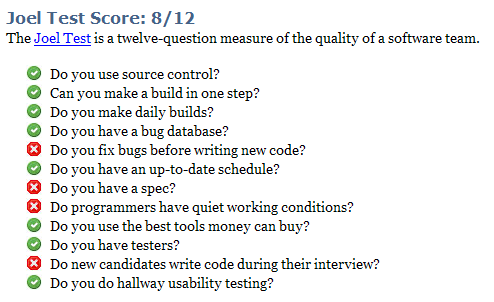
I'm a Joel Lover like many techies folks, and his job board is really tickling me. I just cruised the engineering ads (no, I'm not looking for a development job :-) and saw the the little questionnaire at the bottom of the page that measures the quality of the team hiring. Apparently people posting ads are answering honestly, which is excellent! And even more excellently, usability testing makes his list.

What would a similar test look like for hiring user experience designers, I wonder. A bunch would be similar, I think. I'd propose something like...

  • Do you develop from specs written by designers?
  • Do you have a design process with low fidelity work that is reviewed and refined before final specification is produced?
  • Do you do usability testing during design or only after shipment?
  • Do you change your design based on the results of user testing?
  • Do you measure customer satisfaction with the product, including measures of user experience such as appeal, learnability, ease of use?
  • Do designers talk to customers directly on a regular basis?
  • Are developers involved in the design reviews and process?
  • Does QA test for specification compliance?
  • Is there a dialog about business requirements and product features that includes design staff?
  • Do you require a design test and portfolio review during interviewing?
  • Are other designers involved in interviewing designers?
  • Are deadlines for specifications realistic and staged with multiple deliverables; or do you have single dates and one large spec document?
  • Is your dev process sufficiently flexible to allow for design revisions without breaking everything and everyone?
  • Are designers considered crucial to your business and to your developers? Regardless of the answer, how do you know if they are or not?

Monday, January 01, 2007

Giveaway of the Day

I've been tracking Giveaway of the Day for a little while now, and I've liked some of what I've found on it. If nothing else, it's a way to find out about smaller utility programs and new tools you don't know about, and you can't beat "free" when you want to try one. The hook here is that you only get a window of 24 hours to install and activate each one, so you have to keep up with the site if you want to catch something you want. And then they hope you tell other people so they get sales by word of mouth. I like the model.

Today's Giveaway was a nice tool to clean out your Windows startup apps (I kept wondering what the heck was slowing me down on one laptop); the other day I got a simple video cutter that helps the YouTube crowd splice stuff together and chop out scenes. More and more of these things are being described as simple and easy to use. Yay!

"America's Stonehenge"

Yesterday a friend and I went to see the site in Salem NH called "America's Stonehenge." (No, really, that's what the tourist name of it is.) Having crawled all over farmer's fields in Europe looking for passage graves, dolmens, and standing stones; visited Newgrange and other related sites; seen early archaeological sites in Orkney and Shetland... well, this was still pretty damn good.

It's complex, and dating says it's 4000 BC and younger; the passage graves have genuine boulders propped on supports that look eerily like the European neolithic monuments; as a bonus, there are carvings both on the site and in the visitor's center, claiming to be Ogham and sun-god related. There is even a complex "altar" stone with an underground whisper chamber beneath it.

Less convincing were the smaller "standing stones" and the astronomical alignment theories. We saw a lot of stones that were identical to the stones claimed to be alignment markers, which weren't labelled in any way. Amateur archaeology could be responsible for any number of bad theories and moved stones... but that said, an awful lot of it looked very authentic indeed.

Some of the sites on the topic: pictures of the stone writing, pictures of the site monuments, a timeline of the site's major datings and known historical events, a not bad short article on it, describing the altar stone. Here's the official visitor's site. (They keep pet alpacas there too, who are very pretty.)

All in all, a recommended visit!

Thursday, December 28, 2006

Demotivation and Burnout

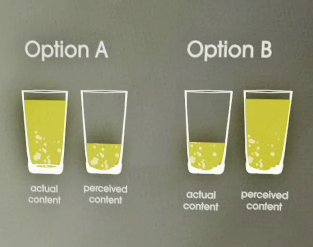
Picture from Creating Passionate Users

Today's post is brought to you by a five day vacation, during which I've been catching up on some reading and not working long hours! I've found a couple interesting pieces recently on the subject of why people burn out, which suggests it's not the overtime in itself.

The first article was on Blogher, It's Not Just You. A recent Wharton School study looked at reasons for worker burnout. (It's unfortunately not yet available free online.)

"One of the biggest complaints employees have is they are not sufficiently recognized by their organizations for the work that they do. Respect is a component of recognition. When employees don't feel that the organization respects and values them, they tend to experience higher levels of burnout." Or, as Ramarajan puts it, "it is often not the job that burns you out, but the organization."

It turns out there was another good piece in the NY Magazine, Can't Get No Satisfaction, which meanders through social worker burnout, teacher burnout, medical burnout, and into high tech and NY Wall Street burnout. This one notes previous good research:

In 1981, Maslach, now vice-provost at the University of California, Berkeley, famously co-developed a detailed survey, known as the Maslach Burnout Inventory, to measure the syndrome. Her theory is that any one of the following six problems can fry us to a crisp: working too much; working in an unjust environment; working with little social support; working with little agency or control; working in the service of values we loathe; working for insufficient reward (whether the currency is money, prestige, or positive feedback). “I once talked to a pediatric dentist,” she says, “and he said, ‘A good day is when there are no screamers.’

Googling for Maslach, I hit an online quiz that rates your current level of burnout risk. The questions are about how you feel and about your work environment, as predicted by Maslach's findings. (E.g., "Do you feel that you are achieving less than you should?"; "Do you feel under an unpleasant level of pressure to succeed?"; "Do you find that you do not have time to plan as much as you would like to?" etc.) See how you score!

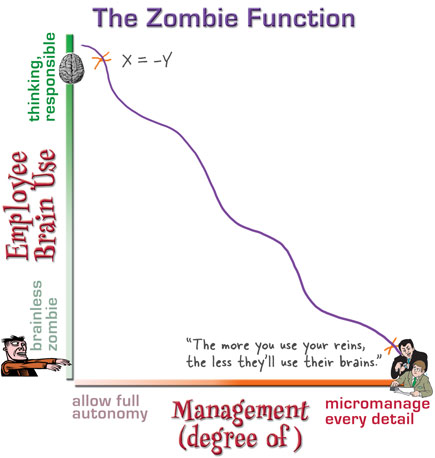
Finally, there's a related by different piece I just read when catching up on Creating Passionate Users, on Knocking the Exhuberance Out of Employees. When you burn people out, you've got robots and zombies working for you. Zombies and robots don't argue, don't have ideas, and don't threaten you or the status quo. They're a lot easier to manage, too. Hopefully no one who works for me is reading this, though, because I like arguing with them and am in no way an advocate of less exhuberance. Let that go as read!

Lastly, an article on Job Burnout in an online manufacturing magazine says (citing Maslach) burnout is about a mismatch "between what people are and what they have to do. It represents an erosion in values, dignity, spirit, and will-—an erosion of the human soul." America, with increasingly long hours and questionable corporate values, is a leader in burnout. We measure customer satisfaction, but worker satisfaction isn't a serious corporate issue, and the 40 hour work week is long dead.

Postscript: I can't believe I forgot the classic article on burnout, the electrocuted dogs experiment by Seligman: Learned Helplessness. This one has a positive spin to it, in that it suggests some therapeutic ways out of the syndrome. Happy New Year!

Wednesday, December 27, 2006

Innovation 1000: Companies Profiting from R&D

An excellent study of companies spending money on R&D over the last five years, and their payoff (or not): Smart Spenders: The Global Innovation 1000.

Some takeaways from this study:

Patents don't equal profit. Although a common measurement for innovation, it's a distractor: portfolio doesn't equal profit.

"Money simply cannot buy effective innovation."

There are no significant statistical relationships between R&D spending and the primary measures of financial or corporate success: sales and earnings growth, gross and operating profitability, market capitalization growth, and total shareholder returns. Gross profits as a percentage of sales is the single performance variable with a statistical relationship to R&D spending.... Researchers who study innovation estimate that 70 to 80 percent of the final unit cost of a product (the cost reflected in gross margin) is driven by R&D-based design decisions — for example, product specifications, the number and complexity of features in a device, the choice of standardized or customized parts, or the selection of manufacturing processes. This correlation of R&D spending and gross margin shows that in many companies, the R&D silo has succeeded in its narrow goal: creating a lower-cost offering that thus yields a wider margin, or a more differentiated offering for which a higher price can be charged.

R&D money is being offshored-- or innovation is now occurring in the "rest of the world" rather than Europe, North America, and Japan.

The "integrated value chain" of innovation shows that companies that leverage their "ideation" into commercial products more efficiently are seeing payoff. This makes sense, but seems to be hard to do.

Many high-leverage companies apply distinctive approaches to innovation at all four stages. For example, from the ideation stage through project selection and product development, high-leverage innovators tend to prize end-user input. The Stryker Corporation, a $4.9 billion medical technology company headquartered in Kalamazoo, Mich., works closely in R&D with the surgeons and other medical professionals who use its products. The Black & Decker Corporation’s innovation strategy is also heavily determined by end-users. “We’ve spent a lot of time focusing on where they work, where they play, where they buy, and where they learn,” says CFO Michael Mangan. “Understanding and developing those relationships really increases the efficiency of our new product introductions.”

There are two great stories of how two very different companies seize opportunities. SanDisk operates by watching the market for parts and capitalizing on opportunities offered by lower costs.

In the flash memory industry, prices fall 40 to 50 percent per year. Thus, at SanDisk, a small team of senior executives meets twice per week to monitor prices and market trends. Their awareness, fed back into the company’s innovation process, allows SanDisk to act quickly on new opportunities. In 2004, for example, the company realized that falling costs had created an opportunity for it to enter the market for MP3 audio players with a flash memory–based device. Management contacted an original equipment maker, defined design specifications, and delivered the new product to retailers’ shelves within six months. The SanDisk player is now number two in the market, after Apple. “We don’t have big planning and product committees,” says SanDisk Chief Financial Officer Judy Bruner. “Most decisions, even those involving huge capital commitments, are made pretty quickly by a small number of pretty visionary people.”

Symantec leverages shared code and a strong core engineering team that allows them to be nimble when responding to changes. “We have a large portfolio of products and business units,” says Ann Marie Beasley, vice president of strategy. “One of the key contributors to our R&D bang for the buck is that there’s a lot of common engineering and design, as well as actual code reuse.”

Not profiled in this article, I recently read an update on Philips Design in Fast Company: Design Intervention. Philips has been recruiting for at least 6 years for its R&D Lab, and I keep wondering what's up with them. This piece pointed out a couple positives from their output, which I recall seeing in stores, including the the Ambilight HD LCD display.

A 1995 Philips Design project called "Vision of the Future" was conceptually very similar to the Simplicity extravaganza in Manhattan--a flood of flash-forward products and ideas. Indeed, the concepts unveiled back then read today like a laundry list of the technologies that are changing our lives, including personal digital assistants and voice-recognition systems. Three years later, though, Philips went back to see how many of those concepts had actually gone into production and discovered that while a laudable 60% were already for sale, only 3% of them were made by Philips. "Their design and technical specs were usually good," says Enrique Dans, a professor at Instituto de Empresa Business School, "but they were disconnected from the market."

They're learning from history and adjusting, it seems.

"Philips's total sales from products introduced in the last year were 49% of total revenues in 2005, up from just 25% in 2003. In medical systems alone, an industry with long product cycles, some 70% of revenues came from products less than two years old--up 20 percentage points from the previous year. And despite disappointing LCD results in 2006's second quarter, from a less-than-expected World Cup boost, growth in Philips's medical systems and consumer electronics came in better than expected, at 9% and 10%, respectively."

I'm always impressed by companies that learn from history. And by good analysis in business. Edited to add: There's a nice piece here about a guy studying incentives for failures, a critical part of the innovation process. A lot of companies pay lip service to the value of risk-taking and failure in the corporate learning process, but few of them have incentive plans that reward risk-taking with failure rather than rewarding only the success stories. Employees aren't dumb when it comes to rewards vs. lip service and know what really counts to their managers.

Sunday, December 24, 2006

Twenty About Design

I seem to update this one once a year. I wrote it when I was frustrated about the invisibility of design as a process and a skill at one company, and I've updated it to moderate it and expand and then contract it over the last 18 months. The latest update focuses more on hiring (a perpetual issue), teamwork, and recognizes management as both a problem and a solution in corporate culture.

Twenty Things About Design

Saturday, December 23, 2006

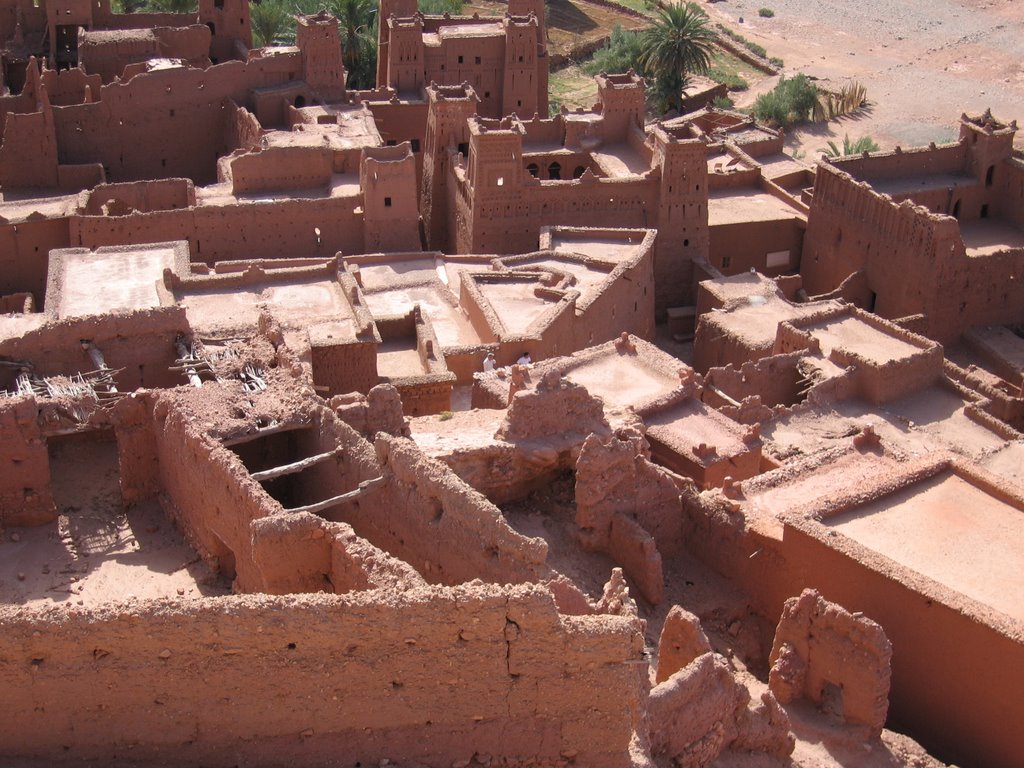
Morocco Photo Selection

I haven't had the time to do this carefully, so this is rather hasty -- but here's a selection of the photos I took in Morocco this summer.