Thursday, December 28, 2006

Demotivation and Burnout

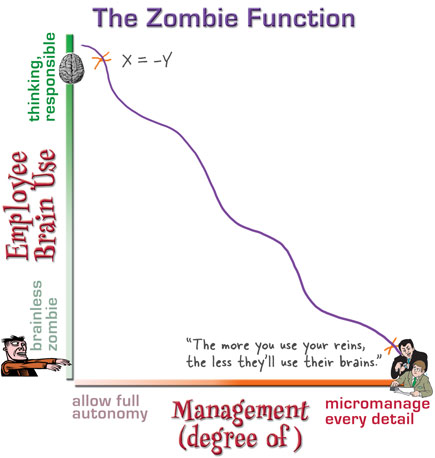
Picture from Creating Passionate Users

Today's post is brought to you by a five day vacation, during which I've been catching up on some reading and not working long hours! I've found a couple interesting pieces recently on the subject of why people burn out, which suggests it's not the overtime in itself.

The first article was on Blogher, It's Not Just You. A recent Wharton School study looked at reasons for worker burnout. (It's unfortunately not yet available free online.)

"One of the biggest complaints employees have is they are not sufficiently recognized by their organizations for the work that they do. Respect is a component of recognition. When employees don't feel that the organization respects and values them, they tend to experience higher levels of burnout." Or, as Ramarajan puts it, "it is often not the job that burns you out, but the organization."

It turns out there was another good piece in the NY Magazine, Can't Get No Satisfaction, which meanders through social worker burnout, teacher burnout, medical burnout, and into high tech and NY Wall Street burnout. This one notes previous good research:

In 1981, Maslach, now vice-provost at the University of California, Berkeley, famously co-developed a detailed survey, known as the Maslach Burnout Inventory, to measure the syndrome. Her theory is that any one of the following six problems can fry us to a crisp: working too much; working in an unjust environment; working with little social support; working with little agency or control; working in the service of values we loathe; working for insufficient reward (whether the currency is money, prestige, or positive feedback). “I once talked to a pediatric dentist,” she says, “and he said, ‘A good day is when there are no screamers.’

Googling for Maslach, I hit an online quiz that rates your current level of burnout risk. The questions are about how you feel and about your work environment, as predicted by Maslach's findings. (E.g., "Do you feel that you are achieving less than you should?"; "Do you feel under an unpleasant level of pressure to succeed?"; "Do you find that you do not have time to plan as much as you would like to?" etc.) See how you score!

Finally, there's a related by different piece I just read when catching up on Creating Passionate Users, on Knocking the Exhuberance Out of Employees. When you burn people out, you've got robots and zombies working for you. Zombies and robots don't argue, don't have ideas, and don't threaten you or the status quo. They're a lot easier to manage, too. Hopefully no one who works for me is reading this, though, because I like arguing with them and am in no way an advocate of less exhuberance. Let that go as read!

Lastly, an article on Job Burnout in an online manufacturing magazine says (citing Maslach) burnout is about a mismatch "between what people are and what they have to do. It represents an erosion in values, dignity, spirit, and will-—an erosion of the human soul." America, with increasingly long hours and questionable corporate values, is a leader in burnout. We measure customer satisfaction, but worker satisfaction isn't a serious corporate issue, and the 40 hour work week is long dead.

Postscript: I can't believe I forgot the classic article on burnout, the electrocuted dogs experiment by Seligman: Learned Helplessness. This one has a positive spin to it, in that it suggests some therapeutic ways out of the syndrome. Happy New Year!


Wednesday, December 27, 2006

Innovation 1000: Companies Profiting from R&D

An excellent study of companies spending money on R&D over the last five years, and their payoff (or not): Smart Spenders: The Global Innovation 1000.

Some takeaways from this study:

Patents don't equal profit. Although a common measurement for innovation, it's a distractor: portfolio doesn't equal profit.

"Money simply cannot buy effective innovation."

There are no significant statistical relationships between R&D spending and the primary measures of financial or corporate success: sales and earnings growth, gross and operating profitability, market capitalization growth, and total shareholder returns. Gross profits as a percentage of sales is the single performance variable with a statistical relationship to R&D spending.... Researchers who study innovation estimate that 70 to 80 percent of the final unit cost of a product (the cost reflected in gross margin) is driven by R&D-based design decisions — for example, product specifications, the number and complexity of features in a device, the choice of standardized or customized parts, or the selection of manufacturing processes. This correlation of R&D spending and gross margin shows that in many companies, the R&D silo has succeeded in its narrow goal: creating a lower-cost offering that thus yields a wider margin, or a more differentiated offering for which a higher price can be charged.

R&D money is being offshored-- or innovation is now occurring in the "rest of the world" rather than Europe, North America, and Japan.

The "integrated value chain" of innovation shows that companies that leverage their "ideation" into commercial products more efficiently are seeing payoff. This makes sense, but seems to be hard to do.

Many high-leverage companies apply distinctive approaches to innovation at all four stages. For example, from the ideation stage through project selection and product development, high-leverage innovators tend to prize end-user input. The Stryker Corporation, a $4.9 billion medical technology company headquartered in Kalamazoo, Mich., works closely in R&D with the surgeons and other medical professionals who use its products. The Black & Decker Corporation’s innovation strategy is also heavily determined by end-users. “We’ve spent a lot of time focusing on where they work, where they play, where they buy, and where they learn,” says CFO Michael Mangan. “Understanding and developing those relationships really increases the efficiency of our new product introductions.”

There are two great stories of how two very different companies seize opportunities. SanDisk operates by watching the market for parts and capitalizing on opportunities offered by lower costs.

In the flash memory industry, prices fall 40 to 50 percent per year. Thus, at SanDisk, a small team of senior executives meets twice per week to monitor prices and market trends. Their awareness, fed back into the company’s innovation process, allows SanDisk to act quickly on new opportunities. In 2004, for example, the company realized that falling costs had created an opportunity for it to enter the market for MP3 audio players with a flash memory–based device. Management contacted an original equipment maker, defined design specifications, and delivered the new product to retailers’ shelves within six months. The SanDisk player is now number two in the market, after Apple. “We don’t have big planning and product committees,” says SanDisk Chief Financial Officer Judy Bruner. “Most decisions, even those involving huge capital commitments, are made pretty quickly by a small number of pretty visionary people.”

Symantec leverages shared code and a strong core engineering team that allows them to be nimble when responding to changes. “We have a large portfolio of products and business units,” says Ann Marie Beasley, vice president of strategy. “One of the key contributors to our R&D bang for the buck is that there’s a lot of common engineering and design, as well as actual code reuse.”

Not profiled in this article, I recently read an update on Philips Design in Fast Company: Design Intervention. Philips has been recruiting for at least 6 years for its R&D Lab, and I keep wondering what's up with them. This piece pointed out a couple positives from their output, which I recall seeing in stores, including the the Ambilight HD LCD display.

A 1995 Philips Design project called "Vision of the Future" was conceptually very similar to the Simplicity extravaganza in Manhattan--a flood of flash-forward products and ideas. Indeed, the concepts unveiled back then read today like a laundry list of the technologies that are changing our lives, including personal digital assistants and voice-recognition systems. Three years later, though, Philips went back to see how many of those concepts had actually gone into production and discovered that while a laudable 60% were already for sale, only 3% of them were made by Philips. "Their design and technical specs were usually good," says Enrique Dans, a professor at Instituto de Empresa Business School, "but they were disconnected from the market."

They're learning from history and adjusting, it seems.

"Philips's total sales from products introduced in the last year were 49% of total revenues in 2005, up from just 25% in 2003. In medical systems alone, an industry with long product cycles, some 70% of revenues came from products less than two years old--up 20 percentage points from the previous year. And despite disappointing LCD results in 2006's second quarter, from a less-than-expected World Cup boost, growth in Philips's medical systems and consumer electronics came in better than expected, at 9% and 10%, respectively."

I'm always impressed by companies that learn from history. And by good analysis in business. Edited to add: There's a nice piece here about a guy studying incentives for failures, a critical part of the innovation process. A lot of companies pay lip service to the value of risk-taking and failure in the corporate learning process, but few of them have incentive plans that reward risk-taking with failure rather than rewarding only the success stories. Employees aren't dumb when it comes to rewards vs. lip service and know what really counts to their managers.

Sunday, December 24, 2006

Twenty About Design

I seem to update this one once a year. I wrote it when I was frustrated about the invisibility of design as a process and a skill at one company, and I've updated it to moderate it and expand and then contract it over the last 18 months. The latest update focuses more on hiring (a perpetual issue), teamwork, and recognizes management as both a problem and a solution in corporate culture.

Twenty Things About Design

Saturday, December 23, 2006

Morocco Photo Selection

I haven't had the time to do this carefully, so this is rather hasty -- but here's a selection of the photos I took in Morocco this summer.

Sunday, December 17, 2006

Atlas Mountains Town

This is where they filmed the slave town in Africa for Gladiator -- they added a fake Hollywood gate to the front of this place for the movie.

Saturday, December 16, 2006

Google Patents Sketches

If you like sketches of product designs, and things people patent (often very odd), I recommend Google Patents search. For the product designer, these sketches are often educational as effective communication tools.

Warning: Most software companies don't want you doing any patent searches on anything you work on, because it can get you in legal trouble if you have prior knowledge of existing patents when you produce new designs. So avoid searching on patents related to your current software design work!

Dennis Frailey: A Day in the Life

Last week I was lucky enough to be in a 3-day training course on project management. I was not entirely sure this course was a good idea for timing and content reasons, despite having a great interest in the topic myself-- but the instructor proved me wrong.

Rather than the usual consulting company instructor (these people often piss me off), we got a thoughtful, wise practitioner, who impressed all of us (a tough crowd) with his depth of experience in the software industry and his thorough research understanding of the problems we were facing.

Dennis Frailey's ACM "a day in the life" bio story is here. The university classes he teaches are described here. He has made career changes based on revised understandings of the "real" problems he encounters in daily work. I share his impressions about research and practice, although I've had far less experience than he has at either:

Although I loved teaching (and still do it on a part time basis), I quickly learned that survival in academia is based on "research", not education. And the numbers game rewards you for cranking out large numbers of papers rather than small numbers of really good papers. I did some innovative research in the areas of real time operating systems and computer architecture, but I found most of the really interesting work in these fields was being done in industry... And when I was granted tenure, I learned that the research that counted the most was what I had done for industry and could not have done in academia. Moreover, there is a certain sense of satisfaction one gets from building a real product that one cannot get by writing research papers. This led me to consider and ultimately to accept a permanent move to industry, which I did in 1977.

Once in industry, at the corporate engineering center of Texas Instruments (now part of Raytheon), I discovered something else. Most of the real problems are not to be found in the research labs but in the areas where real products are being planned and developed. Thus I migrated from doing computer architecture research to actually building computer and software systems that had to work. This gave me a deeper appreciation of the intellectual challenges and rewards associated with "getting dirt under your fingernails" so to speak. It also gave me a totally different understanding of what software "engineering" is... Once I had to make reliable systems that peoples' lives depend on, I began to appreciate the need for "engineering discipline" and for greater emphasis on understanding the processes we use to develop software. This led me to move into new parts of the company where I learned about different kinds of issues. Many years later, my varied background has qualified me for a senior technical position where I am expected to understand the entire scope of a problem, from the technical details to the management concerns.

I bailed from research for some similar reasons, during the dot com boom. I've also had the intuition for years that the hardest problems in building software are not the technical problems or even the design problems, but the management problems. Which may be one reason that UI design and usability methods haven't had the impact they should have had on the industry -- not because of lack of the value they add, but because lack of organizational historical data (of most kinds, but especially quality and process-related), management incomprehension and lack of good design and planning during the dev process, and resulting interdisciplinary confusion and contention when pressure hits. Not to mention that even without the design process differences that UI and usability introduce, complex software development management seems to be entirely lacking at many companies. Chaos, confusion, and conflict are the norms I've experienced in most schedule-driven releases. Few people can make the complicated, emotionally-laden tradeoffs required in a mature, big-picture style, because there just aren't enough managers with this kind of skill and vision.

You can tell a lot about someone from who they admire and why. Dennis's response to this question:

One man I admire is Eugene Helms, who was my first boss at Texas Instruments. He would often sit through a meeting, say very little except asking a few questions, and in the end would sum up the most important points - i.e., he listened, thought about what he was hearing, and put it all together. He also trusted those who worked for him to know more about their specialties than he did. As a result, he could see the big picture better than just about anyone else. He was kind and supportive, and he would stand up for what was right.
I admire Dennis, and I hope that says good things about me.

Saturday, December 09, 2006

VPs as Indicators of Problems

Scott Berkun has a nice snarky post about VPs of Innovation; if you've got one, you're probably in trouble on that front, and it's not likely they're going to help.

Which reminds me of a company in my neck of the woods (not mine): they're created a "VP of Retention." I heard this from a friend recently, as we've interviewed a bunch of folks bailing ship from that place. Ok, kudos to their executive staff for noticing they have a problem; but sad and sorry it is that they had to "solve" it at that level, didn't notice before, and haven't done enough analysis internally to understand why they have a management disaster on their hands.

Management is the least recognized role and the most important, in these situations, in my experience.

Friday, December 01, 2006

A collection of professional essays...

The more involved in management I am, the less I feel I am doing things that I can point to and say "I did that." (Also, the less I work for companies that make consumer or well-known products, but that's a different issue and a weird trend I noticed a few years ago...) But I got the good news today that an essay of mine will appear in a book accepted by MIT Press for 2007 publication along with many others by names that I know from my field: luminaries, old friends, and former research colleagues. Most of the other authors are probably wondering who I am in this list; I feel honored to be there and to have been invited to submit something to it. Here's the info on the current Table of Contents: HCI Remixed: Essays on Works that have Influenced the HCI Community. (This book must be 500 pages long!)

We're all writing about previous work that influenced us, in a personal essay vein. It could become a nice secondary textbook in a reading course in interface design or human-computer interaction research. I was fascinated by the list of source papers and immediately downloaded a bunch that I didn't know myself. As soon as I flipped through them, I wanted to know what the other folks said about them. I can see the appeal of this collection immediately. Great idea, Tom and David.

Sunday, November 19, 2006

Alligator

Data and Infovis and "Art"

I've been thinking about data a lot, since the Infovis 2006 symposium. At this conference was a strange mix of scientists, mathematicians, and a few artists, or those with an artistic bent.

My friends Martin Wattenberg and Fernanda Viegas from IBM Reseach Cambridge secured funding, invited submissions, reviewed, set up the equipment for, and then sat guard over (missing talks in which they were cited) an art show of infovis applications. They were specifically featuring artistic displays of real data (I'm paraphrasing what I think they said were their selection criteria. One was Golan Levin's The Dumpster, which I blogged about a while ago.)

To introduce this art show, they gave an excellent talk that I'd summarize as "What's Going On Out There in the Real World That You Might Not Know About." A bunch of us saw a lot of people in the audience noting down the existence of Ben Fry's Processing Toolkit that makes programming datavis apps accessible to artists and ordinary people who aren't postdocs in mathematics. Sadly, it reminded me of 5 or even 10 years ago when the CHI and CSCW research communities realized web startups had already made community apps that worked and they weren't made by researchers in labs. Where's the actual innovation happening? More often than not, it's students or other clever people with time on their hands and a willingness to play around.

But back to data: When I was doing my dissertation, data was a sticky subject. Collecting data on "human subjects" was overseen by strict board reviews and ethical examination, and I had to go through this as an early internet researcher with a Human Subjects Board who didn't know what to do with this kind of data.

The community I "studied" reacted strongly to some of the data that I collected, post-processed, analysed, and reported, regardless of the reviews I went through. My data said some things that they didn't want made visible, or suggested things they didn't like simply reducible to graphs and charts. (The book is available here, the last chapter discusses this problem in some detail.) Anyone who looks at or exposes recorded human behavior is going to hit this: for example, people who don't think they talk much and discover they talk all the time often don't like knowing this, however measurable it is and however potential this exposure might be for them. Which brings up the questi0n of why and when should you turn something into data? And analyse it?

So, thinking now about how the research and infovis worlds have evolved since then, and the new inevitability of data mining on behavior from the traces we leave behind us, I see these data source dimensions:

  1. Data sets that exist and are known to exist-- census data, weather data, stock market data.
  2. Data that "happens" but isn't necessarily assumed captured or turned into a set that's easily analysable: email, chat, mobile phone records, my retrievals from ATMs, where I walk and what I eat.
  3. Data that we set out to measure, because we're looking for something: experimental data, NSA tapping us, etc.
  4. Data we have (from any of the above means) and we converted to another form of data: e.g., turning activity logs into summaries of time on tasks, turning gene sequences into musical notes, turning video of your cats into a single overlayed image, turning text into images, etc.

The really creative apps for infovis often seem to lie in item 4), because transformation of data into other modalities is a trick of visualisation that might give us insights we didn't have before. Some of them are just elegant visualisations of data we wouldn't have thought of visualising (like Ben Fry's zipcode applet that Martin called an infovis "haiku"). The "insight" part is still tricky to handle; human perception differs, and reasoning skills differ, and that makes drawing conclusions from visualisations tricky too. (Untutored people generally make more of statistical tests than they should, too.)

Martin and Fernanda stayed safely away from defining "art" but I still thought about the artistic component of data mining. The value of data mining and the ability to form and then test hypotheses from different views of data is a skill, perhaps even an art in itself. An event occurs: I capture it, I capture multiple instances of it, and I look for patterns in different views of it, and then I learn from it or measure it some more or in another way to progress towards some truth.

Or, for the more artistic data visualiser: she captures it and events like it, she presents it in a novel and beautiful way, hopefully with some elegant interactivity, and other people learn something. The might learn something ineffable or impossible to reduce to words. But that doesn't make it less important. Scientific creativity still springs from the indescribable ideas you have about the world before proof and publishing.

Friday, November 17, 2006

Moroccan carpet seller

In Morocco. (It's tough to pick which ones to post -- I've got so many.)

Sunday, November 05, 2006

Social Drinkers Earn More Money

Somewhat disturbing, but ringing true in a bunch of dimensions... This study shows that social drinkers earn more money than non-drinkers, and claims it's because of the increase in social capital gained by knocking one back with colleagues.
Although there is a united campaign to restrict alcohol, labor market data may surprise noneconomists: recent studies indicate that drinking and individual earnings are positively correlated. Instead of earning less money than nondrinkers, drinkers earn more. One explanation is that drinking improves physical health, which in turn affects earnings (Hamilton and Hamilton, 1997). We contend that there is an economic explanation. We hypothesize that drinking enhances social capital, which leads to superior market outcomes. Glaeser et al. (2000: 4) describe social capital as “a person's social characteristics, including social skills, charisma, and the size of his Rolodex, which enable him to reap market and nonmarket returns from interactions with others.” Some aspects of social capital might be innate, but people can enhance others, such as Rolodex size. If social drinking increases social capital, social drinking could also increase earnings. We attempt to test whether drinking enhances social capital by differentiating between social and nonsocial drinking; we predict that those who drink in public will have higher earnings than those who drink at home. New data confirm that drinkers earn more, and we find that social drinkers earn even more.

The article is here and comes with a somewhat scary libertarian slant intro, be warned:No Booze? You May Lose:Why Drinkers Earn More Money Than Nondrinkers (pdf). Note, this obviously supports the value of conference trip networking as important for career, if money is an indicator of career success (it is to some).

Saturday, November 04, 2006

E3: Effective, Efficient, Elegant

Hi, my name is Lynn and I work all the time. Too much to post much these days.

But I had a nice break when I went to Infovis 2006, the symposium on information visualization. There was a bit too much math this year, starting from the keynote, which was Eades talking about graph layout algorithms. I still managed to get something thought-provoking from it. His criteria for algorithm evaluation was "effective, efficient, and elegant."

These are good principles for software design as well as algorithm design: a good piece of software should be effective at supporting the tasks it's designed for, be efficient in use and for use, and ideally is elegantly designed. Elegance, of course, implies more than "usability." Usability is a word that's got kind of an old school ugly lab study connotation these days; it's a word that doesn't say enough to capture current thinking about the value of delightful design, rather than just adequate design, in creating a differentiating user experience.

What's "elegant" in a proof or theorem, I asked of a friend who was a mathematician in his previous life. "Simple," was the first thing he said. But not just that -- it can be taught to a second year student, was one of Eades criteria (suggesting "learnability"). Yet also somehow "surprising." An elegant proof is a result with a twist you didn't see coming, but should have, adds an insight that makes it aesthetically pleasing.

At risk of triteness, I did look up elegance on dictionary.com after striking out in a Google search: "gracefully concise and simple; admirably succinct. Combining simplicity, power, and a certain ineffable grace of design." It adds:

The French aviator, adventurer, and author Antoine de Saint-Exup'ery, probably best known for his classic children's book "The Little Prince", was also an aircraft designer. He gave us perhaps the best definition of engineering elegance when he said "A designer knows he has achieved perfection not when there is nothing left to add, but when there is nothing left to take away."

E3 makes a good compound principle for evaluating design of all things, including software. I'd really like more elegance in my design.

10 most real life ghost photos (sic)

Ah, Pravda. It never fails to appear on the Anomalist. Here is a sample of photos of ghosts from the Russian online paper: 10 most real life ghost photos - Pravda.Ru.

Sunday, October 15, 2006

Atlas Mountains at Sunset

One of my vacation nights involved a hike into the mountains.


Morocco, Atlas Mountains, October 2006

Saturday, October 14, 2006

The Powerset Blogstorm

Can anyone beat Google? Well, the natural language processing community is having a go at it. I got back from 2 weeks of vacation to discover that an old friend and mentor from grad school days is now at startup Powerset, co-founded by Barney Pell, whom I knew as a grad student in Cambridge years before. There've been a rash of articles in the blogosphere about their announcements, as Barney summarises:

Barney Pell's Weblog: The Powerset Blogstorm: 1 week later.

Yet more evidence that startups are back and interesting again! And this time they want UX people earlier rather than later, which is a nice change for the industry.

Tuesday, September 26, 2006

Sunday, September 17, 2006

Why Crunch Mode Doesn't Work

I have long been fascinated (and disgusted) by the lack of government, union, or HR care for the abuse of workers in the software industry. During the dot com era, I actually heard it touted as an intentional strategy by some Silicon Valley managers to hire young programmers right out of school who would work long hours for little pay and were considered "disposable." Mostly, they were disposed of, by burn out.

This attitude was reflected a little more indirectly in the cuts in benefits and pensions everywhere including major companies like AT&T, layoffs in which senior people were cut on the principle that they were easy to replace; among other people mismanagement decisions that seemed to me to be incalculably stupid. Incalculable, unfortunately, because the decisions and decisionmakers at these companies were protected by layers of indirection (about the reasoning, minimally) and because there is profound difficulty in measuring the damage to the company, products, and customers, both long and short term. Stupid, because the people in the trenches doing the work understood the impact every day, in terms of workload, quality of work, culture, their attachment to the company, belief in the industry and in what they were doing...

More than one person I knew who was young and abused in the dot com era decided they were "getting out," went to open a record store (or flower shop) and never looked at a computer again. In an era of declining enrollment in computer science programs, we as an industry can't really afford that.

Here's a guy in the game industry--one of the most famously abusive software sectors--trying to make the case with a fairly well-researched article on the subject: IGDA - Articles - Why Crunch Mode Doesn't Work: 6 Lessons. Tagline: There's a bottom-line reason most industries [except the software industry] gave up crunch mode over 75 years ago: It's the single most expensive way there is to get the work done. Of course, in the software industry, quality hasn't mattered that much, till recently. Will things change? Will software management change? Will the calculation become easier to make to argue against the stupid?

And here's an article, only tangentially related, but I think still related, on why America is lagging in R&D. The State of Research Isn't All That Grand. R&D is being outsourced, because it's cheaper that way; and R&D is "hard to measure" because it's a long-term investment. Most American companies aren't actually that good at long-term anything, in a profits-now-or-your-bonus-is-impacted business world.

Why hasn't Built to Last had more impact?

Sunday, September 10, 2006

Birds at the Ren Faire in Carver, MA

Archimedes looking intense. RenFaire, MA, 06