Anyone know anyone looking, in the Boston area or even elsewhere? Job ad here: Mathworks GUI Developer
Thursday, March 31, 2005
GUI Developer Position
I'm pointing this opening out to folks of the Java and UI programming persuasion. It's a great team and a great product, and absolutely cutting edge stuff. The UI challenges are only getting more fun as it evolves (no, I really mean it -- there's a big "whoa, cool!" factor with every other functionality addition). I'd do it myself if I had any serious Java under my belt.

Wednesday, March 30, 2005
Invisible Work, a Short Essay
Talking to a colleague yesterday about design and usability work, I used the phrase "invisible work" a few times and he said he wasn't familiar with it. I gave a short not-very-political explanation, and now I'm delving into it a bit further. Consider this an infomercial or something.
A 1999 issue of Computer Supported Cooperative Work (CSCW) was dedicated to this subject. ("CSCW" is more or less a subdiscipline of the research arm of the field of human-computer interaction, which itself broadly covers aspects of interface design, product design, and usability methods.)Here's the Introduction to the journal, which summarizes the basic topic they covered:
This special issue documents four kinds of invisible work: (1) work done in invisible places, such as the highly skilled behind-the-scenes work of reference librarians, (2) work defined as routine or manual that actually requires considerable problem solving and knowledge, such as the work of telephone operators, (3) work done by invisible people such as domestics, and (4) informal work processes that are not part of anybody's job description but which are crucial for the collective functioning of the workplace, such as regular but open-ended meetings without a specific agenda, informal conversations, gossip, humor, storytelling.The way I actually used the term yesterday was in reference to another kind of invisible work, I think more formalizable than (4): the shadow job, the job you do that doesn't at all match your job description, but more or less has the same end goal. It's the job you have to do to get your job done, and the more it doesn't match your job description, the more dysfunctional something is (or might be) in the company: hiring and evaluation of candidates may not be oriented correctly if the shadow job is done by everyone, or team dynamics may be screwed up if it's only one person doing the shadow job out of the crowd with similar job titles. Perhaps the company doesn't know the categories of work that could exist or need to be done by someone, because they haven't got those activity classifiers in their sights yet. To me, it comes down to an ethnographic research issue: what's labelled vs. what's not, and why? What are the missing vocabulary items?
One of the articles in this issue gets close to another topic dear to my heart, the shadow work involved in the user interview/usability test/qualitative data analysis. It just happens to be about ethnography here:
In her paper, "'It's Just a Matter of Common Sense': Ethnography as Invisible Work," Diana Forsythe turns the analytical lens on ethnographers--those who have made significant contributions to uncovering everyone else's invisible work. Forsythe notes with irony that now that ethnographers have convinced researchers and corporations of the value of ethnographic work in technology design, they face a new and unexpected problem: appropriation of their methods. Ethnography does look easy. It's just talking to people, right?!... Drawing on Star's concept of "deletion," Forsythe observes how certain kinds of activities are "deleted," or simply not considered salient, from various kinds of accounts....For example, Forsythe reports from her studies of artificial intelligence researchers how technical people describe the work they do in terms of programming or system design, but consistently delete social activities such as meetings and other kinds of social interaction. The work would not get done without these interactions, but they are deleted by the researchers as inferior to "the real work."Lots of usability professionals (and UI designers) discuss and have to shrug away this issue in practice; it's better to have 4 developers who've never had a course in interviewing visit the customer alone and bring back enthusiastic (if noisy) stories than to have one usability professional interview a dozen people and return with carefully analysed data that doesn't interest anyone else because they didn't get it viscerally for themselves. And it's better to have everyone participate in usability testing and hear the data first hand even if the signal gets garbled, than to have one person attempt to rein in the wild horses and sour everyone on the practice at the same time. There's usually no time to give people a crash course in methods, after all. We just mope about this at conferences with our colleagues and buck each other up over cocktails.
Invisible work is certainly a problem even for folks in high status positions doing what's seen as the "real work." I've recently had conversations with a few developers about their own invisible work; some of them need cocktails at conferences as well, I think.
(On a personal note, Diana Forsythe was very important to me as a role model and colleague when I was in grad school; she died in a hiking accident in Alaska a year later, an enormous blow to me and to an entire discipline.)
Monday, March 28, 2005
How Yahoo Got Its Mojo Back
I don't know if the mojo is back or never actually left. I'm always distrustful of hype over substance, because in only 15 years I've already seen things come and go that were in or out with the press on alternate days; but here's someone claiming Yahoo is back and looking cool to us again. (Hey: I posted about Yahoo's UED jobs and VP of UED before that flickr buyout happened. I'd like to say I saw something coming from the pulse.)
See Om Malik on Broadband: How Yahoo Got Its Mojo Back. Note the mention for their beta for Yahoo 360, a combined photo and blogging effort, perhaps trying to fix the weaknesses in LJ and in their own communities effort, while competing with blogger. At least I hope, if they've done their usual decent requirements analysis. (Posting photos in LJ was a problem that many people in my blog survey identified as needing improvement.)
Sunday, March 27, 2005
Top Ten Picks for Solo Travel
As a woman who likes to travel and often prefers to do it alone, I'm always worrying a bit about the types of places I go -- will they be difficult or downright dangerous for a woman alone? Here's a nice list of places that are not bad for solo travelers. I wasn't too excited when I saw the cruises at the bottom (I'd never do a cruise, not even when I'm retired), but when I read closer and saw they were sail-powered or river cruises, I got interested again.
In case you like soloing: Fodor's Travel Wire: Lea's Top Ten Picks for Soloists.

Saturday, March 26, 2005
Amphibious Human of the Caspian
Pravda reports a strange merman creature sighted in the Caspian Sea: Mysterious amphibious creature of the Caspian. There are other such sightings from the former Soviet Union:
An amphibious humanlike being was reported in Karelia in 1928. The creature was repeatedly seen in the lake of Vedlozero by local residents. A group of researchers from the Petrozavodsk university arrived to investigate the case on location. Unfortunately, the findings were classified and the members of the research party eventually perished in the Gulag.(Gotten from the Anomalist, which also linked to an article about Cold Fusion this week!)
13 things that do not make sense
I think this has circulated a bit, but in case you missed it, it's a fascinating read: New Scientist's "13 things that do not make sense", a list of thus-far unexplained phenomena in science that you want to be goofs or hoaxes, but apparently you don't get your way. They include homeopathy, cold fusion (I didn't realize it was real), the placebo effect, dark matter, dark energy, bursts of energy from space, tetraneutrons, the 10th planet, methane on Mars, the rapid expansion of the universe.
You too should count the number of times Einstein gets second-guessed in this list.
Statistically Improbable Phrases
I've just had a personal encounter on Amazon with their "SIPs" feature. This is a listing of phrases that appear in the book that are statistically unusual, based on the databases of all scanned contents of books on the site. Needless to say, they're sometimes quite funny, as things automatically detected as deviant often are...
For the Rough Guide Brittany and Normandy, the phrases listed are:
www vedettesdebrehat com, star campsite, menus that start, fishy menus, gulf tours, municipal campsite, brasserie downstairs, least expensive double room, room without shower, pleasure port, cheapest menu, modernized rooms, gare maritime, daily loam, excluding airfare, slower services, second fortnight, moules frites, parish close, pedestrianized street, petit train, low season.Which makes me think that if I buy this book I could actually find a hotel in Normandy in low season on a pedestrianized street, featuring a brasserie downstairs boasting cheap fishy menus and of course moules frites, some fresh daily loam in my room at all times, and convenient access to a pleasure port offering gulf tours; but I think I can do without the typically European room without a shower and slower service all around. If I can get there by a petit train, that's a plus, though.
Another guide, Michelin's Charming Places to Stay in France for Less than 80 Euros, has "plush bourgeois" and "rooms with bathrooms." I guess maybe it IS statistically improbable to get a room with a bathroom for less than 80 Euros in France.
Thursday, March 24, 2005
Nest Box Cams
Since wild critters are always interesting, here are some live webcams for nesting birds, including barn owls: The Birdhouse Network: Nest Box Cam. And a bunch more birdcam links.
Gotten off Research Buzz.
Apartment Therapy on Happiness
I love Apartment Therapy. This is one of those blogs/sites that always amuses me and surprises me when I dip in. Today I caught up and got a suggestion for a keyboard cleaner I'm going to order for a friend at work. I might have it delivered anonymously-- I just want him to have it and don't want funny looks.
Buried in a long list of posts about the ideal kitchen design (using photos of real kitchens as examples), cherry blossoms and the value of cut flowers, links to items for sale in NYC (I always want to move after reading this site), I hit a couple posts that made me pause. In response to a post about typically American competitive more-more-mania and depression, a poster mused on his top ten toolbox for being happy.
I used to keep a Far Side cartoon on my fridge which read, "The Bluebird of Happiness long absent from his life, Ned is visited by the Chicken of Depression." How do I keep the Chicken away?(I obviously quoted that because it's funny and about some guy named Ned, but anyway:) His list includes Review, Don't Take Yourself Too Seriously, Too Much is Not Enough, And Yet Splash Out, Don't Postpone Joy, and Clean Your Plate. And he ends with a poem that made me think of Paris, so when you read it you should think of your version of Paris, too: Apartment Therapy: On Happiness.
Wednesday, March 23, 2005

The Memory Championships
This article on the awesome feats of the memory champions ("Forget Me Not - How to win the U.S. memory championship") reminded me of one of my favorite novels from my younger days -- Little, Big by John Crowley. In it is a massive tangled house, full of memories, and in it is a character who uses the trick used by the memory champions to remember things: building a landscape--like a house--in your head, and adding details to the house to trigger memories you want to retain.
Glancing at the 84 rave reviews of the book on Amazon, I am picturing myself rereading Little, Big on my sun porch this summer when the weather is good again. I intend to remember this plan, so the sun porch looks particularly nice; on the rocking chair is a model of a complex little house that I can't quite understand from the outside.
Sunday, March 20, 2005
Yahoo's UED Jobs
I keep tabs on jobs in my field as a way of feeling the pulse of the industry. They tell you a lot about the corporate situation and the company vision; and sometimes, if you read between the lines, you can tell how healthy their internal design and usability efforts are. Most of the hot industry jobs right now are interaction design or information architecture; there aren't that many strictly "usability evaluation" jobs now (this has been noted on a contracting mailing list I'm on as well). Except at Yahoo. They've got 36 jobs open in their User Experience Design category, which encompasses interaction design, visual design, web programming, and user research, which they are now calling "Design Research." I like this title, in that it focuses better on the deliverables and end-goal of research in usability.
Some of the key responsibilities for this role include:
- Responsible for the user research, including planning and running usability studies, benchmark studies, competitive evaluations, participatory design sessions, ethnographic field studies, user surveys, heuristic evaluations, and similar methods.
- Provide insight and vision for the team based on researching user needs. Convert research findings into actionable items.
- Collaborate with other research organizations within Yahoo! (market researchers and data mining analysts) in order to create comprehensive coordinated research.
- Synthesize research findings from other data sources (including market research and data mining) into meaningful recommendations and actionable items.
Their new corporate design mantra is "Life Engine," which you'll have to embrace to work there. It's all about integration of experience, in the face of Google's growing presence.
The VP position is most interesting and revealing (my commentary in brackets):
...A key goal for this position is to elevate the influence of the UE group to become a strategic resource. [Whoa: They aren't now. They're biting the bullet and making it a VP-level job--unless someone quit--because everyone in the industry knows user experience can't succeed as a priority without VP-level support--? But I'm a little surprised Yahoo feels this too; it must be Google nipping at their backside.]
...Ensure successful knowledge sharing and improve visual, functional, and conceptual consistency across products and components - oversee the development of design standards, guidelines, and best practices; [Again, I always thought they were remarkably consistent and had this already. One ad says "new creative direction," so I suppose they're just worried about continuing and pulling deviant products into line.]
...Partner with Engineering on the development of new interface conventions and code libraries to ensure consistent and efficient deployment of design; [Ah, the crucial insight into why standards are hard to enforce -- the tools need to enforce them well, not a human post-design police force. This goes back to Don Norman in, like, the Stone Age, I think. But few places get it.]
....A professional manager with strong executive presence, credibility, and a reputation for unquestioned integrity and management skills that allow for instant credibility with business partners; Demonstrated ability to build strong relationships with and influence senior executives and internal clients; Degree in graphic design, human interface design, interaction design, computer science, or information design; advanced degree in these fields and/or MBA a plus. [I like this: Computer science counts too, and an MBA is an asset. And the rest: Whoever wrote this is pretty right on.]
Other places hiring widely now: Google (of course, and in multiple regions), Adobe (because of a small diaspora, I believe), Intuit (always hiring, very hard to please), Microsoft (ditto and hard to please the hiree, too), and a few design agencies like Razorfish, which is usually the best indicator that the industry is in an up-turn. You can check out the Yahoo UED job list at Yahoo! Find a Job.
Interested in Sleep? Try Circadiana.
I've been really enjoying this blog on the biological study of sleep and sleep disorders. Here's an excellent post taking stock of "what the blog is all about," a mission statement that describes what I've enjoyed about the site: occasional science tidbits accessible to lay people, still research-oriented --not bleached into pop science writing, educationally oriented (in that it's actually useful for students of biology), full of good references to other work in the field.
If you're interested in the physical processes behind sleep, or lacking it far too often, this is the place to go: Circadiana: Quarterly Summary.
Saturday, March 19, 2005
MIT OpenCourseWare
I was cruising around for some online courses (so I won't get stuck in any more blizzards whilst trying to educate myself), and I hit the OpenCourseWare files at MIT. Here is the list of courses with online materials for browsing:
MIT OpenCourseWare | Master Course List. The list includes a nice set of architecture classes, bio and biotech (some requiring MATLAB and including the M-files they use!), Sloan School courses, and economics. There's also mathematics, so maybe I can ditch my newly purchased Calculus for Dummies. However, the lecture notes aren't always self-explanatory; there's no substitute for being there, of course.
Wednesday, March 16, 2005
biodiversity comes and goes
This is a tiny bit odd: "A detailed and extensive new analysis of the fossil records of marine animals over the past 542 million years [says that] biodiversity appears to rise and fall in mysterious cycles of 62 million years for which science has no satisfactory explanation."
I jump for "alien tinkering" in this kind of situation, but the scientists involved are looking for things like exposure to galactic radiation as we move around the universe; Oort cloud meteor gravitational effects; planetary plumes of eruptions, and Improbable Stuff Like That.
Monday, March 14, 2005
Touchgraphing LiveJournal Friends
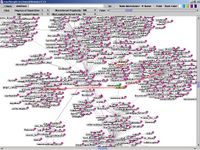
This is a Touchgraph of some LJ friends networks, showing a cross-linkage I wouldn't have suspected. Mostly it's a mess, and I arbitrarily picked nodes to expand; but it showed a few interesting things fairly quickly, at least to someone who knew something about the clusters. If you want to try it yourself, you can download it here: Touchgraph's LJ browser.

CiteULike
This is a nice tool for keeping track of bibliographic references and looking at social linking to academic (i.e., scholarly, peer-reviewed, as opposed to just blogosphere-reviewed) articles. It has some interesting UI attributes, including a display of tags (natch) for the articles, and a graph view of related articles using TouchGraph's cool tools. Unfortunately, in the Touchgraph, I couldn't figure out how to "go to" an article node I wanted to pursue. If anyone else figures it out, please drop me a note.
Topics of current interest to academic groups using this include bioinformatics, protein structure, social networks, bayesian inference, and a whole lot of other HCI (human computer interaction) stuff. In other words, lots of stuff I care about right now :-) For an actual example, see this citation: CiteULike: Community structure in social and biological networks.
Now I just need access to a real academic library again.

Saturday, March 12, 2005
Exprimental Gameplay
For years I have swallowed the myth espoused by the game industry that it's not possible to make commercial fun anymore without a huge stable of developers and cutting edge machines and graphics cards. But as I play with different simulation tools on the job, without the high-end machinery around them, I'm revising my thinking slowly but surely.
I am firming up my latest theory on certain Things that Are Fun on the computer: There's some element of chance involved (that mimics expectations about the "real world"), a system to interact with, and a well-presented result of the interaction between the two that's both surprising and predictable in some measure. The more the system is complex and hidden, the more it can look like "chance" and remain fun as discovery occurs. Here's a site that I think agrees with me, that I want to spend some time playing with:
Subscribe to:
Posts
(
Atom
)